A cordless planer runs continuously while you feed timber through, unlike a drill that works in short bursts, so battery choice matters. Pick too small a pack and you’ll be swapping batteries mid-job; too large and you carry extra weight for no gain.

The makers do not publish runtimes for these tool and battery pairs, and we have not tested them, so we do not estimate them. For serious carpentry—doors, architrave, solid timber work—we suggest at least 5.0Ah, and 6.0Ah if you’re planing all day.
We have not tested these batteries ourselves; the suggestions below are our editorial picks, and the battery details come from the makers.
| Use Case | Makita 18V LXT | DeWalt 20V MAX | Milwaukee M18 |
|---|---|---|---|
| Best all-round | BL1850B 5.0Ah | DCB205 5.0Ah | 48-11-1850 5.0Ah |
| Best for heavy use | BL1860B 6.0Ah | DCB206 6.0Ah | 48-11-1860 6.0Ah |
| Smaller pack | BL1830 3.0Ah | DCB204 4.0Ah | 48-11-1840 4.0Ah |
Starter packs by platform
As an Amazon Associate we earn from qualifying purchases. Genuine packs only; check the listing matches your platform before buying (affiliate links).
Before you buy: check that the size, fitting/bore and maximum-rated speed marked on the accessory match what your tool’s manual specifies. We have not physically tested these products; listings are compiled from published specifications. These are affiliate links.
Get the free Power-Tool Battery Compatibility Handbook (PDF)
Which batteries fit which tools — cross-brand, adapters & Ah, decoded.
Why Battery Choice Matters for Planers
A planer is not like a drill or saw: you can’t stop halfway through a board and swap batteries without the cut showing, so start each board with enough charge.
Small packs (under 3.0Ah) fit, but need swapping more often. We have no maker data on how cutting performance changes as a pack runs down.
We suggest 5.0Ah as a practical minimum for serious planing, and 6.0Ah for hardwood or all-day work: a 6.0Ah pack has 20% more capacity, and Makita UK, for example, lists its 6.0Ah BL1860B only 30 g heavier than its 5.0Ah BL1850B.
Best Batteries for Makita Planers
Best All-Round: Makita BL1850B 5.0Ah
The BL1850B is our pick for most planing jobs. Makita UK lists it at 0.63 kg, about the same as the 3.0Ah BL1830B, so the extra capacity costs little in weight. Makita does not publish a runtime for this pair, and we have not tested one. Makita UK quotes about 45 minutes to charge a 5.0Ah pack on its DC18RC rapid charger.

Model: BL1850B
Best for Heavy Use: Makita BL1860B 6.0Ah
The BL1860B has 20% more capacity than the BL1850B, and Makita UK lists it only 30 g heavier (0.66 kg vs 0.63 kg), so it suits professionals or a full day of planing. Makita does not publish a runtime for this pair.

Model: BL1860B
Smaller Pack: Makita BL1830 3.0Ah
The BL1830 is a 3.0Ah pack for occasional edge chamfers or light softwood work; if planing is a core part of your work, it is too small. It does not save weight, though: Makita UK lists the BL1830B at 0.64 kg, about the same as the 5.0Ah BL1850B.

Model: BL1830
Learn more: Makita 18V LXT Battery Compatibility
Best Batteries for DeWalt Planers
Best All-Round: DeWalt DCB205 5.0Ah
The DCB205 is DeWalt’s 5.0Ah 20V MAX pack (US part number; DeWalt’s UK 5.0Ah 18V XR pack is the DCB184) and our pick for DeWalt planers on most jobs. DeWalt does not publish a runtime for this pair, and we have not tested one.

Model: DCB205
Best for Heavy Use: DeWalt DCB206 6.0Ah
The DCB206 has 20% more capacity than the DCB205, for professional planing such as hardwood doors, trim carpentry and contract work. DeWalt US lists it at 2.25 lb against 1.54 lb for the DCB205, so expect a little more weight.

Model: DCB206
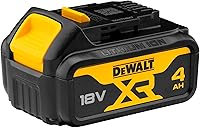
Best Lightweight: DeWalt DCB204 4.0Ah
The DCB204 is a 4.0Ah pack, slightly lighter than the 5.0Ah DCB205 (DeWalt US: 1.4 lb vs 1.54 lb), for light planing on softwood, or if you combine planing with other tools.
Model: DCB204
Learn more: DeWalt 20V MAX Battery Compatibility
Best Batteries for Milwaukee Planers
Best All-Round: Milwaukee 48-11-1850 5.0Ah
The 48-11-1850 is Milwaukee’s US M18 REDLITHIUM XC5.0 pack (Milwaukee’s UK 5.0Ah M18 pack is the M18 B5) and our pick for Milwaukee planers on most jobs. Milwaukee does not publish a runtime for this pair, and we have not tested one.

Buy Milwaukee 48-11-1850 on Amazon
Model: 48-11-1850
Best for Heavy Use: Milwaukee 48-11-1860 6.0Ah
The 48-11-1860 is Milwaukee’s US M18 REDLITHIUM XC6.0 pack (an XC pack, not a HIGH OUTPUT one), with 20% more capacity than a 5.0Ah pack, for full days of planing.

Buy Milwaukee 48-11-1860 on Amazon
Model: 48-11-1860
Smaller Pack: Milwaukee 48-11-1840 4.0Ah
The 48-11-1840 is Milwaukee’s US M18 REDLITHIUM XC 4.0 pack, for light planing work, or if you split your time between planing and other M18 tools. It may not save much weight: Milwaukee UK lists its 4.0Ah and 5.0Ah M18 packs (M18 B4, M18 B5) at the same 0.7 kg.
Buy Milwaukee 48-11-1840 on Amazon
Model: 48-11-1840
Learn more: Milwaukee M18 Battery Compatibility
Full Comparison Table
| Battery | Platform | Capacity | Best For | Buy |
|---|---|---|---|---|
| BL1850B | Makita 18V LXT | 5.0Ah | Standard planing, mixed projects | Amazon |
| BL1860B | Makita 18V LXT | 6.0Ah | All-day hardwood planing | Amazon |
| BL1830 | Makita 18V LXT | 3.0Ah | Light edge work only | Amazon |
| DCB205 | DeWalt 20V MAX | 5.0Ah | Standard planing, mixed projects | Amazon |
| DCB206 | DeWalt 20V MAX | 6.0Ah | All-day hardwood planing | Amazon |
| DCB204 | DeWalt 20V MAX | 4.0Ah | Light planing, mixed toolkit | Amazon |
| 48-11-1850 | Milwaukee M18 | 5.0Ah | Standard planing, mixed projects | Amazon |
| 48-11-1860 | Milwaukee M18 | 6.0Ah | All-day hardwood planing | Amazon |
| 48-11-1840 | Milwaukee M18 | 4.0Ah | Light planing, mixed toolkit | Amazon |
Watch: Video Guide
Frequently Asked Questions
Do cordless planers drain batteries quickly?
Planers run continuously while you feed timber through, so they can empty a pack faster than stop-start tools. The makers do not publish runtimes for these tool and battery pairs, and we have not tested them, so we do not estimate them.
What’s the minimum battery size for planing solid timber doors?
We suggest 5.0Ah as a practical minimum for planing solid timber doors, and 6.0Ah if you are planing several doors in one session.
Does hardwood versus softwood make a difference in battery drain?
Yes, hardwood generally takes more effort to plane than softwood, so expect a shorter runtime per charge. We have no maker figures for the difference and have not measured it.
Can I use a 5.0Ah battery for planing if I’m switching between multiple tools?
If planing is your primary task that session, yes. If you are mixing planing with other work, keep a second battery charged so one is always ready.
Are Makita, DeWalt and Milwaukee planer runtimes the same on the same capacity battery?
The makers do not publish runtimes for these tool and battery pairs, and we have not compared them, so we cannot say whether one brand’s 5.0Ah pack runs a tool longer than another’s. Brand choice is mainly about the tools you already own.
How we compile this guide
We cross-reference compatibility details against manufacturer specifications where available, official tool manuals, and the physical standards that govern fitment (bore sizes, arbor diameters, voltage platforms, connector types). We prioritise primary sources over retailer listings, flag anything we can’t confirm, and re-verify the data on a regular cycle. Where we give a buying recommendation, we tell you the reasoning — not just the link. More on our method →