One of the most common questions in the cordless power tool world is whether batteries from one platform — or one brand — can be used in another. The short answer is almost always no, but the details matter. This page covers every major cross-compatibility question and links to our in-depth guides.

Browse Power Tool Batteries on Amazon
Within-Brand Compatibility
Most major tool manufacturers run multiple battery platforms at different voltages. These platforms are generally not cross-compatible within the same brand, with a few important exceptions.
Makita: 18V LXT vs 40V XGT
Makita’s 18V LXT and 40V XGT batteries are not directly interchangeable. Different physical rails, different voltages, different electronics. Makita’s ADP10 is a charging adapter for charging LXT batteries on compatible XGT chargers; Makita does not describe it as running XGT tools.
Read our full Makita LXT vs XGT compatibility guide →
DeWalt: 20V MAX vs FLEXVOLT
DeWalt UK says its XR FLEXVOLT batteries are backwards compatible with the entire XR 18V range (sold as 20V MAX in North America), running at 18V in 18V tools. DeWalt lists only FLEXVOLT packs for its 54V tools (60V MAX in North America), so standard 18V packs cannot power them. That one-way compatibility makes FLEXVOLT packs the most flexible choice if you own both 18V and 54V tools.
Read our full DeWalt 20V MAX vs FLEXVOLT compatibility guide →
Milwaukee: M12 vs M18
Milwaukee’s M12 and M18 are completely separate platforms with no cross-compatibility. Different battery sizes, different voltages, different rails. Milwaukee does offer a dual charger (M12-18C) that handles both platforms, but the batteries themselves cannot be swapped between tools.
Read our full Milwaukee M12 vs M18 compatibility guide →
Cross-Brand Compatibility
Can you use Makita batteries in DeWalt tools? DeWalt batteries in Milwaukee tools? No. Every major power tool brand uses proprietary battery designs. The physical connectors, pin layouts, and electronic safety systems are all brand-specific. Third-party adapters exist but pose safety and warranty risks.
Read our full cross-brand battery compatibility guide →
Quick Reference Table
| Question | Answer |
|---|---|
| Makita LXT battery in XGT tool? | No (the ADP10 is a charging adapter only) |
| Makita XGT battery in LXT tool? | No |
| DeWalt FLEXVOLT in 18V XR (20V MAX) tool? | Yes (DeWalt UK: works across the XR 18V range) |
| DeWalt 18V XR (20V MAX) in 54V (60V MAX) tool? | No (DeWalt lists only FLEXVOLT packs for these tools) |
| Milwaukee M12 in M18 tool? | No |
| Milwaukee M18 in M12 tool? | No |
| Makita battery in DeWalt tool? | No |
| DeWalt battery in Milwaukee tool? | No |
| Milwaukee battery in Makita tool? | No |
Starter packs by platform
As an Amazon Associate we earn from qualifying purchases. Genuine packs only; check the listing matches your platform before buying (affiliate links).
Before you buy: check that the size, fitting/bore and maximum-rated speed marked on the accessory match what your tool’s manual specifies. We have not physically tested these products; listings are compiled from published specifications. These are affiliate links.
Get the free Power-Tool Battery Compatibility Handbook (PDF)
Which batteries fit which tools — cross-brand, adapters & Ah, decoded.
Key Takeaways
Once you buy into a battery platform you are usually committed to it. Exceptions include cross-brand alliances such as the Cordless Alliance System (Metabo and partners) and Bosch AMPShare, and DeWalt FLEXVOLT packs, which also run 18V XR tools. Plan battery purchases carefully, because packs are a large part of the cost of a cordless collection.
If you’re building a new collection from scratch, consider which tools you need across the full range of voltages a brand offers, and check whether the brand offers within-platform compatibility (like DeWalt’s FLEXVOLT system) before committing.
Related Guides
- How Long Do Power Tool Batteries Last?
- Can I Use a Higher Ah Battery in My Drill?
- Every Makita 18V LXT Battery Compared
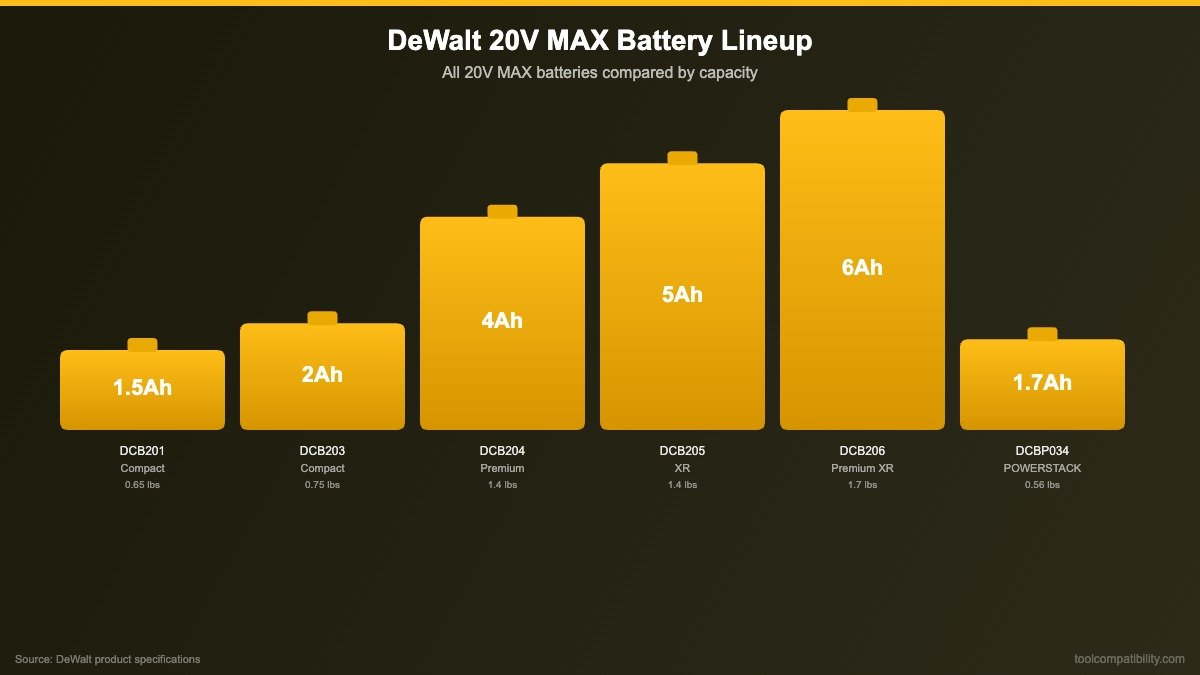
- Every DeWalt 20V MAX Battery Compared
- Every Milwaukee M18 Battery Compared
Video Guide
Frequently Asked Questions
Can I use a higher Ah battery than the one that came with my tool?
Generally yes, within the same brand and voltage platform: a 6.0Ah pack will run a tool that shipped with a 2.0Ah pack and simply gives longer runtime. Check the tool manual, as some makers list the packs approved for each tool.
Will a bigger battery damage my tool?
Generally no. The amp-hour (Ah) rating mainly affects capacity (runtime), and the main trade-off is the extra weight of a larger pack. Some higher-output packs can deliver more power; use packs the maker lists for your tool.
Do all batteries in the same platform charge on the same charger?
Usually, within a brand and voltage platform, but check the charger manual for its battery list. For example, the Makita DC18RC manual lists LXT packs from the BL1815N to the BL1860B, with charge times from 15 minutes (1.5Ah) to 55 minutes (6.0Ah). Older or compact chargers may not list the newest packs.
How do I know which batteries fit my power tool?
Check the battery platform label on your tool. Common platforms include Makita 18V LXT, DeWalt 18V XR (20V MAX in North America), Milwaukee M18 and Ryobi ONE+ 18V. Batteries from the same platform fit your tool; our platform pages list the batteries and tools in each system.
How we compile this guide
We cross-reference compatibility details against manufacturer specifications where available, official tool manuals, and the physical standards that govern fitment (bore sizes, arbor diameters, voltage platforms, connector types). We prioritise primary sources over retailer listings, flag anything we can’t confirm, and re-verify the data on a regular cycle. Where we give a buying recommendation, we tell you the reasoning — not just the link. More on our method →