No. Makita, DeWalt, and Milwaukee batteries are not interchangeable between brands. Each manufacturer uses its own battery design, with a different physical interface and its own electronics. (Their 18V-class packs are similar in voltage: DeWalt’s 20V MAX is 18V nominal.) There is no official way to use one brand’s batteries in another brand’s tools.
Get the free Power-Tool Battery Compatibility Handbook (PDF)
Which batteries fit which tools — cross-brand, adapters & Ah, decoded.

Browse Makita 18V Batteries on Amazon
Check Cross-Brand Battery Adapters on Amazon
The Short Answer
Power tool batteries are brand-specific. A Makita 18V LXT battery will not physically fit a DeWalt 20V MAX tool, and a Milwaukee M18 battery cannot be inserted into a Makita tool. The rail designs, pin layouts, and electronic communication protocols are completely different between manufacturers.
Why Aren’t Power Tool Batteries Universal?
Proprietary connectors: Each brand designs its own battery slide rail and locking mechanism. Packs from one brand do not fit another brand’s tools.
Different voltage naming: While Makita, DeWalt, and Milwaukee all have 18V-class battery platforms, they label them differently. DeWalt calls theirs “20V MAX” (which is the unloaded maximum voltage of a fully charged 18V lithium-ion pack). Makita labels theirs “18V LXT” (nominal voltage). Milwaukee uses “M18.” Despite the different labels, the actual cell voltages are nearly identical — but the tools and batteries are still mechanically incompatible.
Smart communication chips: Makita, for example, says its Star Protection Computer Controls enable real-time communication between tool and battery to prevent overload, over-discharge and overheating. Each maker’s system is its own, so even if you could physically connect a Makita battery to a DeWalt tool, that protection would not be designed to work.
What About Third-Party Adapters?
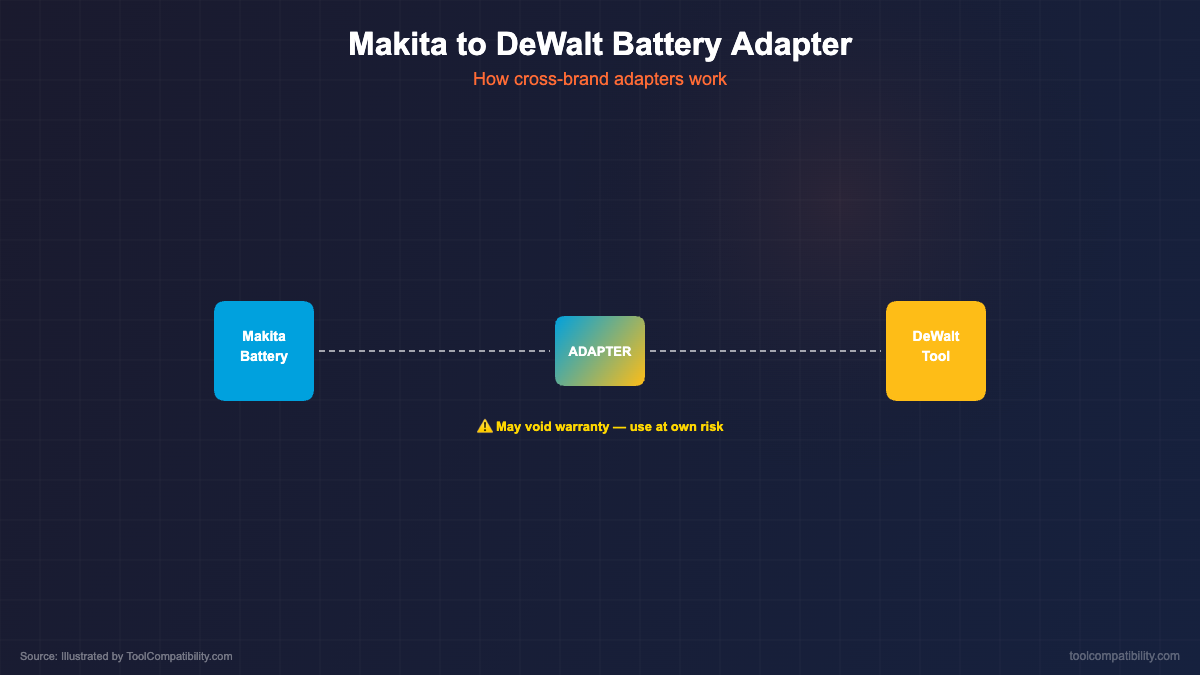
You’ll find third-party cross-brand adapters for sale online — for example, adapters claiming to let you use Makita batteries in DeWalt tools, or Milwaukee batteries in Ryobi tools. We strongly recommend against using these. Here’s why:
Safety risk: Without the maker’s own battery-to-tool communication, overheating and overload protection may not work as designed, which raises the risk of overheating and fire.
Warranty cover: Damage linked to a third-party adapter may not be covered by the tool maker’s guarantee (Makita and Milwaukee exclude non-Makita or non-approved parts and accessories).
Potential tool damage: We have not tested any adapter, and the makers do not support them, so any damage to the tool or battery is a risk you take on.
Brand-by-Brand Battery Platform Summary
Makita runs three main platforms: 12V CXT, 18V LXT and 40V XGT. LXT and XGT batteries are not interchangeable; Makita’s ADP10 is a charging adapter for charging LXT batteries on compatible XGT chargers, and Makita does not describe it as running XGT tools.
DeWalt runs 12V MAX, 20V MAX, and FLEXVOLT (60V/120V). FLEXVOLT batteries are backwards compatible with 20V MAX tools, but not the other way around.
Milwaukee runs M12 (12V), M18 (18V) and MX FUEL. Milwaukee says M18 batteries are compatible with M18 tools and chargers, and M12 batteries with M12 tools and chargers; some Milwaukee chargers, such as its M12-18 chargers, charge both.
Other major brands such as Bosch, Hikoki (MultiVolt 36V/18V) and Metabo HPT (MultiVolt) have their own systems. Bosch Professional 18V packs are part of the AMPShare alliance, which Bosch says is compatible with more than 35 brands.
The Exception: Multi-Brand Battery Systems
There is one notable cross-brand initiative: the CAS (Cordless Alliance System), which Metabo announced in 2018 as a partnership with other tool makers (including Mafell, Eisenblätter, Eibenstock and Collomix); CAS says its batteries are compatible with over 50 brands. CAS-compatible tools all share the same 18V battery interface, allowing genuine cross-brand battery use. However, none of the “big three” (Makita, DeWalt, Milwaukee) participate in CAS.
Frequently Asked Questions
Can I use Makita batteries in DeWalt tools?
No. Makita and DeWalt use completely different battery designs. The physical connectors don’t match, and the electronic communication systems are incompatible. There is no official adapter for cross-brand use.
Can I use Milwaukee batteries in Makita tools?
No. Milwaukee M18 and Makita 18V LXT batteries have different rail designs and pin layouts. They cannot be physically connected to each other’s tools.
Are DeWalt 20V and Milwaukee M18 the same voltage?
Essentially yes — both use 18V nominal lithium-ion cells. DeWalt markets theirs as “20V MAX” (the peak unloaded voltage), while Milwaukee calls theirs “M18” (nominal voltage). Despite the similar actual voltage, the batteries are mechanically incompatible.
Are third-party cross-brand adapters safe?
We don’t recommend them. Third-party adapters are not part of any maker’s battery system, so the protection between battery and tool may not work as designed, which raises the risk of overheating, fire and tool damage. Damage linked to one may also not be covered by the maker’s guarantee.
Will power tool batteries ever be universal?
It’s unlikely in the near future. Battery platforms are a core part of each manufacturer’s business model — once you buy into a brand’s battery system, you’re incentivised to keep buying their tools. Cross-brand alliances such as CAS (announced by Metabo in 2018; over 50 brands) and Bosch’s AMPShare (more than 35 brands) let several brands share one battery, but neither lists Makita, DeWalt or Milwaukee among its brands.
Related Guides
- Every Makita 18V LXT Battery Compared
- Every Makita 18V LXT Tool and Which Batteries Fit
- Makita 18V LXT Charger Compatibility Guide
- Makita 18V LXT vs 40V XGT
- Every DeWalt 20V MAX Battery Compared
Video Guide
How we compile this guide
We cross-reference compatibility details against manufacturer specifications where available, official tool manuals, and the physical standards that govern fitment (bore sizes, arbor diameters, voltage platforms, connector types). We prioritise primary sources over retailer listings, flag anything we can’t confirm, and re-verify the data on a regular cycle. Where we give a buying recommendation, we tell you the reasoning — not just the link. More on our method →
Starter packs by platform
As an Amazon Associate we earn from qualifying purchases. Genuine packs only; check the listing matches your platform before buying (affiliate links).
Before you buy: check that the size, fitting/bore and maximum-rated speed marked on the accessory match what your tool’s manual specifies. We have not physically tested these products; listings are compiled from published specifications. These are affiliate links.