A cordless router gives you the freedom to profile edges, cut grooves, and trim laminate without being tethered to a mains outlet. But routers spin at 25,000–30,000 RPM and draw moderate-to-high power continuously, which means battery choice has a real impact on how long you can work before swapping packs.

Below we compare the best battery options for cordless routers across Makita 18V LXT, DeWalt 20V MAX, and Milwaukee M18 so you can match capacity to your routing tasks.
Quick Recommendations
| Use Case | Makita 18V LXT | DeWalt 20V MAX | Milwaukee M18 |
|---|---|---|---|
| Best all-round | BL1850B (5.0Ah) | DCB205 (5.0Ah) | 48-11-1850 (5.0Ah) |
| Best for heavy use | BL1860B (6.0Ah) | DCB206 (6.0Ah) | 48-11-1860 (6.0Ah) |
| Best lightweight | BL1830 (3.0Ah) | DCB204 (4.0Ah) | 48-11-1840 (4.0Ah) |
Starter packs by platform
As an Amazon Associate we earn from qualifying purchases. Genuine packs only; check the listing matches your platform before buying (affiliate links).
Before you buy: check that the size, fitting/bore and maximum-rated speed marked on the accessory match what your tool’s manual specifies. We have not physically tested these products; listings are compiled from published specifications. These are affiliate links.
Get the free Power-Tool Battery Compatibility Handbook (PDF)
Which batteries fit which tools — cross-brand, adapters & Ah, decoded.
Why Battery Choice Matters for Routers
Routers sustain high RPM throughout the cut. Unlike a drill that pulses or a nailer that fires intermittently, a router motor runs at full speed the entire time the cutter is engaged. That means battery drain is consistent and predictable — and a 5.0Ah pack gives you roughly 30–45 minutes of active routing before you need to swap.
Weight is less of a concern with routers than with jigsaws or nailers because the tool sits on the workpiece rather than being held overhead. That said, a lighter battery does make the tool easier to manoeuvre freehand on edge work.
Best Batteries for Makita Routers
Makita’s 18V LXT platform powers routers like the DRT50Z and the newer DRT52Z compact trim router.
Makita BL1850B — Best All-Round (5.0Ah)
The BL1850B delivers 30–45 minutes of continuous routing. That’s enough for edge profiling an entire kitchen’s worth of worktops or trimming laminate on multiple sheets. The weight is manageable and the fuel gauge helps you plan swaps.

Makita BL1860B — Best for Heavy Use (6.0Ah)
For prolonged plunge routing or heavy edge profiling in hardwood, the BL1860B gives you 40–55 minutes per charge. Worth the extra weight if you’re doing production work.

Makita BL1830 — Best Lightweight (3.0Ah)
The BL1830 keeps things light for quick chamfers and laminate trimming. Expect 15–25 minutes of routing — enough for touch-up work but not sustained sessions.

Best Batteries for DeWalt Routers
DeWalt’s 20V MAX platform includes the DCW604NT brushless router with plunge base.
DeWalt DCB205 — Best All-Round (5.0Ah)
The DCB205 pairs well with the DCW604NT, delivering 30–40 minutes of routing. The electronic speed control on DeWalt routers maintains consistent RPM under load, which helps the battery discharge evenly.

DeWalt DCB206 — Best for Heavy Use (6.0Ah)
The DCB206 extends runtime to 40–50 minutes for sustained plunge routing and heavy edge work. If you’re routing housing joints or deep profiles, this is the one to reach for.

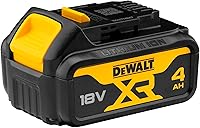
DeWalt DCB204 — Best Lightweight (4.0Ah)
The DCB204 is a reasonable middle ground at 4.0Ah. You’ll get 20–30 minutes of routing — enough for laminate trimming and light chamfering.
Best Batteries for Milwaukee Routers
Milwaukee’s M18 platform offers the M18 FTR FUEL trim router with variable speed 10,000–31,000 RPM.
Milwaukee 48-11-1850 — Best All-Round (5.0Ah)
The 48-11-1850 delivers solid runtime for general routing tasks. The M18 FUEL router’s efficient brushless motor helps stretch battery life compared to brushed alternatives.

Buy Milwaukee 48-11-1850 on Amazon
Milwaukee 48-11-1860 — Best for Heavy Use (6.0Ah)
The 48-11-1860 is the pick for extended profiling sessions. High Output cells deliver the current routers demand during deep cuts.

Buy Milwaukee 48-11-1860 on Amazon
Milwaukee 48-11-1840 — Best Lightweight (4.0Ah)
The 48-11-1840 keeps the tool nimble for freehand edge work. Runtime is limited, but sufficient for quick jobs and touch-ups.
Buy Milwaukee 48-11-1840 on Amazon
Full Comparison Table
| Battery | Platform | Capacity | Best For | Buy Link |
|---|---|---|---|---|
| Makita BL1850B | 18V LXT | 5.0Ah | All-round routing | Amazon |
| Makita BL1860B | 18V LXT | 6.0Ah | Heavy profiling / production | Amazon |
| Makita BL1830 | 18V LXT | 3.0Ah | Laminate trim / quick jobs | Amazon |
| DeWalt DCB205 | 20V MAX | 5.0Ah | All-round routing | Amazon |
| DeWalt DCB206 | 20V MAX | 6.0Ah | Heavy profiling / plunge work | Amazon |
| DeWalt DCB204 | 20V MAX | 4.0Ah | Light trim / chamfers | Amazon |
| Milwaukee 48-11-1850 | M18 | 5.0Ah | All-round routing | Amazon |
| Milwaukee 48-11-1860 | M18 | 6.0Ah | Heavy profiling / production | Amazon |
| Milwaukee 48-11-1840 | M18 | 4.0Ah | Freehand edge work | Amazon |
Watch: Video Guide
Frequently Asked Questions
How long does a battery last when routing?
A 5.0Ah battery typically delivers 30–45 minutes of continuous routing. A 6.0Ah extends that to 40–55 minutes. A 3.0Ah gives roughly 15–25 minutes. Actual runtime depends on cutter size, material hardness, and depth of cut.
What’s the best battery size for trim routing?
For laminate trimming and light edge work, a 3.0–4.0Ah battery is sufficient and keeps the tool light. For sustained edge profiling or plunge routing, step up to 5.0Ah or 6.0Ah.
Does plunge routing drain the battery faster?
Yes. Plunge routing at full depth draws more current than shallow edge trimming. If you’re regularly cutting deep housing joints or grooves, a 6.0Ah battery is worth the extra weight.
Can I use a bigger battery in my router?
Yes. Within the same platform, any battery fits any tool. A 6.0Ah works in the same router as a 2.0Ah — it’s just heavier and lasts longer.
Are Makita, DeWalt and Milwaukee router batteries interchangeable?
No. Each brand uses proprietary connectors. You cannot use a Makita battery in a DeWalt router. See our Makita, DeWalt, and Milwaukee compatibility pages.
How we compile this guide
We cross-reference compatibility details against manufacturer specifications where available, official tool manuals, and the physical standards that govern fitment (bore sizes, arbor diameters, voltage platforms, connector types). We prioritise primary sources over retailer listings, flag anything we can’t confirm, and re-verify the data on a regular cycle. Where we give a buying recommendation, we tell you the reasoning — not just the link. More on our method →