Never use nylon wall plugs or plasterboard anchors for safety-critical fixings. Handrails, stair rails, banisters, balustrades, gates, ladders, climbing or play equipment, overhead fixings, and anything else whose failure could cause a fall or injury need a fixing designed and rated for that purpose — typically a through-bolt, a mechanical anchor or a resin-bonded anchor with a published load rating (and, for structural use, a European Technical Assessment). If you are not certain the wall and the fixing are up to the job, get advice from a builder or structural engineer.
Mounting heavy shelves securely is all about understanding the forces involved and choosing fixings that can handle them. A loaded bookshelf can easily weigh 30–50 kg — the shelf itself, plus books, ornaments, or kitchen items — and all that weight is concentrated on just two or three bracket fixings. Get the fixings wrong and the shelf tears away from the wall, potentially damaging the wall surface and anything below it.
This guide covers the exact fixings you need for every type of shelf on every UK wall type, from floating shelves to heavy-duty bracket shelving and full bookcase systems.
Quick Answer — Shelf Fixings by Wall Type and Weight
| Wall Type | Shelf Load | Recommended Fixing | Bracket Spacing |
|---|---|---|---|
| Solid brick/block | Light (up to 10 kg) | Red wall plugs (6mm) + No. 8 screws | 600mm max |
| Solid brick/block | Medium (10–25 kg) | Brown wall plugs (7mm) + No. 10 screws | 500mm max |
| Solid brick/block | Heavy (25–50 kg) | Brown or blue plugs + coach bolts | 400mm max |
| Plasterboard (stud wall) | Light (up to 10 kg) | Metal self-drill anchors | 600mm (on fixings) |
| Plasterboard (stud wall) | Medium (10–25 kg) | Spring toggles or screw into studs | Align with studs (400/600mm) |
| Plasterboard (stud wall) | Heavy (25+ kg) | Screw into studs only, or use battens | Every stud (400/600mm) |
Recommended Wall Plugs & Fixings
As an Amazon Associate we earn from qualifying purchases. Check fitment & current price on Amazon (affiliate links).
Before you buy: check that the size, fitting/bore and maximum-rated speed marked on the accessory match what your tool’s manual specifies. We have not physically tested these products; listings are compiled from published specifications. These are affiliate links.
Understanding Shelf Forces
A shelf doesn’t just pull downward on its fixings — it creates a lever effect (moment force) that tries to rotate the bracket away from the wall. The top screw of each bracket is under tension (being pulled out of the wall), while the bottom is under compression (being pushed into the wall). The top fixing takes the heaviest load — this is why it’s the one that fails first when shelves collapse.
Key principle: The deeper the shelf (the further the load sits from the wall), the greater the lever force on the top fixing. A 150mm deep shelf puts roughly half the lever force on the fixings compared to a 300mm deep shelf carrying the same weight.
Shelf Fixings on Solid Masonry
Bracket Shelves on Brick
Standard metal or wooden shelf brackets secured to solid brick with the right wall plugs provide excellent holding power. Each bracket should have at least two fixings — top and bottom.
- Light shelves (decorative, light ornaments): Red 6mm plugs with No. 8 × 50mm screws. Two fixings per bracket.
- Medium shelves (books, kitchenware): Brown 7mm plugs with No. 10 × 60mm screws. Two fixings per bracket.
- Heavy shelves (full bookshelves, workshop storage): Brown 7mm or blue 10mm plugs with coach bolts. Two fixings per bracket, brackets every 400mm.
Fischer brown wall plugs with screws — check price on Amazon
Floating Shelves on Brick
Floating shelves (no visible brackets) use concealed fixings — usually metal rods or a hidden mounting plate that slots into the back of the shelf. The fixings are entirely hidden, giving a clean, modern look.
The challenge with floating shelves is that the concealed mounting system often uses only two fixing points, and the rod/plate design creates even greater lever forces than standard brackets. For anything heavier than decorative items, use brown 7mm plugs minimum and ensure the mounting rods are at least 100mm long.
Weight limit for floating shelves: Most floating shelf brackets are designed for decorative loads only — 5–10 kg per shelf. Don’t load a floating shelf with heavy books unless the manufacturer specifically rates it for that weight.
Shelf Fixings on Plasterboard
Light Decorative Shelves
For lightweight display shelves holding a few picture frames or small plants, metal self-drill anchors are adequate — two per bracket. Combined capacity is about 16 kg across two fixings: fischer publishes 8 kg per metal self-drill anchor in 12.5mm board, so these are light-duty only.
Medium Shelves — Find the Studs
For shelves that will hold books or kitchenware, the best approach is to position your brackets over timber studs. A screw driven properly into a timber stud is far stronger than any plasterboard fixing. Use a stud finder to locate the studs and plan your bracket positions accordingly.
If the studs don’t align with where you want the shelves, you have two options:
- Use spring toggles or snap toggles: Each one holds 15–25 kg in plasterboard. Two per bracket for medium loads.
- Install a timber batten: Screw a horizontal timber batten (38 × 38mm or larger) across two or more studs, then mount your shelf brackets anywhere along the batten. This is the strongest approach for plasterboard walls.
Heavy Shelves — Batten Method
For heavy loaded shelves on stud walls, the batten method is essential. A timber batten screwed into two studs can support 100+ kg of shelf load. Paint the batten to match the wall colour and it becomes virtually invisible behind the shelf and brackets.
How Many Brackets Do I Need?
| Shelf Length | Light Load | Medium Load | Heavy Load |
|---|---|---|---|
| Up to 600mm | 2 brackets | 2 brackets | 2 brackets |
| 600mm–1200mm | 2 brackets | 3 brackets | 3 brackets |
| 1200mm–1800mm | 3 brackets | 3–4 brackets | 4 brackets |
| 1800mm+ | 3–4 brackets | 4–5 brackets | 5+ brackets |
Rule of thumb: No more than 600mm between brackets for medium loads, and no more than 400mm for heavy loads. Insufficient brackets cause the shelf to sag in the middle, even if the fixings are strong enough at the ends.
Shelf Bracket Types
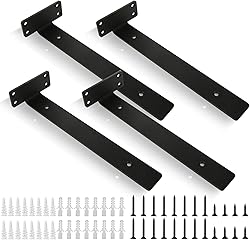
- L-brackets (angle brackets): The simplest and most common. Available in every size from 75mm to 400mm. The longer the bracket, the more weight it can support. Heavy-duty shelf brackets — check price on Amazon
- Concealed shelf supports (floating): Metal rods or plates that hide inside the shelf. Limited to lighter loads. Best on masonry walls.
- Adjustable shelving tracks: Wall-mounted tracks (like Spur shelving) with clip-in brackets. Excellent for multiple shelves — one set of wall fixings supports many shelves. Adjustable shelving system — check price on Amazon
- Cantilever brackets: Triangulated brackets for heavy loads. The diagonal strut transfers the shelf weight directly into the wall fixing, reducing lever force.
Watch: Video Guide
Frequently Asked Questions
What fixings for heavy floating shelves?
On solid brick: brown 7mm wall plugs minimum. Ensure the concealed mounting rods are at least 100mm long and the shelf is rated for the intended load. On plasterboard: floating shelves should be limited to light decorative use unless the hidden brackets are screwed directly into studs.
Can plasterboard hold shelves with books?
Yes, but only with the right fixings. A shelf of books (600mm wide) weighs roughly 15–20 kg. On plasterboard, you need to screw the brackets into studs or use spring toggles / snap toggles. Metal self-drill anchors alone are not strong enough for a full shelf of books. See our plasterboard fixings guide.
How much weight can a shelf bracket hold?
It depends on the bracket size, the wall type, and the fixings used. A 200mm steel L-bracket on two brown 7mm plugs in solid brick will carry a normal domestic shelf load; the limit is set by the plug and the wall rather than the bracket, and the published figures are on our masonry wall plugs guide. The same bracket with two spring toggles in plasterboard: about 30 kg, using fischer published figure of 15 kg per toggle in 12.5mm board. The bracket itself is rarely the weak point — it’s almost always the wall fixings that limit the capacity.
Related Guides
- Wall Plug & Fixing Compatibility Guide
- Wall Plug Size Chart
- Masonry Wall Plugs & Fixings Guide
- Plasterboard Fixings Guide
- Cavity Wall Fixings Guide
- What Fixings for a TV Mount?
- What Fixings for Heavy Mirrors?
Recommended Shelf Fixings & Brackets
The bracket and fixing combination determines your maximum shelf load. Steel L-brackets are rarely the weak point — the wall fixings are what limit the load.
Check Price on Amazon

Check Price on Amazon

Check Price on Amazon
How we compile this guide
We cross-reference compatibility details against manufacturer specifications where available, official tool manuals, and the physical standards that govern fitment (bore sizes, arbor diameters, voltage platforms, connector types). We prioritise primary sources over retailer listings, flag anything we can’t confirm, and re-verify the data on a regular cycle. Where we give a buying recommendation, we tell you the reasoning — not just the link. More on our method →