Never use nylon wall plugs or plasterboard anchors for safety-critical fixings. Handrails, stair rails, banisters, balustrades, gates, ladders, climbing or play equipment, overhead fixings, and anything else whose failure could cause a fall or injury need a fixing designed and rated for that purpose — typically a through-bolt, a mechanical anchor or a resin-bonded anchor with a published load rating (and, for structural use, a European Technical Assessment). If you are not certain the wall and the fixing are up to the job, get advice from a builder or structural engineer.
Hanging a heavy mirror securely is a job where the consequences of getting it wrong are severe — a falling mirror is a genuine safety hazard, and heavy mirrors are often expensive to replace. Unlike a shelf or TV mount that has multiple fixing points distributing the load, many mirrors hang from just one or two points, concentrating all the weight on a very small area of wall.
This guide covers the correct fixings for mirrors of every weight on every UK wall type, from lightweight bathroom mirrors to large statement mirrors weighing 30 kg or more.
Quick Answer — Mirror Fixings by Weight and Wall Type
| Mirror Weight | Solid Masonry | Plasterboard | Dot-and-Dab |
|---|---|---|---|
| Up to 5 kg (small bathroom mirrors, decorative) | Yellow or red wall plug (5–6mm) + picture hook | Self-drill anchor or picture hook | Standard picture hook into adhesive dab |
| 5–15 kg (medium mirrors, framed mirrors) | Red wall plugs (6mm) + mirror screws or heavy-duty hooks | 2× metal self-drill anchors or spring toggles | Long plugs through to masonry |
| 15–30 kg (large statement mirrors, gym mirrors) | Brown wall plugs (7mm) + mirror bolts or French cleat | Gravity toggles or screw into studs | Long masonry fixings through to brick |
| 30+ kg (very large or antique mirrors) | Brown/blue plugs + French cleat or mirror brackets | Must fix into studs + cavity fixings | Long masonry fixings with security clips |
Recommended Wall Plugs & Fixings
As an Amazon Associate we earn from qualifying purchases. Check fitment & current price on Amazon (affiliate links).
Before you buy: check that the size, fitting/bore and maximum-rated speed marked on the accessory match what your tool’s manual specifies. We have not physically tested these products; listings are compiled from published specifications. These are affiliate links.
Mirror Hanging Methods
Method 1: Wire and Hook
The traditional method — a hanging wire across the back of the mirror frame, suspended from a hook or screw in the wall. Simple and allows easy repositioning, but the single hook point means all the weight hangs from one fixing.
Suitable for: Framed mirrors up to about 10 kg on masonry. For heavier mirrors, use two hooks spaced apart.
Method 2: D-Rings and Screws
D-ring hangers (also called strap hangers) fixed to the back of the mirror frame, one on each side. Each D-ring hooks over a screw head protruding from the wall. This distributes the weight across two fixing points and is more secure than a single wire.
Suitable for: Medium to heavy framed mirrors up to 20 kg. Two fixing points provide redundancy — if one fails, the other still holds.
Method 3: French Cleat
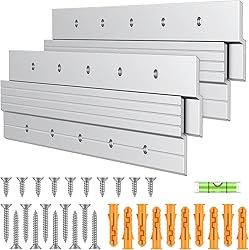
A French cleat uses two interlocking bevelled strips — one fixed to the wall, one to the back of the mirror. The mirror simply hooks over the wall strip. This is the strongest and most secure method for heavy mirrors because the load is distributed along the entire length of the cleat.
Suitable for: Any mirror, but especially heavy mirrors over 15 kg. A 600mm French cleat on solid brick can hold 50+ kg. Heavy-duty French cleat kit — check price on Amazon
Method 4: Mirror Screws (Direct Fix)
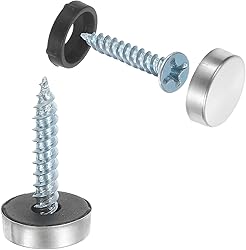
For frameless mirrors (common in bathrooms), mirror screws pass through pre-drilled holes in the glass and into the wall. Chrome dome caps cover the screw heads for a neat finish. This permanently fixes the mirror to the wall — the most secure option for bathrooms where steam and moisture can loosen adhesive mounts.
Mirror screw set with chrome caps — check price on Amazon
Method 5: Adhesive Mirror Pads
Heavy-duty adhesive pads or mirror adhesive bond the mirror directly to the wall without any drilling. Only suitable for lightweight mirrors (up to 5 kg) on smooth, clean, dry surfaces. Not recommended for heavy mirrors, bathrooms (steam weakens adhesive), or on wallpaper (the paper may peel off the wall under load).
Heavy Mirror Fixings on Solid Masonry
Solid masonry is the easiest surface for heavy mirrors. Standard wall plugs provide excellent holding power, and you have your choice of hanging methods.
For Mirrors 5–15 kg
Two red wall plugs (6mm) with No. 8 × 50mm screws, positioned to align with the mirror’s D-rings or wire. Leave 8–10mm of screw head protruding so the D-ring or wire can hook over it.
For Mirrors 15–30 kg
Two brown wall plugs (7mm) with No. 10 × 60mm screws, or install a French cleat secured with three or four brown plugs. The French cleat distributes the load along its full length, making it ideal for large, heavy mirrors.
For Mirrors Over 30 kg
A French cleat with blue 10mm plugs or chemical resin anchors. For antique mirrors with irreplaceable frames, consider adding security fixings at the bottom corners (small L-brackets or mirror clips) to prevent the mirror swinging or being knocked off the cleat.
Heavy Mirror Fixings on Plasterboard
Hanging heavy mirrors on plasterboard requires careful fixing selection. The plasterboard alone can support a surprising amount of weight with the right fixings, but for mirrors over 20 kg, try to get at least one fixing into a stud.
Up to 10 kg
Two metal self-drill anchors provide plenty of capacity. Position them at the mirror’s hanging points and leave 8–10mm of screw head exposed.
10–20 kg
Two heavy-duty gravity toggles of the SnapToggle type give roughly 55–60 kg combined, working to the manufacturer guidance of a quarter of the published ultimate load. Two standard spring toggles give about 30 kg — fischer publishes 15 kg per toggle in 12.5mm board. Alternatively, if a stud aligns with one hanging point, use a stud screw for that side and a self-drill anchor or toggle for the other.
Over 20 kg
Use a French cleat spanning across two studs, screwed firmly into each stud with No. 10 × 50mm screws. This is the only reliable method for very heavy mirrors on stud walls.
Bathroom Mirror Fixings
Bathrooms present unique challenges for mirror mounting: moisture, steam, tiled surfaces, and often a mix of wall materials (tiles on plasterboard or tiles on masonry).
Fixing Through Tiles
- Mark the fixing position on the tile with a cross of masking tape (prevents the drill bit from skating)
- Start with a tile/glass drill bit on slow speed, no hammer action — drill through the tile only
- Switch to a masonry bit and engage hammer action to drill into the masonry behind
- Insert the wall plug through the tile and into the masonry
- Use a mirror screw with a rubber washer between the chrome cap and the glass to prevent cracking
Important: Never use hammer action while drilling through tile — it will crack the tile. Only engage hammer mode once you’re into the masonry behind.
Watch: Video Guide
Frequently Asked Questions
Can I hang a heavy mirror on plasterboard?
Yes, with the right fixings. For mirrors up to 20 kg, gravity toggles provide ample capacity. For heavier mirrors, use a French cleat screwed into studs. See our plasterboard fixings guide for full details on plasterboard fixing options.
What’s the best way to hang a mirror without drilling?
Heavy-duty adhesive strips or mirror adhesive can work for lightweight mirrors (up to 5 kg) on smooth, dry, clean walls. For anything heavier, drilling is the only safe approach. Adhesive fails over time — especially in bathrooms where steam and temperature changes weaken the bond.
How do I hang a mirror on a brick wall?
Drill into the brick (not the mortar) with a masonry drill bit in hammer mode. Insert an appropriately sized wall plug — red (6mm) for mirrors up to 15 kg, brown (7mm) for heavier mirrors. Leave 8–10mm of screw head exposed for the hanging wire or D-ring. For very heavy mirrors, use a French cleat with multiple fixings. See our masonry fixings guide.
What size wall plug for a large mirror?
For mirrors 15–30 kg: brown wall plugs (7mm) with a 7mm masonry drill bit and No. 10 screws. For mirrors over 30 kg: blue wall plugs (10mm) or chemical resin anchors. Always use at least two fixing points — three or more for very large mirrors. See our wall plug size chart for complete specifications.
Related Guides
- Wall Plug & Fixing Compatibility Guide
- Wall Plug Size Chart
- Masonry Wall Plugs & Fixings Guide
- Plasterboard Fixings Guide
- Cavity Wall Fixings Guide
- What Fixings for a TV Mount?
- What Fixings for Curtain Poles?
Recommended Mirror Hanging Fixings
For heavy mirrors, French cleats provide the strongest and most level hanging system. Mirror screws with decorative caps give a clean, professional finish on smaller mirrors.
Check Price on Amazon
Check Price on Amazon

Check Price on Amazon

Check Price on Amazon
How we compile this guide
We cross-reference compatibility details against manufacturer specifications where available, official tool manuals, and the physical standards that govern fitment (bore sizes, arbor diameters, voltage platforms, connector types). We prioritise primary sources over retailer listings, flag anything we can’t confirm, and re-verify the data on a regular cycle. Where we give a buying recommendation, we tell you the reasoning — not just the link. More on our method →