
Never use nylon wall plugs or plasterboard anchors for safety-critical fixings. Handrails, stair rails, banisters, balustrades, gates, ladders, climbing or play equipment, overhead fixings, and anything else whose failure could cause a fall or injury need a fixing designed and rated for that purpose — typically a through-bolt, a mechanical anchor or a resin-bonded anchor with a published load rating (and, for structural use, a European Technical Assessment). If you are not certain the wall and the fixing are up to the job, get advice from a builder or structural engineer.
Screw Sizes for Wall Plugs — Which Screw for Which Plug?
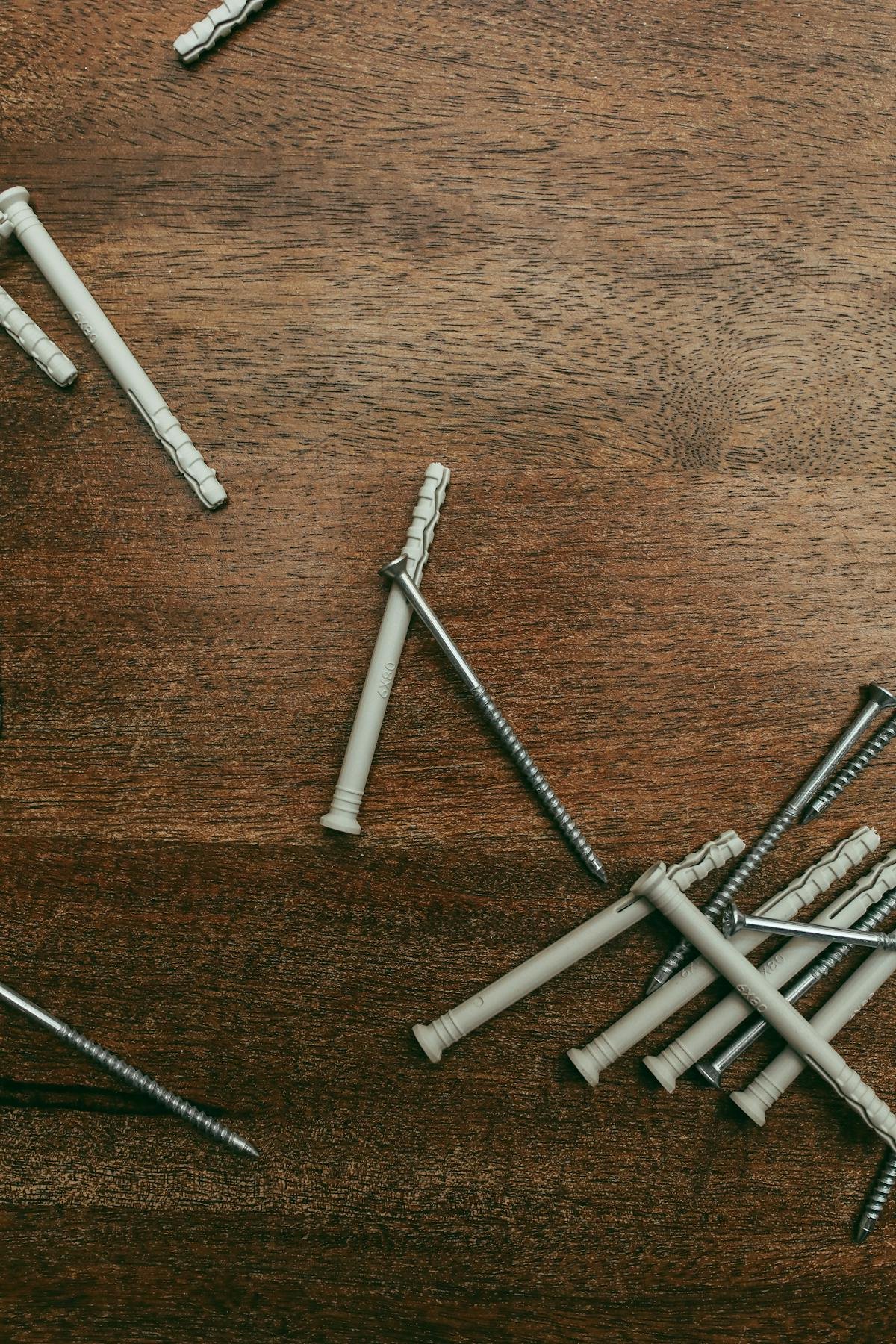
Every wall plug size accepts a range of screw gauges — not just one. Using a screw that’s too thin means the plug won’t expand properly and your fixing will be weak. Too thick and the screw will either split the plug or won’t drive in at all. This guide explains how to choose the screw for a plug: use the screw diameter range the plug maker gives on the packaging or datasheet.
Key Takeaway
Each plug takes a range of screw diameters, which the maker publishes. For example, fischer gives 4.0–5.0mm wood or chipboard screws for its SX Plus 6 x 30 plug and 4.5–6.0mm for DuoPower 8 x 40. Use a screw within the range on the packaging.
Wall Plug to Screw Size Chart
| Plug Colour (Rawlplug UNO) | Plug Diameter | Drill Bit | Screw |
|---|---|---|---|
| 🟡 Yellow | 5mm | 5mm | As on the packaging |
| 🔴 Red | 6mm | 6mm | As on the packaging |
| 🟤 Brown | 7mm | 7mm | As on the packaging |
| 🔵 Blue | 8mm | 8mm | As on the packaging |
| ⚪ Grey | 10mm | 10mm | As on the packaging |
Recommended Wall Plugs & Fixings
As an Amazon Associate we earn from qualifying purchases. Check fitment & current price on Amazon (affiliate links).
Before you buy: check that the size, fitting/bore and maximum-rated speed marked on the accessory match what your tool’s manual specifies. We have not physically tested these products; listings are compiled from published specifications. These are affiliate links.
Plug colours on this page follow Rawlplug’s UNO range (yellow 5mm, red 6mm, brown 7mm, blue 8mm, grey 10mm). Other brands use different colours, so go by the diameter printed on the plug or box.
Get the free Torx & Screwdriver Bit Chart (PDF)
Every Torx, Pozi, Phillips & hex size — with an actual-size sizer.
Understanding Screw Gauge Numbers
Older UK screws are sized by gauge numbers (No. 6, No. 8 and so on), where a higher number means a thicker screw. We don’t give a gauge-to-millimetre table because we have no freely available standard to check it against. Plug makers give screw sizes in millimetres, so use the metric diameter on the screw packet. Two examples from maker data:
Maker Screw Ranges: Examples
| Plug (example) | Drill | Wood or chipboard screw diameter | Source |
|---|---|---|---|
| fischer SX Plus 6 x 30 | 6mm | 4.0–5.0mm | fischer UK product page |
| fischer DuoPower 8 x 40 | 8mm | 4.5–6.0mm | fischer UK product page |
How Screw Length Affects Holding Power
The screw must be long enough to pass through the item you’re fixing AND fully engage the wall plug. As a rule: screw length = thickness of item being fixed + wall plug length. For example, fixing a 20mm-thick bracket with a 30mm plug needs a screw at least 50mm long; check the packaging for any extra length the maker specifies.
Screw Length Formula
Minimum screw length = thickness of item + wall plug length. A bit longer is fine (the screw just goes deeper into the plug), but too short means the screw doesn’t reach the plug properly and your fixing will be weak.
What Happens If You Use the Wrong Screw?
Screw Too Thin
If the screw gauge is below the minimum for the plug, the plug won’t expand fully. The fixing will feel loose and won’t hold its rated weight.
Screw Too Thick
If the screw gauge is above the maximum, it may split the wall plug or push the plug out of the hole instead of expanding it. The screw could also refuse to drive in fully, leaving the fixing incomplete.
Screw Too Short
The screw doesn’t reach far enough into the plug to create expansion. The fixing feels tight during installation but fails under load because only the top of the plug is expanded.
Frequently Asked Questions
Do I need to buy screws separately from wall plugs?
Often yes — many wall plug packs don’t include screws. However, some kits (particularly mixed assortment kits) include matched screws. Check the packaging. If buying separately, use the screw diameter given on the plug packaging.
Can I use metric screws with standard wall plugs?
Yes. Plug makers give screw sizes in millimetres; for example, fischer gives 4.0–5.0mm wood or chipboard screws for its SX Plus 6 x 30 plug. Use the metric diameter on the screw packet.
What head type should I use?
Countersunk heads sit flush, which is neater. Pan heads sit proud on the surface, which is useful if fixing through a keyhole bracket or hanging something that needs to lift off. For most wall-fixing jobs, countersunk is the standard choice.
Recommended Screw & Wall Plug Kits
| Product | Contents | Best For | Link |
|---|---|---|---|
| Rawlplug Mixed Wall Plug Kit (272 Pieces) | Assorted plugs + screws | All-in-one for most jobs | View on Amazon |
| Fischer SX 6mm + Screws (50 Sets) | SX plugs + screws | General-purpose fixing kit | View on Amazon |
As an Amazon Associate, we earn from qualifying purchases.
Where to Buy Screws & Wall Plugs
Screw & Wall Plug Sets on Amazon
Wood Screw Assortment Boxes on Amazon
How we compile this guide
We cross-reference compatibility details against manufacturer specifications where available, official tool manuals, and the physical standards that govern fitment (bore sizes, arbor diameters, voltage platforms, connector types). We prioritise primary sources over retailer listings, flag anything we can’t confirm, and re-verify the data on a regular cycle. Where we give a buying recommendation, we tell you the reasoning — not just the link. More on our method →