
Never use nylon wall plugs or plasterboard anchors for safety-critical fixings. Handrails, stair rails, banisters, balustrades, gates, ladders, climbing or play equipment, overhead fixings, and anything else whose failure could cause a fall or injury need a fixing designed and rated for that purpose — typically a through-bolt, a mechanical anchor or a resin-bonded anchor with a published load rating (and, for structural use, a European Technical Assessment). If you are not certain the wall and the fixing are up to the job, get advice from a builder or structural engineer.
What Wall Plug for Heavy Items? TVs, Shelves, Radiators & More
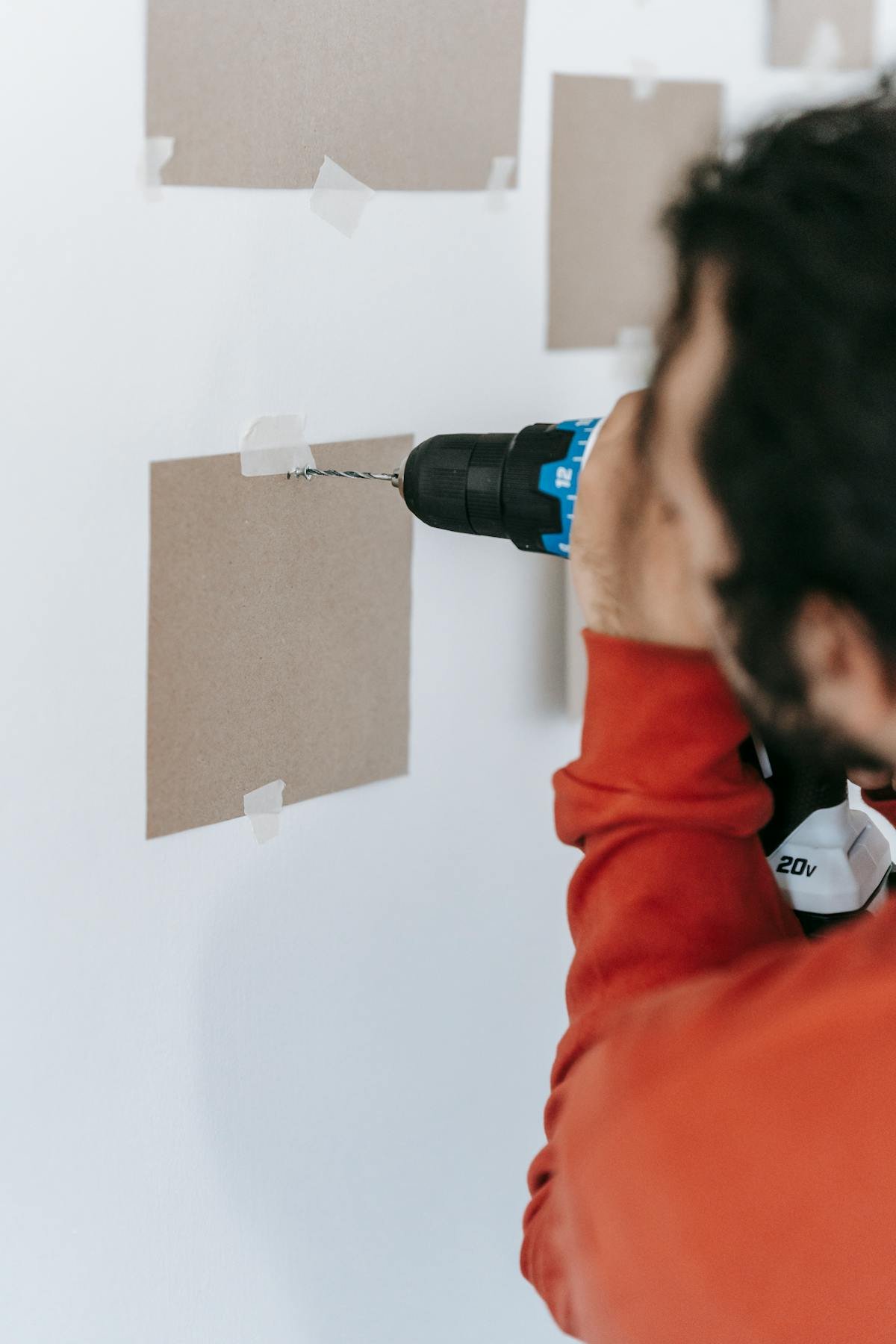
Hanging heavy items like TVs, floating shelves, radiators, and kitchen wall units requires the right combination of wall plug, screw, and technique. Get it wrong and you risk a dangerous failure — a 30kg TV falling off the wall can cause serious injury and damage. This guide covers the correct fixings for every common heavy item, in both masonry and plasterboard walls.
Safety First
Always use a pipe and cable detector before drilling into any wall. Heavy items need secure fixings — if you’re unsure about the wall type or your ability to install safely, hire a professional. A failed heavy fixing can cause injury and expensive damage.
Quick Reference — Fixings by Item
| Item | Typical Weight | Masonry Fixing | Plasterboard Fixing |
|---|---|---|---|
| Small TV (up to 15kg) | 5–15kg | Brown (7mm) plugs + No. 10 screws | GripIt 20mm or gravity toggles |
| Large TV (15–30kg) | 15–30kg | Brown (7mm) or blue (10mm) plugs | Fix into studs + GripIt for non-stud points |
| Floating shelf (loaded) | 10–25kg | Brown (7mm) plugs + No. 10 screws | Fix into studs where possible |
| Kitchen wall unit | 20–40kg (loaded) | Brown (7mm) plugs, multiple fixings | Must fix into studs or use mounting rail |
| Radiator | 15–40kg (filled with water) | Brown (7mm) or blue (10mm) plugs | Must fix into studs |
| Large mirror | 5–20kg | Red (6mm) or brown (7mm) plugs | Spring toggles or GripIt |
| Curtain pole (heavy) | 5–15kg (+ curtain weight) | Brown (7mm) plugs + No. 10 screws | GripIt 15mm or fix into studs |
| Bike rack (wall) | 10–15kg (bike weight) | Brown (7mm) plugs | Must fix into studs |
| Grab rail (bathroom) | Dynamic load — person’s weight | Safety-critical — do not use a plastic plug. Plastic plugs are approved only for redundant, non-structural fixings (EAD 330284-00-0604). Use an ETA-approved metal or resin anchor selected for the actual wall and installed per BS 8539:2012+A1:2021. In plasterboard, fix to solid backing — a noggin or plywood pattress screwed to the studs. Full guidance | |
Recommended Wall Plugs & Fixings
As an Amazon Associate we earn from qualifying purchases. Check fitment & current price on Amazon (affiliate links).
Before you buy: check that the size, fitting/bore and maximum-rated speed marked on the accessory match what your tool’s manual specifies. We have not physically tested these products; listings are compiled from published specifications. These are affiliate links.
Get the free Drill Bit & Wall-Plug Size Chart (PDF)
Every drill size, wall-plug colour & tap size on one printable sheet.
Hanging a TV on Masonry
Most TV wall brackets use 4–6 fixing points. For a standard TV (15–25kg), use brown (7mm) wall plugs with No. 10 x 50mm screws in solid brick or block. For larger TVs (30kg+) or articulating brackets (which create extra leverage), step up to blue (10mm) plugs or use coach bolts.
Tip: Articulating TV Brackets
Full-motion (articulating) TV brackets create significant leverage when extended. A 20kg TV on a fully extended arm can exert 3–4 times its weight as a pulling force on the top fixings. Always size up your fixings for articulating brackets — use brown or blue plugs even for smaller TVs.
Hanging a TV on Plasterboard
For TVs on plasterboard, the strongest approach is to fix the bracket directly into timber studs behind the board. Use a stud finder to locate them — they’re typically at 400mm or 600mm centres. Drive No. 10 x 50mm screws directly into the studs (no wall plug needed in timber).
If the studs don’t align with your bracket holes, use GripIt fixings (20mm brown for heavy TVs) or gravity toggles for the non-stud points. Never rely solely on plasterboard fixings for a TV over 15kg — at least two fixing points should be into studs.
Heavy Shelving
Floating shelves and bracket shelves carry load that increases significantly the further out from the wall the weight sits. A 20kg load at the end of a 300mm-deep shelf creates substantial leverage on the fixings. In masonry, use brown (7mm) plugs as minimum, with long screws (50–60mm). In plasterboard, fix the brackets into studs wherever possible.
For very heavy loads (books, tools, heavy ornaments), use two or more brackets per shelf and ensure they’re evenly spaced. Wider bracket spacing = less load per fixing point.
Radiators
A filled radiator is much heavier than you might think — a standard double-panel radiator (1000mm x 600mm) weighs around 15kg empty and over 30kg when filled with water. Radiator brackets must support both the static weight and the thermal expansion forces.
On masonry: use brown (7mm) or blue (10mm) plugs depending on the radiator size, with long No. 10 or No. 12 screws. On plasterboard: always fix into studs — plasterboard fixings alone are not recommended for radiators due to the combination of weight and thermal cycling.
Kitchen Wall Units
Kitchen wall units are among the heaviest items hung on walls. An empty unit might weigh 10kg, but loaded with crockery, tins, and glassware it can easily reach 30–40kg. Professional kitchen fitters use a mounting rail system (a continuous metal rail screwed to the wall) which distributes the load across many fixing points.
On masonry: the mounting rail is fixed with brown (7mm) plugs at 300–400mm intervals. On plasterboard: the rail must pass through multiple studs. If studs are sparse, use a combination of stud fixings and heavy-duty plasterboard fixings, or fit a timber batten across the studs first.
General Rules for Heavy Fixings
Rules for Heavy Fixings
1. More fixing points = safer. Spread the load across as many fixings as the bracket allows. 2. Size up, not down. When in doubt, use the next plug size up. 3. Use a detector. Always check for pipes and cables before drilling. 4. Masonry is always stronger than plasterboard. If you have the option, fix to masonry. 5. Studs are your best friend. On plasterboard, finding a stud gives you a much stronger fixing than any plasterboard fitting.
Recommended Heavy-Duty Fixings
| Product | Type | Best For | Link |
|---|---|---|---|
| GripIt 20mm Plasterboard Fixings (4 Pack) | Heavy-duty plasterboard | TVs, heavy shelves on plasterboard — GripIt publishes “up to 93 kg” for the 20 mm; its safe-load datasheet gives 50 kg | View on Amazon |
| Fischer DuoPower 8x40mm (18 Pack) | Universal heavy-duty | Heavy loads on any wall type | View on Amazon |
| Bosch 8-Piece Masonry Drill Bit Set | Masonry drill bits | Complete set for all plug sizes | View on Amazon |
As an Amazon Associate, we earn from qualifying purchases.
Where to Buy Heavy Duty Fixings
Heavy Duty Wall Plugs on Amazon
Chemical Anchor Kits on Amazon
How we compile this guide
We cross-reference compatibility details against manufacturer specifications where available, official tool manuals, and the physical standards that govern fitment (bore sizes, arbor diameters, voltage platforms, connector types). We prioritise primary sources over retailer listings, flag anything we can’t confirm, and re-verify the data on a regular cycle. Where we give a buying recommendation, we tell you the reasoning — not just the link. More on our method →