Introduction
A jigsaw is one of the most versatile power tools on a tradesperson’s shelf — but it only cuts as well as the blade you fit. The difference between a rough, slow cut and a clean, efficient one often comes down to choosing the right blade for the job.
This guide covers everything you need to know: blade types, materials, tooth counts, shank types, and how to match them to your cutting task. Whether you’re cutting wood, metal, plastic, or tile, you’ll find the blade type and model number to get the job done right.
Quick Reference Table: Blade Selection at a Glance
| Material | Best Blade Type | TPI Range | Recommended Models |
|---|---|---|---|
| Softwood (pine, fir) | HCS (High Carbon Steel) | 6–10 TPI | Bosch T101B, Makita A-90350 |
| Hardwood (oak, ash) | HCS fine tooth | 8–12 TPI | Bosch T101BF, DeWalt DT2294 |
| Plywood & chipboard | HCS down-cut | 10–12 TPI | Bosch T101BR, Milwaukee 49-22-5030 |
| Laminate & MDF | HCS fine or BIM | 10–14 TPI | Bosch T101BF, Makita A-90310 |
| Thin sheet metal | BIM (Bimetal) | 24+ TPI | Bosch T118A, DeWalt DT2205 |
| Thick steel/pipe | BIM progressive | 14–21 TPI | Bosch T118BF, Makita A-90507 |
| Aluminium | BIM | 14–18 TPI | Bosch T127D, Milwaukee 49-22-5032 |
| Stainless steel | BIM | 18–24 TPI | Bosch T118AO, DeWalt DT2251 |
| Plastic & PVC | HCS fine tooth | 8–14 TPI | Bosch T101BF, Makita A-90310 |
| Ceramic tile | Carbide-coated | N/A | Bosch T127CG (carbide grit) |
Recommended Jigsaw Blades
As an Amazon Associate we earn from qualifying purchases. Check fitment & current price on Amazon (affiliate links).
Before you buy: check that the size, fitting/bore and maximum-rated speed marked on the accessory match what your tool’s manual specifies. We have not physically tested these products; listings are compiled from published specifications. These are affiliate links.
Understanding Jigsaw Blades: The Essentials
Blade Materials
High Carbon Steel (HCS) is the standard choice for wood and wood composites. HCS is sharp, affordable, and quick to dull — but that’s fine for softwood projects. When you see a Bosch T101B or Makita A-90350, you’re looking at HCS.
Bimetal (BIM) blades have HCS teeth welded to a flexible steel backing. This combination makes them far more durable than HCS, and they can cut through harder materials like metal, hardwoods, and composites. They cost more but last significantly longer in heavy-duty work. Look for this when cutting steel, stainless, or aluminium.
Carbide-coated blades are the premium option. Carbide edges stay sharp longest and can cut ceramics, glass, and very hard materials. Not essential for most tradespeople, but invaluable for tile work or specialist jobs.
Blade Shanks: T-Shank vs U-Shank
The shank is the part that grips into your jigsaw. Two standards dominate:
T-Shank (Bosch-style) is the modern standard. Nearly all new jigsaws accept T-shank blades, and they’re easier to change. If you’ve bought a jigsaw in the last 15 years, it almost certainly uses T-shank.
U-Shank (or pin-shank) is the older style. Older Makita, DeWalt, and Milwaukee models may still use it. If your jigsaw has a blade with a pin sticking out the top, you need U-shank blades. Check your tool manual if you’re unsure.
For a detailed comparison with specific tool models, see Are Jigsaw Blades Universal? T-Shank vs U-Shank Compatibility.
Teeth Per Inch (TPI) — The Most Important Number
TPI is the count of teeth along one inch of the blade. It’s the single most important number when choosing a blade:
Lower TPI (6–10) = faster cutting but rougher finish. Use for rip cuts in softwood, fast demolition work, or thick materials.
Mid-range TPI (10–14) = balanced speed and finish. Works for general-purpose wood cutting and composites like plywood and MDF.
Higher TPI (18+) = slower cutting but very smooth finish, essential for metal, thin materials, and laminate. The finer the teeth, the more cuts per second, and the cooler the blade stays.
For a complete TPI reference by material, see Jigsaw Blade TPI Guide — What Teeth Per Inch for Every Material.
Cutting Direction: Down-Cut vs Up-Cut vs Scroll
Standard (up-cut) teeth point upward and pull the material toward the baseplate. This is the default for most blades.
Down-cut teeth point downward, which reduces splintering on the top face of the material. Use down-cut blades for visible surface cuts on plywood and laminate (kitchen worktops, cabinet sides). Look for model numbers ending in “O” (Bosch T101AO).
Scroll blades have a wavy or asymmetrical tooth pattern, allowing very tight radius turns. These are specialist blades for intricate fretwork.
Choosing the Right Blade by Material
Wood Cutting
For softwood (pine, fir, plywood), a standard HCS blade with 6–10 TPI is ideal. If you want a smoother finish or are cutting hardwood, step up to 8–12 TPI. Bosch T101B and T101BF are reliable all-rounders.
For plywood and MDF, use a finer blade (10–12 TPI) to reduce splintering. A down-cut blade (Bosch T101BR) minimises chip-out on the visible face.
See the full wood guide at What Jigsaw Blade for Cutting Wood?
Metal Cutting
Metal always requires a BIM blade. Thin sheet metal (up to 1.5 mm) needs 24+ TPI. Thick steel or pipe needs a coarser BIM blade, typically 14–21 TPI with a progressive tooth pattern.
Never force a metal blade; feed slowly and let the tool do the work. Lubricate thick steel with light machine oil to keep the blade cool.
See the full metal guide at What Jigsaw Blade for Cutting Metal?
Plastic, Laminate & Composites
Plastics, PVC, and laminate all need fine-tooth HCS or BIM blades (10–14 TPI) to avoid chipping. Feed slowly and let the blade do the work — pushing too hard will generate heat and potentially melt the material.
Brand-Specific Jigsaw Blade Compatibility
Most modern jigsaws accept Bosch T-shank blades as the universal standard. However, some brands and older models have proprietary recommendations:
- Makita — Modern Makita jigsaws accept T-shank blades universally. Older models may use U-shank. See Makita Jigsaw Blade Compatibility.
- DeWalt — DeWalt jigsaws (20V MAX and compact models) all use T-shank blades. See DeWalt Jigsaw Blade Compatibility.
- Milwaukee — Milwaukee M18 and M12 jigsaws accept T-shank blades. See Milwaukee Jigsaw Blade Compatibility.
- Bosch — Bosch is the T-shank standard. All Bosch jigsaws use Bosch T-shank blades, naturally. See Bosch Jigsaw Blade Compatibility.
- Ryobi — Ryobi ONE+ jigsaws accept T-shank blades. See Ryobi Jigsaw Blade Compatibility.
If you’re unsure whether your jigsaw accepts T-shank or U-shank blades, check the manual or pull the current blade — the shank design is obvious from inspection.
Safety Essentials
A few critical safety points:
- Always fit the blade with the teeth pointing upward toward the baseplate. An inverted blade will break immediately.
- Ensure the blade is fully seated and locked. A loose blade will rattle and break.
- Check that the blade has no cracks or damage before each use.
- Wear eye protection — jigsaw work can throw fine dust and splinters.
- Clamp or secure your workpiece. Never hold it by hand near the cutting path.
- For metal cutting, wear gloves or handle the blade carefully — the fine teeth are very sharp.
For a complete safety guide with jigsaw-specific recommendations, see Jigsaw Blade Safety Guide.
Popular Blade Sets & Where to Buy
Most tradespeople buy blades in sets to cover the most common jobs. A good starter set includes a few HCS blades for wood (different TPI) and at least one BIM blade for occasional metal work.
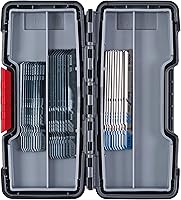
Bosch 30-Piece Jigsaw Blade Set on Amazon — includes T101B, T101BF, and BIM blades. A reliable all-in-one starter set.
WORKPRO Jigsaw Blade Set on Amazon — budget-friendly mixed set with good variety.
Recommended Products
| Product | Details |
|---|---|
 | Bosch 30-Piece Set View on Amazon |
 | WORKPRO 25-Piece Set View on Amazon |
 | DeWalt DT2294 10-Piece Set View on Amazon |
 | Makita A-86898 Selection Pack View on Amazon |
Watch: Video Guide
Frequently Asked Questions
Can I use any jigsaw blade in any jigsaw?
Not quite. Most modern jigsaws (post-2005) use Bosch T-shank blades, and these are interchangeable across brands. However, older jigsaws and some specialist models use U-shank (pin-shank) blades, which are not compatible. Check your tool manual or inspect your current blade to determine which type you need.
What does TPI mean?
TPI stands for Teeth Per Inch. It’s the number of teeth along one inch of the blade. Lower TPI (6–10) cuts faster but rougher; higher TPI (18+) cuts slower but smoother. Always match TPI to your material — thick wood uses 6–10 TPI, thin metal uses 24+ TPI.
Why do my jigsaw blades keep breaking?
Blades typically break because they’re being forced or twisted during the cut. Common causes: pushing too hard, twisting the tool side-to-side, using the wrong blade for the material (wrong TPI), or a loose blade in the chuck. Feed slowly and let the blade do the work.
Is a higher TPI always better?
No. Higher TPI gives a finer finish but cuts more slowly. For thick softwood, a low TPI (6–10) blade will be faster and more efficient. Save high TPI blades for thin materials, metal, or when you need a smooth finish. Match the TPI to the job.
Can I use a wood blade to cut metal?
Not safely. Wood blades (HCS) are too soft and will dull instantly or break when hitting steel. Metal cutting always requires a BIM (bimetal) blade. Attempting to force a wood blade through metal can cause the blade to catch and snap.
How often should I replace my jigsaw blades?
Replace a blade when it stops cutting cleanly or feels dull — you’ll notice the tool struggling and producing a rough finish. HCS blades (wood) may need replacing after 10–20 cuts in hardwood; BIM blades (metal) can last 100+ cuts. There’s no fixed schedule; go by how the tool feels.
What’s the difference between Bosch T101B and T101BF?
The T101B is a general-purpose blade with 8 TPI — fast for softwood, adequate for hardwood. The T101BF is finer (10 TPI) with a tapered blade for smoother cuts and better control in curves. If you need versatility, start with T101BF; if you’re doing fast rough cuts, T101B is quicker.
More on Jigsaw Blades
Related jigsaw reading:
How we compile this guide
We cross-reference compatibility details against manufacturer specifications where available, official tool manuals, and the physical standards that govern fitment (bore sizes, arbor diameters, voltage platforms, connector types). We prioritise primary sources over retailer listings, flag anything we can’t confirm, and re-verify the data on a regular cycle. Where we give a buying recommendation, we tell you the reasoning — not just the link. More on our method →