The Ryobi P197 is a 2.0Ah compact battery for the Ryobi ONE+ 18V platform. It’s a lightweight, budget-friendly option commonly included in starter kits and ideal for lighter tasks. Here’s what you need to know about finding a replacement.
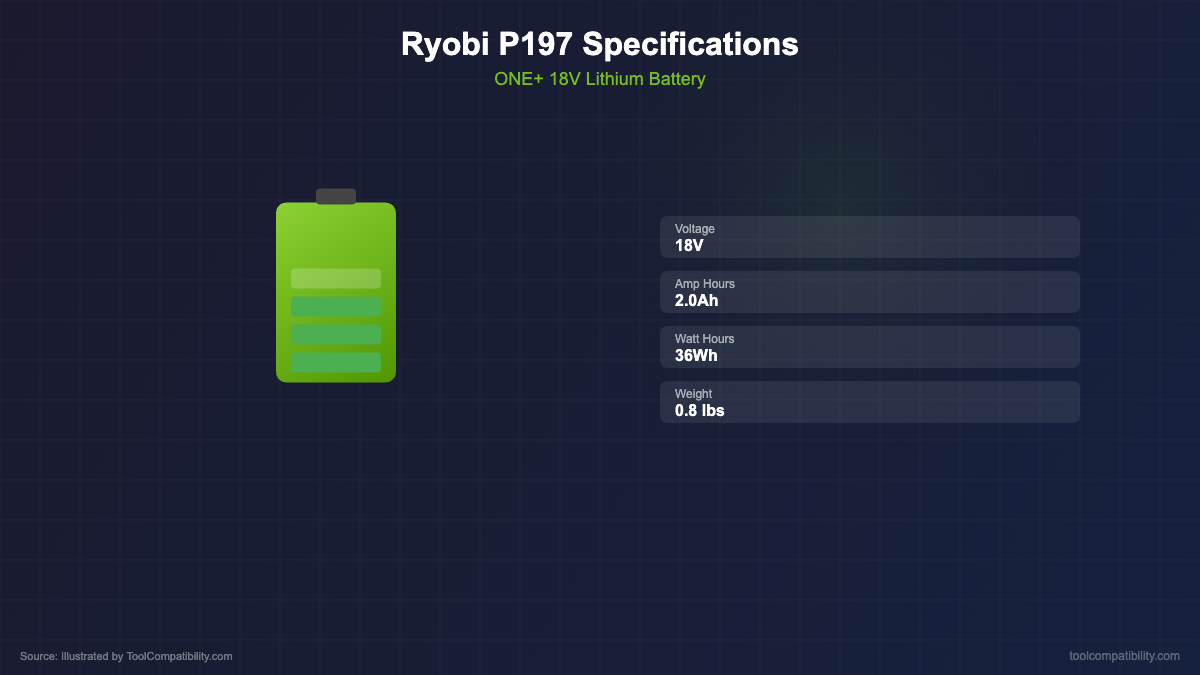
P197 Specifications
Voltage: 18V
Capacity: 2.0Ah (36Wh)
Chemistry: Lithium-ion
Platform: Ryobi ONE+
Fuel gauge: Yes — onboard LED indicator
Weight: Approximately 0.37 kg
What Tools Does the P197 Fit?
Like all Ryobi ONE+ batteries, the P197 fits every tool in the ONE+ 18V range — over 300 products. Its compact size and light weight make it particularly good for overhead work, impact drivers, and smaller tools where reducing fatigue matters more than maximum runtime.
Replacement Options
Direct replacement (same spec): The P197 or equivalent Ryobi 2.0Ah ONE+ compact batteries are widely available individually and in multi-packs.
Upgrade options: If you found the P197’s runtime too short, consider stepping up:
- P108 (4.0Ah) — Double the runtime of the P197, only slightly heavier. The most popular mid-range Ryobi battery
- PBP005 (3.0Ah HP) — 50% more capacity in a compact form factor with HIGH PERFORMANCE cells
- PBP004 (4.0Ah HP) — Same capacity as the P108 but with improved cells for better performance in ONE+ HP tools
All Ryobi ONE+ batteries are cross-compatible, so any replacement works in every tool you own.
Where to Buy
Search for Ryobi P197 on Amazon UK
Browse all Ryobi ONE+ 2.0Ah batteries on Amazon UK
Tips for Getting the Most from Your Replacement
Compact batteries like the P197 are more sensitive to deep discharge because they have fewer cells sharing the load. Swap to a fresh battery when performance drops rather than running it completely flat. Store indoors at partial charge when not in use. For more advice, see our Battery Care & Storage Guide.
Related Guides
- Every Ryobi ONE+ 18V Tool and Which Batteries Fit
- Can You Use Ryobi Batteries in Other Brand Tools?
- How Long Do Power Tool Batteries Last?
- Can I Use a Higher Ah Battery in My Drill?
Video Guide
Frequently Asked Questions
Can I upgrade from a P197 to a higher capacity battery?
Yes. Any Ryobi ONE+ 18V battery is a direct replacement. The P197 (2.0Ah) can be upgraded to the P108 (4.0Ah) for double the runtime, or the PBP005 (4.0Ah HP) for both longer runtime and higher performance. All ONE+ batteries share the same physical connection.
Why does my P197 run out so quickly?
At 2.0Ah, the P197 is one of Ryobi’s lower-capacity batteries. It is designed for lightweight tools and occasional use. High-draw tools like circular saws and leaf blowers will drain it in 10-15 minutes. For better runtime, upgrade to a 4.0Ah or 6.0Ah battery.
Is it worth buying a third-party P197 replacement?
For the price of a third-party P197 (2.0Ah) replacement, you can often find a third-party 4.0Ah battery for just a few dollars more. Unless you specifically need the lighter weight of a 2.0Ah pack, upgrading to higher capacity is usually better value.
Key Specifications
| Specification | Details |
|---|---|
| Nominal Voltage | 18V (ONE+) |
| Capacity | 4.0 Ah |
| Watt-Hours | 72 Wh |
| Chemistry | Lithium-Ion |
| Weight | 0.52 kg |
| Battery Indicator LED | Yes |
| Compatible Platform | Ryobi ONE+ 18V (300+ tools) |
Signs Your P197 Battery Needs Replacing
Lithium-ion batteries degrade naturally over time. Here are the key signs that your Ryobi P197 battery needs replacing:
- Rapid discharge: The battery drains noticeably faster than when it was new, even after a full charge. If a battery that once lasted an hour now dies in 20 minutes, capacity has degraded significantly.
- Charges but dies quickly under load: The battery appears to charge fully but shuts off within minutes when powering demanding tools. This indicates internal cell failure where the battery can no longer deliver sufficient current.
- Excessive heat during use or charging: While some warmth is normal, a battery that becomes uncomfortably hot during operation or on the charger has damaged cells. Excessive heat is both a symptom and a cause of further degradation.
- Physical swelling or damage: Any visible bulging, cracking, or deformation of the battery casing means the cells inside have failed. Stop using a swollen battery immediately and dispose of it safely at a recycling point.
- Charger error indicators: If your Ryobi charger flashes red or shows error lights rather than charging normally, it has detected a fault in the battery. Most Ryobi chargers include diagnostic features that identify damaged batteries.
- Age beyond 3-5 years: Even well-maintained lithium-ion batteries lose 20-30% of their original capacity after 3-5 years of regular use. If your battery is approaching this age and performance has declined, replacement is worthwhile.
OEM vs Third-Party Replacement Batteries
When replacing your Ryobi P197, you have two main options: genuine Ryobi batteries or third-party compatible alternatives. Both will physically fit and power your ONE+ tools, but there are meaningful differences worth considering.
| Factor | Genuine Ryobi | Third-Party Compatible |
|---|---|---|
| Typical Price | £30-55 | £15-30 |
| Cell Quality | Tested to Ryobi standards | Varies by manufacturer |
| Warranty | 3-year Ryobi warranty | 6-12 months typically |
| Safety Certifications | Full Ryobi standards, CE marked | CE marked, meets EN standards |
| Expected Lifespan | 800-1,000 charge cycles | 400-700 charge cycles |
| Performance Consistency | Optimised for all ONE+ tools | Compatible, slight variation possible |
Choose genuine Ryobi batteries if you want the security of a full manufacturer warranty and guaranteed compatibility across all 300+ ONE+ tools. Ryobi batteries are tested specifically for the ONE+ ecosystem and offer consistent, predictable performance.
Third-party batteries make sense for budget-conscious users who want to expand their battery collection affordably. Ryobi ONE+ is particularly well-served by the aftermarket because of its massive user base. Reputable third-party manufacturers engineer their batteries to strict compatibility standards, and many users report excellent results at a fraction of the OEM price.
How to Get the Most from Your Replacement Battery
Follow these care tips to maximise the lifespan and performance of your new Ryobi P197 replacement battery:
- Complete the initial charge: Fully charge your new battery before first use. This calibrates the battery management system and ensures accurate charge level readings from the start.
- Store at 40-60% charge: For long-term storage, keep your battery at roughly half charge. Storing a battery fully charged or completely depleted accelerates capacity fade. Check stored batteries every 2-3 months.
- Avoid temperature extremes: Keep your battery between 5°C and 40°C during use and storage. Never leave batteries in a hot vehicle or exposed to direct sunlight. Cold weather temporarily reduces output but does not cause permanent damage.
- Remove from charger promptly: Once fully charged, disconnect your battery. Leaving it on the charger continuously causes unnecessary stress on the cells, even with Ryobi smart chargers.
- Use compatible Ryobi chargers: Always use Ryobi ONE+ chargers (P118B, P117, or the dual chemistry IntelliPort charger). These include essential safety features like temperature monitoring and overcharge protection that generic chargers may lack.
Frequently Asked Questions
For most users, the Ryobi ONE+ HP batteries offer the best upgrade path — more power, same charger, and full backward compatibility with your existing 18V tools.
What is the difference between P197 and P108?
The P197 is a 2.0Ah compact battery while the P108 is 4.0Ah. The P197 is lighter and more compact, ideal for light tasks, while the P108 provides double the runtime for more demanding work.
Is the Ryobi P197 good for heavy-duty work?
The P197 (2.0Ah) is best for lighter tasks like drilling, driving, and inflating. For sustained heavy use like circular saws or sanders, a 4.0Ah+ battery is recommended.
Can I use aftermarket P197 batteries?
Yes, several third-party manufacturers offer P197 compatible batteries. Look for options with proper BMS protection and safety certifications for safe operation.