
Reciprocating Saw Blade Compatibility Guide
Reciprocating saw blades (also called recip saw or sabre saw blades) are the most widely interchangeable of all power saw blade types. Nearly all current reciprocating saws from the major brands use the same ½” universal tang, so in most cases the question is not “will it fit?” but “which blade is right for the job?” There are exceptions — some older, specialist and pneumatic body saws use a different blade holder, and a few quick-release chucks are fussy about tang thickness — so check your saw’s manual if you are unsure.
Quick Answer
In nearly all cases, yes. Current saws from the major brands (Bosch, DeWalt, Makita, Milwaukee, Ryobi, HiKOKI) use the same ½” universal tang, so a Bosch blade will normally fit a DeWalt saw, a Milwaukee blade a Makita, and so on. The exceptions to watch for are older or specialist saws with a proprietary blade holder, and choosing a blade whose length suits your saw’s stroke and the material — check your saw’s manual if in doubt.
The Universal Tang Standard
Reciprocating saw blades connect to the saw via a tang — the shaped end that slots into the blade holder. The overwhelming standard is the ½” universal tang, which has a standardised width, thickness, and locating hole pattern. This tang design has been the industry standard for decades and is used by all the major manufacturers on their current ranges.
Some older or very specialised reciprocating saws may use a proprietary tang, but these are exceptionally rare. If your recip saw was made by any major brand in the last 30 years, it uses the universal tang.
Choosing the Right Recip Blade
Since compatibility isn’t a concern, the key factors when choosing a reciprocating saw blade are:
| Factor | Wood Cutting | Metal Cutting | Demolition |
|---|---|---|---|
| TPI (Teeth Per Inch) | 5-10 TPI | 14-24 TPI | 8-14 TPI |
| Blade length | 150-300mm | 100-200mm | 200-300mm |
| Material | HCS (High Carbon Steel) | Bi-metal (BIM) | Bi-metal or Carbide |
| Tooth pattern | Large, widely spaced | Fine, closely spaced | Variable pitch |
Recommended Reciprocating Blades
As an Amazon Associate we earn from qualifying purchases. Check fitment & current price on Amazon (affiliate links).
Before you buy: check that the size, fitting/bore and maximum-rated speed marked on the accessory match what your tool’s manual specifies. We have not physically tested these products; listings are compiled from published specifications. These are affiliate links.
Recommended Reciprocating Saw Blades
| Blade Set | Pieces | Best For | Link |
|---|---|---|---|
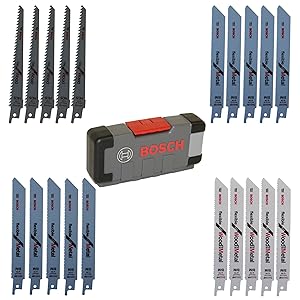
| Bosch Reciprocating Saw Blade Set | Mixed set | All-round — wood, metal, demolition | View on Amazon |
| Saxton 200mm Heavy Duty Metal Blades (10-Pack) | 10 | Metal cutting — thick steel, pipes | View on Amazon |
| Reciprocating Saw Blade Set (36-Piece) | 36 | Maximum value — wood, metal, plastic | View on Amazon |
As an Amazon Associate, we earn from qualifying purchases.
Related guides: Saw Blade Compatibility Guide | Saw Blade Types Guide | Compatibility Chart
How we compile this guide
We cross-reference compatibility details against manufacturer specifications where available, official tool manuals, and the physical standards that govern fitment (bore sizes, arbor diameters, voltage platforms, connector types). We prioritise primary sources over retailer listings, flag anything we can’t confirm, and re-verify the data on a regular cycle. Where we give a buying recommendation, we tell you the reasoning — not just the link. More on our method →