The cordless drill is the most commonly owned power tool in the world, and it’s often the first tool people buy when entering a battery platform. Choosing the right battery for your drill affects everything from comfort during overhead work to whether you can get through a full project on a single charge.
Get the free Power-Tool Battery Compatibility Handbook (PDF)
Which batteries fit which tools — cross-brand, adapters & Ah, decoded.

This guide covers the best battery pairings for cordless drills across Makita, DeWalt, and Milwaukee — whether you’re hanging shelves or drilling through steel.
Compare All Cordless Drills Batteries on Amazon
Why Battery Choice Matters for Drills
Drills sit in the middle of the power draw spectrum. They’re not as light as impact drivers, but they’re not as demanding as circular saws. What makes battery choice interesting for drills is weight balance — a drill with a massive battery feels front-heavy and tiring during extended use, especially overhead. For most drilling tasks, a mid-range battery is the perfect compromise.
Match your battery to the task — lightweight 2.0Ah packs for overhead and quick jobs, mid-range 4.0-5.0Ah for general use, and high-capacity 6.0Ah+ only for sustained heavy-duty applications.
Best Batteries by Brand
Makita 18V LXT Drills
- Light use (shelves, flat-pack, small holes): BL1820B (2.0Ah) — compact and light for comfortable one-handed drilling.
- General use (mixed drilling and driving): BL1830B (3.0Ah) — the kit-standard battery that covers most tasks.
- Heavy use (masonry with hammer mode, large hole saws): BL1850B (5.0Ah) — the extra capacity handles high-torque drilling without fading. See our BL1850B replacement guide.
Browse Makita 18V Batteries on Amazon
DeWalt 20V MAX Drills
- Light use: DCB203 (2.0Ah) — lightweight and well-balanced for the DCD series drills.
- General use: DCB204 (4.0Ah) — handles a full day of mixed drilling comfortably. See our DCB204 replacement guide.
- Heavy use: DCB205 (5.0Ah) — the professional standard for all-day drilling. See our DCB205 replacement guide.
Browse DeWalt 18V Batteries on Amazon
Milwaukee M18 Drills
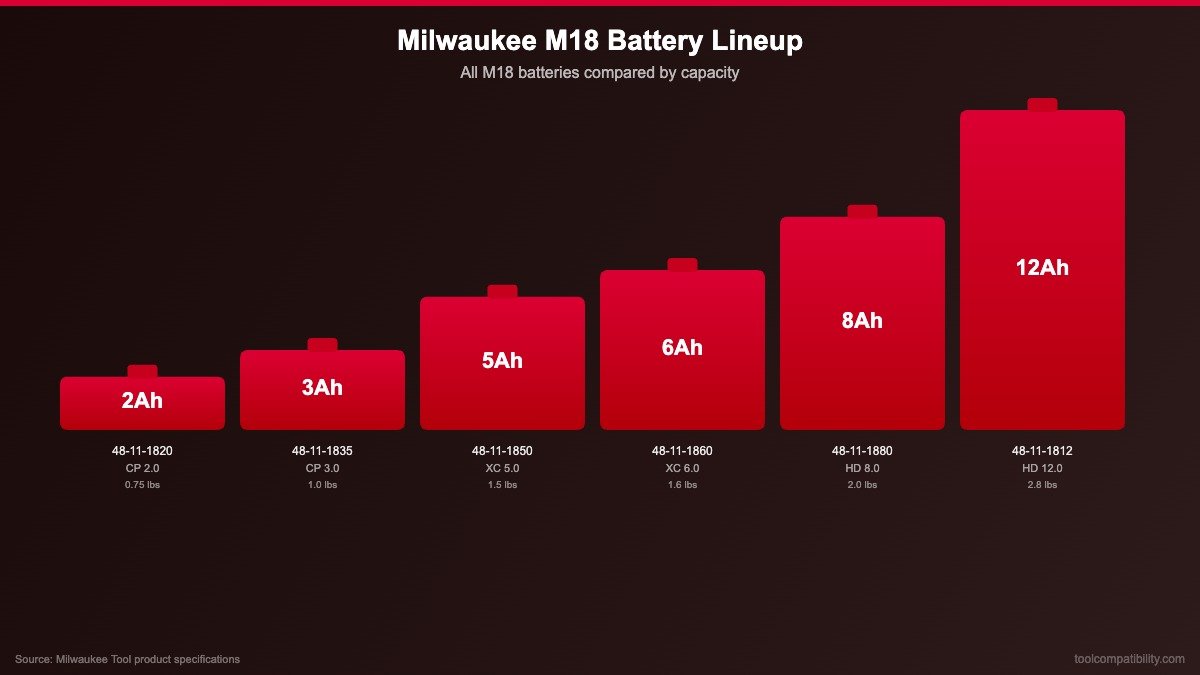
- Light use: 48-11-1820 (2.0Ah) — the compact pack designed for Milwaukee’s sub-compact drills.
- General use: 48-11-1850 (5.0Ah) — the default trade battery that pairs well with M18 FUEL drills. See our 48-11-1850 replacement guide.
- Heavy use: 48-11-1860 (6.0Ah) — for hole saws, auger bits, and all-day use. See our 48-11-1860 replacement guide.
Browse Milwaukee M18 Batteries on Amazon
Combi Drill vs Drill Driver — Does It Change the Recommendation?
Slightly. Combi drills (hammer drills) draw more power in hammer mode when drilling into masonry. If you regularly drill into brick or concrete, go one step higher in capacity than you would for a standard drill driver. For a drill driver used only in wood and metal, the lighter battery option will serve you well.
Our Top Pick
A 3.0Ah battery is the sweet spot for most cordless drill users. It provides enough runtime for a solid day of mixed drilling while keeping the tool comfortable to use, especially overhead. Step up to 5.0Ah if you run a combi drill in hammer mode regularly or use large-diameter bits.
Related Guides
- Best Battery for Impact Drivers (2026)
- Best Battery for Cordless Circular Saws (2026)
- Every Makita 18V LXT Battery Compared
- Every DeWalt 20V MAX Battery Compared
Watch: Video Guide
Frequently Asked Questions
Matching Battery Capacity to Drilling Tasks
Cordless drills are versatile tools used for everything from assembling flat-pack furniture to drilling through masonry. The ideal battery depends on your typical drilling and driving tasks.
Light assembly and home tasks: A 1.5-2.0Ah compact battery keeps your drill light and manoeuvrable. For hanging shelves, assembling furniture, or installing light fixtures, compact batteries provide more than enough runtime and make the drill comfortable to use one-handed.
General construction and renovation: A 3.0-5.0Ah battery suits most trade and serious DIY work. Drilling through studs, driving coach bolts, and boring holes for plumbing or electrical runs all benefit from the sustained current delivery that larger batteries provide.
Heavy drilling (masonry, metal, large holes): A 5.0Ah or higher battery is recommended for hammer drilling into concrete, boring large-diameter holes, or sustained metal drilling. These applications draw significantly more current than standard wood drilling, and higher-capacity batteries maintain consistent drill speed throughout.
Weight vs Runtime: Finding the Balance
Drill weight directly affects user fatigue and precision. A drill fitted with a 2.0Ah compact battery typically weighs 30-40% less than the same drill with a 6.0Ah pack. Over an 8-hour working day, this difference is significant.
Professional tradespeople often keep both compact and full-size batteries on hand: compact batteries for light driving and overhead work, and larger batteries for sustained drilling. This approach optimises both comfort and productivity.
If you can only buy one battery size, 4.0-5.0Ah is the sweet spot for most drill users. It provides adequate runtime for all but the most demanding all-day drilling while maintaining a reasonable overall tool weight.
What battery should I use for drilling into concrete?
For hammer drilling into concrete, use a 4.0Ah or larger battery from your platform. Hammer drilling draws heavy current and a small battery will deplete rapidly. Milwaukee M18 FUEL and DeWalt 20V MAX XR hammer drills paired with HIGH OUTPUT or POWERSTACK batteries respectively deliver the best concrete drilling performance in the 18V/20V class.
Is a compact battery OK for a cordless drill?
Yes — for most drilling tasks, a compact 1.5-2.0Ah battery is fine and keeps the drill lightweight and manoeuvrable. Compact batteries are ideal for overhead work, working in cabinets, and general-purpose drilling. Only step up to a larger battery for sustained drilling, large hole saws, or mixing applications.
Do I need a special battery for a brushless drill?
No. Brushless drills accept any battery from their platform. A brushless motor is simply more efficient than a brushed motor — it extracts more work from the same battery. This means a brushless drill will run longer on any given battery compared to a brushed equivalent, regardless of battery type or capacity.
Drill Battery Maintenance
To get the longest life from your drill batteries, store them at around 40–60% charge in a cool, dry location when not in use for extended periods. Avoid leaving batteries on the charger permanently after reaching full charge, as this can gradually reduce overall cell longevity. Most modern chargers include maintenance modes, but removing the battery once charged is still the best practice for long-term health.
How we compile this guide
We cross-reference compatibility details against manufacturer specifications where available, official tool manuals, and the physical standards that govern fitment (bore sizes, arbor diameters, voltage platforms, connector types). We prioritise primary sources over retailer listings, flag anything we can’t confirm, and re-verify the data on a regular cycle. Where we give a buying recommendation, we tell you the reasoning — not just the link. More on our method →
Recommended Batteries
As an Amazon Associate we earn from qualifying purchases. Check fitment & current price on Amazon (affiliate links).
Before you buy: check that the size, fitting/bore and maximum-rated speed marked on the accessory match what your tool’s manual specifies. We have not physically tested these products; listings are compiled from published specifications. These are affiliate links.