Cordless circular saws are among the heavier-drawing tools on a battery platform, so battery choice matters: too small a pack means frequent swapping mid-job.
Get the free Power-Tool Battery Compatibility Handbook (PDF)
Which batteries fit which tools — cross-brand, adapters & Ah, decoded.

This guide explains which batteries deliver the best results for cordless circular saws across Makita, DeWalt, and Milwaukee.
Compare All Circular Saws Batteries on Amazon
Why Battery Choice Matters More for Circular Saws
Unlike impact drivers that work in short bursts, circular saws run the blade continuously through the material, so a low-capacity pack empties quickly. We have no maker data on how blade speed changes as a pack runs down.
Match your battery to the task — lightweight 2.0Ah packs for overhead and quick jobs, mid-range 4.0-5.0Ah for general use, and high-capacity 6.0Ah+ only for sustained heavy-duty applications.
Best Batteries by Brand
Makita 18V LXT Circular Saws
- Minimum recommended: BL1840B (4.0Ah) — adequate for occasional cross-cuts in softwood.
- Best overall: BL1850B (5.0Ah) — the ideal balance of capacity and weight for regular use. See our BL1850B replacement guide.
- Maximum runtime: BL1860B (6.0Ah) — for sustained ripping or all-day site work. See our BL1860B replacement guide.
Browse Makita 18V Batteries on Amazon
DeWalt 20V MAX Circular Saws
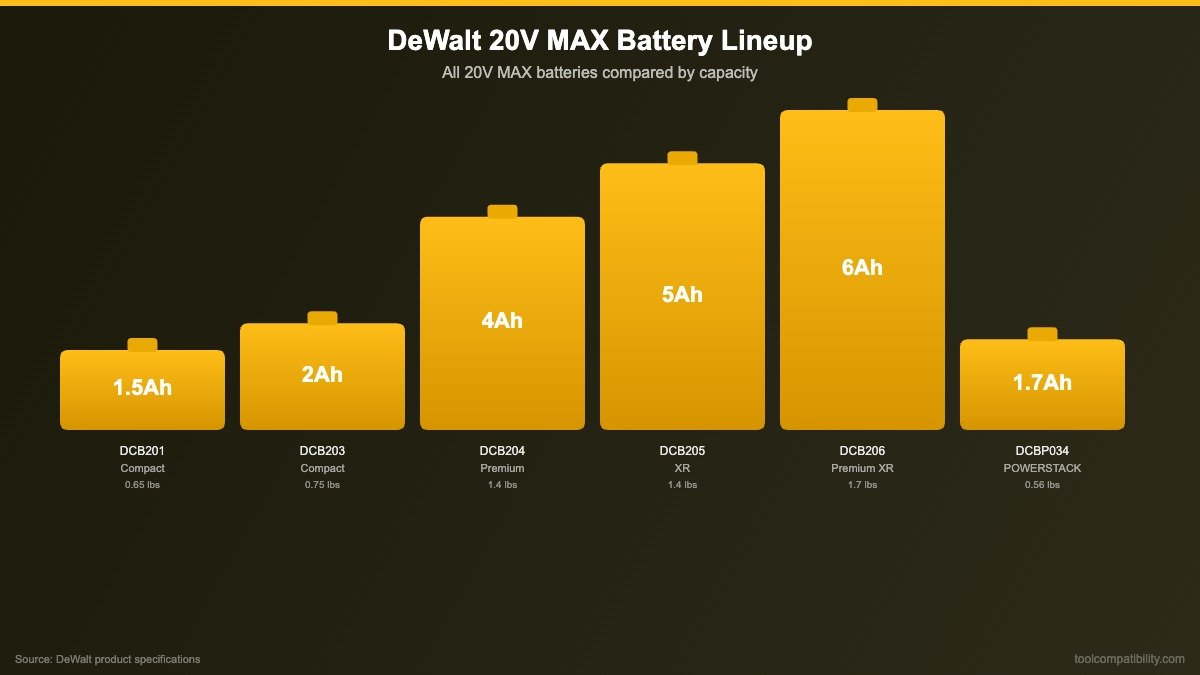
- Minimum recommended: DCB204 (4.0Ah) — fine for light cutting tasks.
- Best overall: DCB206 (6.0Ah) — gives you the runtime and sustained power for regular use. See our DCB206 replacement guide.
- Maximum runtime: DCB208 (8.0Ah) — for demanding jobsite cutting all day.
Browse DeWalt 18V Batteries on Amazon
Milwaukee M18 Circular Saws
- Minimum recommended: 48-11-1850 (5.0Ah) — the baseline for acceptable performance.
- Best overall: 48-11-1880 (8.0Ah High Output) — Milwaukee says its HIGH OUTPUT XC8.0 provides 50% more power and runs 50% cooler than its XC packs.
- Maximum runtime: 48-11-1812 (12.0Ah High Output) — for non-stop cutting on large projects.
Browse Milwaukee M18 Batteries on Amazon
Should You Use a High Output Battery?
It can help. Milwaukee says its HIGH OUTPUT packs provide 50% more power and run 50% cooler than its XC packs, and DeWalt claims “50% more power” for its POWERSTACK compact battery. We have not tested either in a circular saw. If your saw maker lists a HIGH OUTPUT or POWERSTACK pack for it, that is the upgrade to consider.
Our Top Pick
For circular saws, always go with the largest battery you can reasonably afford. A 5.0–6.0Ah pack is the practical minimum for regular use, and 8.0Ah or higher is ideal for professional jobsite work. Unlike lighter tools where weight balance matters, circular saws carry the battery low and the extra grams are barely noticeable.
Related Guides
- Every Makita 18V LXT Battery Compared
- Every DeWalt 20V MAX Battery Compared
- Every Milwaukee M18 Battery Compared
Watch: Video Guide
Frequently Asked Questions
Why Battery Choice Matters for Circular Saws
Circular saws are among the most power-hungry cordless tools available. They draw sustained high current during cuts, which means battery selection has a dramatic impact on both performance and runtime compared to lighter-duty tools like drills.
An undersized battery in a cordless circular saw drains quickly and means more swaps mid-job, especially in thicker or harder materials. Choosing a suitable capacity keeps interruptions down.
Recommended Capacity by Task
Sheet goods and trim work: A 4.0-5.0Ah battery handles occasional crosscuts in plywood, MDF, and softwood trim efficiently. The makers do not publish cut counts for these saw and battery pairs, and we have not tested them.
Framing and construction: A 5.0-6.0Ah battery provides the sustained current delivery needed for repeated rip cuts and crosscuts in dimensional lumber. Professional framers typically carry 2-3 batteries and rotate through them during a shift.
All-day professional use: The largest available batteries (8.0-12.0Ah depending on brand) maximise runtime for sustained cutting operations. They are heavier, and the makers do not publish runtime or cutting-speed comparisons for them.
If your platform offers a high-output pack (such as Milwaukee HIGH OUTPUT or DeWalt POWERSTACK), it is worth considering for a circular saw; Milwaukee, for example, says its HIGH OUTPUT packs provide 50% more power than its XC packs. We have not measured cut quality or cuts per charge.
What size battery should I use for a cordless circular saw?
A 5.0Ah or 6.0Ah battery is recommended for cordless circular saws. These tools draw significantly more power than drills or drivers, and a small battery will drain quickly under sustained cutting. For professional framing work, carry at least two large-capacity batteries to avoid downtime.
Can a cordless circular saw cut as well as a corded one?
We have not compared cordless and corded circular saws ourselves. The main practical difference is continuous duty: a corded saw runs indefinitely, while a battery saw needs periodic battery swaps during extended use.
Does battery voltage matter for circular saws?
Yes, voltage matters more for saws than for most other tools. Higher voltage means more available power under load. This is why DeWalt and Makita offer 60V and 40V circular saws respectively for demanding cuts. For general carpentry, an 18V/20V saw with a high-output battery performs well, but for ripping hardwood or cutting thick stock a higher-voltage platform may be worth considering; we have not compared them.
Circular Saw Battery Considerations
Circular saws are among the most power-hungry cordless tools in any workshop. Unlike drills or impact drivers that operate in short bursts, a circular saw draws sustained high current throughout every cut. This makes battery selection particularly important — not just for runtime, but for maintaining consistent blade speed under load.
When cutting dense hardwoods or thick sheet goods, a larger pack (5.0 Ah or more) means fewer swaps. We have no maker data on how pack size affects blade speed or cut quality. For professional use involving full sheets of plywood or framing timber, consider keeping two fully charged batteries on hand to avoid workflow interruptions.
How we compile this guide
We cross-reference compatibility details against manufacturer specifications where available, official tool manuals, and the physical standards that govern fitment (bore sizes, arbor diameters, voltage platforms, connector types). We prioritise primary sources over retailer listings, flag anything we can’t confirm, and re-verify the data on a regular cycle. Where we give a buying recommendation, we tell you the reasoning — not just the link. More on our method →
Starter packs by platform
As an Amazon Associate we earn from qualifying purchases. Genuine packs only; check the listing matches your platform before buying (affiliate links).
Before you buy: check that the size, fitting/bore and maximum-rated speed marked on the accessory match what your tool’s manual specifies. We have not physically tested these products; listings are compiled from published specifications. These are affiliate links.