Milwaukee M18 batteries don’t natively fit DeWalt 20V MAX tools — the connector shapes are completely different. However, third-party battery adapters exist that let you use your Milwaukee batteries in DeWalt tools (and vice versa). This guide covers how these adapters work, which ones are available, the safety risks involved, and whether they’re worth buying.
Browse Milwaukee M18 Batteries on Amazon
Check Cross-Brand Battery Adapters on Amazon
Short Answer
Yes, you can use Milwaukee M18 batteries in DeWalt 20V MAX tools with a third-party adapter. These adapters are widely available on Amazon and eBay for around $15–$30. However, they bypass built-in safety communication between battery and tool, void warranties on both sides, and are not endorsed by either Milwaukee or DeWalt.
How Do Milwaukee-to-DeWalt Battery Adapters Work?
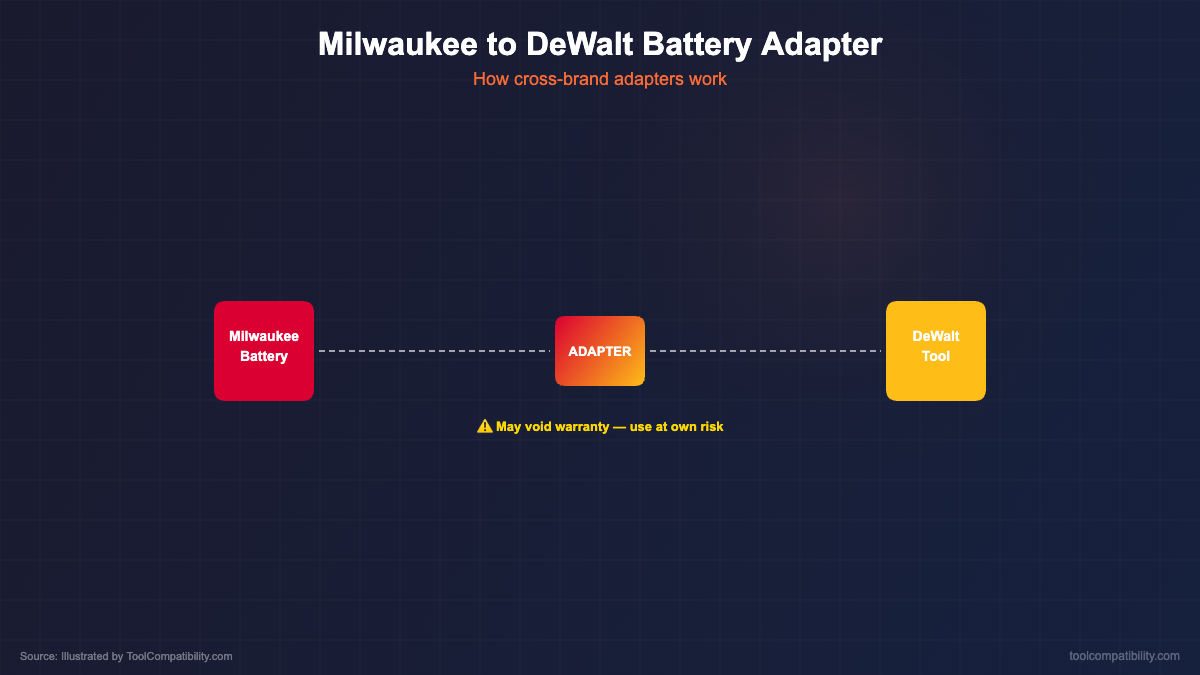
A battery adapter is a passive connector that bridges the gap between a Milwaukee M18 slide-on battery interface and a DeWalt 20V MAX battery slot. It has a Milwaukee-style receptacle on one end and a DeWalt-style connector on the other, routing power from the Milwaukee battery’s terminals to the corresponding terminals on the DeWalt tool.
The voltage is compatible: Milwaukee’s M18 batteries and DeWalt’s “20V MAX” batteries both operate at a nominal 18 volts. DeWalt’s “20V MAX” label refers to the peak unloaded voltage — the actual working voltage is the same 18V as Milwaukee. This means the power output is functionally identical.
Available Adapters
| Direction | What It Does | Typical Price | Where to Buy |
|---|---|---|---|
| Milwaukee M18 → DeWalt 20V | Use Milwaukee batteries in DeWalt tools | $15–$25 | Amazon, eBay, AliExpress |
| DeWalt 20V → Milwaukee M18 | Use DeWalt batteries in Milwaukee tools | $15–$25 | Amazon, eBay, AliExpress |
Recommended Batteries
As an Amazon Associate we earn from qualifying purchases. Check fitment & current price on Amazon (affiliate links).
Before you buy: check that the size, fitting/bore and maximum-rated speed marked on the accessory match what your tool’s manual specifies. We have not physically tested these products; listings are compiled from published specifications. These are affiliate links.
Get the free Power-Tool Battery Compatibility Handbook (PDF)
Which batteries fit which tools — cross-brand, adapters & Ah, decoded.
Popular adapter brands include MAKBOS (model MIL18DL), aikeec, NovaQuantic, Mellif, and Biswaye. The MAKBOS MIL18DL is one of the most popular options. Most adapters are passive — they bridge connectors without active electronics.
Safety Risks & Limitations
| Risk | Explanation |
|---|---|
| BMS communication bypass | Milwaukee and DeWalt batteries have onboard Battery Management Systems that communicate with their respective tools. Adapters bypass this — the tool cannot read the battery’s state, temperature, or charge level. |
| No automatic shutoff | Without BMS communication, the tool won’t shut off when the battery is depleted, risking over-discharge and permanent cell damage. |
| Overheating risk | High-draw tools can push the battery into thermal stress. Without temperature monitoring, there’s no protection. |
| Warranty void | Both Milwaukee and DeWalt exclude warranty coverage for damage caused by third-party accessories. |
| Not compatible with all batteries | Adapters typically don’t fit Milwaukee NiCad V18 batteries or work with tools that have enclosed battery compartments. |
| Not for HIGH OUTPUT tools | Milwaukee HIGH OUTPUT and FUEL tools that require high current draw are not recommended with adapters. |
When It Makes Sense to Use an Adapter
- You already own one brand and need a single tool from the other occasionally. If you’re a Milwaukee user who picked up a DeWalt tool at a sale, an adapter saves buying into a whole new battery platform.
- Low-power tools only. LED lights, radios, fans, inflators, and compact drills are safe candidates.
- Temporary or infrequent use. Occasional weekend use carries minimal risk. Daily professional use is a different calculation.
When You Should NOT Use an Adapter
- High-draw tools: Circular saws, angle grinders, SDS rotary hammers, reciprocating saws.
- Professional daily use: The warranty and safety risks outweigh the savings.
- Milwaukee FORGE or HIGH OUTPUT batteries on cheap adapters: These premium batteries deliver very high current and cheap adapters may not handle the load safely.
The Bottom Line
Milwaukee-to-DeWalt battery adapters work and are affordable. They’re a practical solution for occasional, light-duty cross-brand use. But they come with real trade-offs: bypassed safety systems, voided warranties, and potential battery damage. For anything beyond casual use, buying the correct battery for your tool is the safer long-term investment.
Related Guides
- Every DeWalt 20V MAX Battery Compared
- Every DeWalt 20V MAX Tool and Which Batteries Fit
- DeWalt 20V MAX Charger Compatibility Guide
- DeWalt POWERSTACK vs Standard Battery
- Every Milwaukee M18 Battery Compared
Video Guide
Frequently Asked Questions
The Bottom Line on Cross-Brand Use
While the idea of sharing batteries between Milwaukee and DeWalt tools is appealing, the risks outweigh the convenience for most users. Third-party adapters introduce points of failure, void warranties on both the tool and battery, and cannot replicate the sophisticated communication protocols that each brand builds into their ecosystem.
If you find yourself needing tools from both platforms, the most practical approach is to maintain separate battery collections for each. Both Milwaukee M18 and DeWalt 20V MAX offer comprehensive tool ranges, and investing in a few batteries for each platform is far safer than relying on adapters. Many professional tradespeople successfully run two platforms by keeping brand-specific batteries in clearly labelled bags or cases to avoid mix-ups on site.
For new tool purchases, consider which platform you already have more invested in and try to standardise where possible. Reducing the number of battery platforms you maintain simplifies your workflow and reduces overall battery costs.
Can I put a Milwaukee M18 battery on a DeWalt 20V MAX drill?
Only with a third-party adapter. Milwaukee M18 and DeWalt 20V MAX have different physical connections, but aftermarket adapters bridge this gap. Since both platforms use nominally 18V cells, the voltage match is close. However, neither manufacturer supports or recommends this approach.
Which direction do Milwaukee-DeWalt adapters work?
Adapters are directional — a “Milwaukee to DeWalt” adapter lets you use a Milwaukee battery in a DeWalt tool. A “DeWalt to Milwaukee” adapter does the reverse. Make sure you buy the correct direction for your needs. Each adapter only works one way.
Is it cheaper to buy an adapter or a new battery?
Adapters typically cost between $15-30, while a new battery costs $50-150 depending on capacity. If you only need occasional cross-platform use, an adapter saves money. But for regular use, buying a native battery is more reliable, safer, and performs better. Adapters are best viewed as a temporary or emergency solution.
How we compile this guide
We cross-reference compatibility details against manufacturer specifications where available, official tool manuals, and the physical standards that govern fitment (bore sizes, arbor diameters, voltage platforms, connector types). We prioritise primary sources over retailer listings, flag anything we can’t confirm, and re-verify the data on a regular cycle. Where we give a buying recommendation, we tell you the reasoning — not just the link. More on our method →