
What Drill Bit for Metal & Steel — Complete Guide
Drilling metal requires HSS (High-Speed Steel) bits for general work, or cobalt bits for stainless steel and hardened materials. The key difference from masonry or timber is lubrication—cutting oil or metal paste is essential. Without it, you’ll blunt a bit in a few holes and risk seizure in stainless steel.
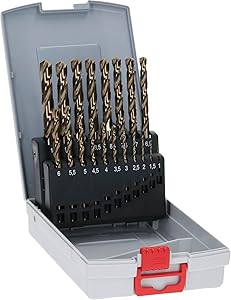
This guide covers which bit type to use, speeds, lubrication, pilot holes, and techniques for clean holes without bit breakage.
Drill Bit Types for Metal
HSS (High-Speed Steel)
What it is: A steel alloy containing tungsten, molybdenum, vanadium, and chromium. Retains hardness at high temperatures better than regular carbon steel.
Best for: Mild steel, aluminium, brass, copper, plastic, cast iron (soft grade).
Speed: 1000–3000 RPM depending on material. Faster for soft metals (aluminium, brass), slower for hard steel.
Cost: £0.20–£1.50 per bit. Budget-friendly.
Durability: Good in soft materials. Wears quickly in stainless steel and hardened steel if no cutting oil is used.
Why HSS works: The alloy stays hard enough at high temperatures to cut steel. Regular carbon steel would lose hardness.
Amazon: HSS drill bit sets on Amazon
Titanium-Coated HSS
What it is: Standard HSS bits with a thin titanium nitride (TiN) coating applied to the surface.
Best for: Same as HSS, but longer-lasting (especially useful on automated drilling or production runs).
Speed: 1000–3000 RPM (same as HSS).
Cost: £0.50–£3 per bit. More expensive than plain HSS, but lasts 2–3x longer.
Durability: Better than plain HSS. The coating resists wear and heat.
Limitation: The coating offers no advantage in stainless steel. Use cobalt instead.
Amazon: Titanium-coated HSS bits on Amazon
Cobalt (HSS-Co, typically 5–8% cobalt content)
What it is: HSS alloy with added cobalt. Cobalt makes the steel harder and able to withstand higher temperatures.
Best for: Stainless steel (304, 316), hardened steel, cast iron (hard), tool steel. This is the specialist bit for tough metals.
Speed: 600–1500 RPM. Slower than HSS because the material is harder, but cobalt tolerates the stress better.
Cost: £1–£4 per bit. 3–5x more expensive than HSS, but essential for stainless steel.
Durability: Exceptional in stainless steel. A cobalt bit will drill 5–10x more holes in stainless than HSS.
Why cobalt works: Stainless steel work-hardens rapidly (the more you drill, the harder the material becomes). Cobalt’s superior hardness resists this hardening and drills through without seizing.
Common grades: M35 (5–8% cobalt, general purpose), M42 (8% cobalt, premium, for the hardest materials).
Amazon: Cobalt drill bit sets on Amazon
Step Drill Bits (for sheet metal)
What they are: Bits that step down in size (2–3 mm increments) on a single flute. No centre point—they deburr as they drill.
Best for: Sheet metal, thin gauge steel, plastic sheets. They drill clean holes without burrs on entry or exit.
Speed: 1000–2000 RPM.
Cost: £1–£3 per bit (worth the investment for sheet metal work).
Advantage: One bit drills multiple sizes. Reduces hole deburring time.
Amazon: Step drill bits for sheet metal on Amazon
Cutting Oils and Lubrication
Why Cutting Oil Is Essential
Cutting oil serves three critical functions when drilling metal:
- Cooling: Drilling generates intense friction heat. Cutting oil cools the bit tip, preventing it from losing hardness (or in stainless steel, preventing seizure).
- Lubrication: Oil reduces friction between the bit flutes and the metal, allowing smoother cutting action.
- Chip clearance: Oil carries away fine metal chips (swarf), preventing them from re-cutting and jamming the hole.
Result: Without cutting oil, a new HSS bit will blunt in 2–5 holes on steel. With oil, the same bit can drill 50–100 holes. The difference is dramatic.
Types of Cutting Oil
Straight cutting oils (mineral oil-based): Pure oil, usually 30–50 viscosity. Best for manual drilling and intermittent use. Messy but effective.
Soluble oils (emulsions): Mix with water (typically 10:1 ratio). Less messy than straight oil, good cooling properties. Popular in industrial shops.
Cutting pastes/creams: Thick paste consistency. Stick to the hole location better than liquid oil. Good for vertical drilling (overhead work). No mess.
Aerosol spray (“WD-40” type): Convenient but not a true cutting oil. Works in a pinch for small holes on soft metals, but inadequate for serious steel drilling.
Tap water: In an emergency, will work. Not ideal, but better than nothing for mild steel or aluminium.
Application method: For manual drilling, apply oil directly to the hole or the bit flute before drilling. Re-apply every 5–10 holes. Use a rag or drip bottle—don’t oversaturate.
Amazon: Cutting oils and pastes on Amazon
Best Practice: Oil Types by Metal
| Metal Type | Best Oil | Tip |
|---|---|---|
| Mild steel | Cutting oil or tap water | Any oil works. Heavy-duty oil not necessary. |
| Stainless steel | Heavy-duty cutting oil or paste | Use liberal amounts. Stainless heat-seizure is the enemy. Apply frequently. |
| Aluminium | Cutting oil or soluble oil | Lighter oil OK. Aluminium is soft and cuts easily. |
| Brass, copper | Mineral cutting oil | Soft metals. Oil helps chip clearance. Not as critical as steel. |
| Cast iron | Light oil or cutting paste | Hard grades benefit from oil. Use moderate amounts. |
Recommended Drill Bit Sets
As an Amazon Associate we earn from qualifying purchases. Check fitment & current price on Amazon (affiliate links).
Before you buy: check that the size, fitting/bore and maximum-rated speed marked on the accessory match what your tool’s manual specifies. We have not physically tested these products; listings are compiled from published specifications. These are affiliate links.
Get the free Drill Bit & Wall-Plug Size Chart (PDF)
Every drill size, wall-plug colour & tap size on one printable sheet.
Speeds for Metal Drilling
The Speed Formula
Metal drilling speed depends on two factors:
- Material hardness: Harder metals require slower speeds.
- Hole size: Larger holes require slower speeds (because the outer edge of the bit moves faster).
| Material | 3–6mm Bit | 6–10mm Bit | 10–16mm Bit | 16mm+ Bit |
|---|---|---|---|---|
| Aluminium, brass (soft) | 2000–3000 RPM | 1500–2000 RPM | 1000–1500 RPM | 800–1200 RPM |
| Mild steel | 1500–2000 RPM | 1000–1500 RPM | 600–1000 RPM | 400–800 RPM |
| Stainless steel (HSS) | 800–1200 RPM | 600–1000 RPM | 400–800 RPM | 200–600 RPM |
| Stainless steel (Cobalt) | 1000–1500 RPM | 800–1200 RPM | 600–1000 RPM | 400–800 RPM |
| Hardened steel | 800–1200 RPM | 600–1000 RPM | 400–800 RPM | 300–600 RPM |
| Cast iron (hard) | 1200–1800 RPM | 800–1200 RPM | 600–1000 RPM | 400–800 RPM |
Key principle: Faster speeds are OK for small bits and soft metals. Slow down for large bits and hard metals. When in doubt, go slower—you risk dulling the bit if too fast, but won’t damage it if too slow.
Variable Speed Drills Are Important
A drill with variable speed control (trigger-sensitive or two-speed modes) is worth the investment for metal work. You can set precise speeds for each material type.
Single-speed drills (typically 1500–2000 RPM): Adequate for small bits in soft metals, but not ideal for larger bits or hard metals. You can only use full speed.
Pilot Holes and Technique
Why Pilot Holes Matter
Pilot hole: A small pre-drilled hole (typically 2–4mm) that guides the larger bit.
Benefits:
- Prevents the large bit from walking across the surface (the centre point of a large bit can slip sideways)
- Reduces torque reaction. A large bit can twist your wrist if it binds—a pilot hole reduces this risk
- Easier progression. Starting in a pilot hole is smoother than starting on a flat surface
- Cleaner holes. Less burring and better hole geometry
When to use pilot holes: Always recommended for holes 6mm and larger. For small holes (under 6mm), pilots are optional.
Pilot Hole Sizes
Rule of thumb: Pilot hole = 1/2 to 2/3 the diameter of the final hole.
Examples:
- For 10mm hole → 5–6mm pilot
- For 16mm hole → 8–10mm pilot
- For 20mm hole → 10–12mm pilot
Step-by-Step Metal Drilling Technique
Step 1: Mark the Hole
Use a pencil or marker. For precision work, use a centre punch (tap it with a hammer) to create a small indent. The indent helps the pilot bit start without walking.
Step 2: Apply Cutting Oil
Apply cutting oil to the hole location or to the drill bit flutes. A few drops is enough.
Step 3: Drill the Pilot Hole
Insert a small bit (2–4mm, HSS). Set speed appropriate for the bit size and metal type (see speed table above). Drill the pilot hole 1–2cm deep (or fully through the workpiece if thin).
Pressure: Light to medium. Let the bit cut—don’t force it.
Lubrication: If drilling stainless steel, reapply oil halfway through.
Step 4: Clear the Hole
Withdraw the pilot bit and brush away metal chips (swarf). Don’t let them accumulate in the hole.
Step 5: Drill the Final Hole
Insert the larger bit (your target size). Apply fresh cutting oil. Set speed for the new bit size and material.
Depth: If drilling through-and-through, go all the way. If drilling a blind hole (stopping short), measure or mark the depth on the bit with tape.
Pressure: Start gently. The pilot hole guides the large bit, so less pressure is needed. Maintain steady pressure as you progress.
Step 6: Approaching Breakthrough
If drilling all the way through: As the bit approaches the back surface, you’ll feel reduced resistance. Maintain even pressure. Once the tip breaks through, the flutes may suddenly engage and torque will increase. Use caution—a large bit breaking through can twist your wrist if you’re not prepared.
Technique: Once the point breaks through, immediately reduce pressure (almost no pressure), maintain speed, and let the flutes finish cutting the back rim. This prevents jamming.
Step 7: Withdraw Slowly
Once complete, slowly reduce pressure and withdraw the bit. Don’t jerk it out—a smooth, steady withdrawal prevents bit breakage.
Special Consideration: Stainless Steel Seizure
Work hardening: Stainless steel has a nasty property—the more you drill, the harder the material becomes. If you pause mid-drill and restart, the material has hardened and the bit may seize.
Prevention: Once you start drilling stainless steel, don’t stop and restart. Go all the way through in one continuous motion. If you must pause, do so for less than 5 seconds, or the bit will seize on restart.
If seizure happens: The bit will stop rotating and torque will spike. Release the trigger immediately. Let the motor stop. Gently wiggle the bit back and forth (very small movements) to break it free. Once free, reapply oil and continue at slightly lower speed.
Metal Drilling Problems and Solutions
Problem: Bit is dull after a few holes
Cause: No cutting oil, or oil dried out.
Solution: Apply cutting oil before every 5–10 holes. Without oil, metal drilling will blunt any bit rapidly. Use liberal amounts on stainless steel especially.
Problem: Bit seized in the hole and won’t come out
Cause: Stainless steel work-hardening (most likely), or the bit bound up on metal chips.
Solution: Release the trigger. Let the motor stop completely. Do NOT force the drill or bit. Gently wiggle the drill back and forth (very small movements) to work the bit free. Once free, reverse the drill and back it out slowly.
Prevention: Don’t pause and restart mid-drill on stainless steel. Drill continuously. Use cobalt bits (not HSS) for stainless.
Problem: Bit broke inside the workpiece
Cause: Usually a combination of: wrong speed (too fast), excessive pressure, or binding on chips.
Solution: Stop drilling. The broken piece may have to be carefully drilled out with a smaller bit, or extracted with a centre punch and hammer. Use more gentle technique next time.
Problem: Hole has rough, jagged edges (burrs) on entry or exit
Cause: Metal chips tearing at the surface as the bit engages or disengages.
Solution: Deburr the hole using a deburring tool, a countersink bit, or fine sandpaper. For prevention: use a pilot hole, maintain steady pressure, and withdraw the bit slowly once through.
Problem: Drill bit keeps slipping and spinning uselessly
Cause: Round-shank bit slipping in the keyless chuck, or the chuck isn’t tightened enough.
Solution: Tighten the chuck as hard as possible by hand (or use a chuck key if available). Check that the bit shank isn’t bent. If persistent, the chuck may be worn—consider replacing the drill or upgrading to a keyed chuck.
Problem: Bit is smoking or discolouring (turning blue)
Cause: Overheating from excessive speed, excessive pressure, or no cutting oil.
Solution: Stop immediately. Let the bit cool. Reduce speed, check that oil is applied, reduce pressure. If overheating has already occurred, the bit may be compromised (hardness lost)—replace it.
Choosing HSS vs. Cobalt
| Factor | HSS (Standard) | Cobalt (Premium) |
|---|---|---|
| Cost | £0.20–£1.50/bit | £1–£4/bit |
| Best for | Mild steel, aluminium, brass, soft metals | Stainless steel, hardened steel, tough metals |
| Speed capability | 1000–3000 RPM | 600–1500 RPM (slower but more powerful) |
| Durability in mild steel | Good (50–100 holes) | Excellent (100–200 holes) |
| Durability in stainless steel | Poor (2–5 holes before dulling) | Excellent (50–100 holes) |
| Lubrication dependency | Moderate (works OK with intermittent oil) | High (MUST use frequent oil, especially on stainless) |
| For home DIY | Adequate. Get a mixed set. | Overkill for occasional use, but worth it if drilling stainless regularly. |
| For professionals | Backup bits for soft metals | Primary choice for versatility and durability |
Recommendation: Homeowners → mixed HSS set. If you plan to drill stainless steel, buy a few cobalt bits separately. Professionals → invest in a good cobalt set (M35 or M42 grade) and a general HSS set as backup.
Watch: Video Guide
Frequently Asked Questions
Can I use masonry bits on metal?
No. Masonry bits are brittle tungsten carbide and will shatter on metal. They’re designed for masonry (brick, concrete) only. Always use HSS or cobalt for metal.
What’s the difference between M35 and M42 cobalt?
M35: 5% cobalt. Good all-purpose cobalt bit. Drills stainless and hardened steel well.
M42: 8% cobalt. Premium grade. Harder, stays sharper longer, handles the toughest materials. More expensive (£2–£5/bit).
For most work: M35 is excellent and costs less. Use M42 only for production work or extremely hard materials.
Can I drill stainless steel with HSS if I use lots of oil?
Partially. Abundant oil helps, but HSS will still dull rapidly in stainless steel. You’ll manage a few holes with heavy oiling, but cobalt is far superior. Stainless steel’s work-hardening property makes it very hard on HSS bits.
Why does my cordless drill feel like it’s going to twist my wrist?
Cause: Torque reaction. When a large bit suddenly engages or binds, the drill motor resists (tries to twist in your hands).
Solution: Use a pilot hole (reduces binding). Use steady, moderate pressure (not excessive). Be prepared for the twist reaction and grip firmly with both hands. Modern cordless drills have clutch settings—set lower torque for larger bits.
Is titanium coating worth buying?
For occasional home use: not critical. Plain HSS works fine with oil.
For regular work: yes. Titanium-coated HSS lasts 2–3x longer and justifies the extra cost.
For stainless steel: no. Titanium coating doesn’t help stainless steel drilling. Use cobalt instead.
What’s the best way to clear metal chips from a hole?
Withdraw the bit occasionally (every few seconds) and brush away chips with a small brush or cloth. Don’t let chips accumulate in the hole—they’ll re-cut and dull the bit faster. For deep holes, periodically clear the chips completely.
Related Drill Bit Guides
- Drill bit compatibility guide (all shank types)
- What drill bit for stainless steel (detailed)
- What drill bit for brick and masonry
- What drill bit for concrete
How we compile this guide
We cross-reference compatibility details against manufacturer specifications where available, official tool manuals, and the physical standards that govern fitment (bore sizes, arbor diameters, voltage platforms, connector types). We prioritise primary sources over retailer listings, flag anything we can’t confirm, and re-verify the data on a regular cycle. Where we give a buying recommendation, we tell you the reasoning — not just the link. More on our method →