Walk into a toolshop and you’ll see three main types of metal drill bits on the shelf: plain HSS, cobalt, and titanium-coated. They all cost different amounts, they all look slightly different (gold coating, for instance), and choosing the wrong one can mean dulled bits, broken drills, and wasted time.
This guide explains what each type is made from, why that matters, and which one to buy for your specific job.
HSS vs Cobalt vs Titanium — Quick Comparison
| Type | Material | Best For | Hardness | Heat Resistance | Can Resharpen? | Price Per Bit |
|---|---|---|---|---|---|---|
| HSS (M2) | High-speed steel | General metal, wood, soft materials | Medium | ~600°C | Yes | £0.30–0.80 |
| Cobalt (M35) | HSS + 5% cobalt | Stainless steel, hardened steel, cast iron | High | ~800°C | Yes | £1.50–3.00 |
| Cobalt (M42) | HSS + 8% cobalt | Extremely hard materials, continuous cutting | Very high | ~900°C | Yes | £2.50–5.00 |
| Titanium Nitride (TiN) | HSS core + gold coating | Production work, mixed materials, general trade | Very high (coating) | ~800°C | No (coating lost when sharpening) | £0.80–1.80 |
| Titanium Carbonitride (TiCN) | HSS core + darker coating | Hard metals, abrasive materials | Extremely high (coating) | ~900°C | No | £1.50–2.80 |
| Black Oxide | HSS core + oxide coating | General use, light production | Medium | ~600°C | No | £0.50–1.20 |
Recommended Drill Bit Sets
As an Amazon Associate we earn from qualifying purchases. Check fitment & current price on Amazon (affiliate links).
Before you buy: check that the size, fitting/bore and maximum-rated speed marked on the accessory match what your tool’s manual specifies. We have not physically tested these products; listings are compiled from published specifications. These are affiliate links.
Get the free Drill Bit & Wall-Plug Size Chart (PDF)
Every drill size, wall-plug colour & tap size on one printable sheet.
HSS (High-Speed Steel) — The Standard
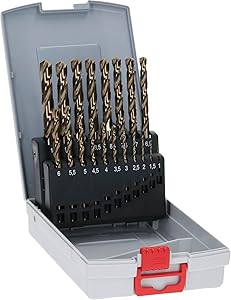
HSS is the most common drill bit material. It’s an alloy of iron, tungsten, molybdenum, chromium, and vanadium—designed to stay hard even when hot. The most common grade is M2, which is universal and cheap.
HSS Advantages
- Cheap: Often the least expensive option, especially in bulk
- Versatile: Works on steel, aluminium, brass, wood, plastic, cast iron
- Sharpenable: Dull HSS bits can be resharpened on a grindstone and used again
- Forgiving: Won’t break easily if you hit a hard spot or pause mid-drilling
- Available: Every toolshop stocks HSS; widest range of sizes
HSS Disadvantages
- Dulls quickly: In hard materials (stainless, hardened steel), HSS dulls rapidly and loses efficiency
- Heat sensitive: Loses hardness above ~600°C; prolonged high-speed drilling can soften the cutting edges
- Low production output: If you’re drilling 100+ holes in tough material, HSS will slow you down
When to Use HSS
- DIY projects (hanging shelves, light drilling)
- Mixed materials (wood, plastic, soft metals)
- One-off jobs where you drill a few holes then put the bits away
- Budget toolkits for occasional use
Buy HSS drill bit sets on Amazon.
Cobalt Steel — The Hard Material Specialist
Cobalt drill bits are HSS cores with 5–8% cobalt alloyed in. Cobalt is an extremely hard element that allows the alloy to maintain its hardness at higher temperatures and resist dulling in tough materials.
Two Cobalt Grades
- M35 (5% cobalt): The more common grade. Good balance of hardness and cost.
- M42 (8% cobalt): Premium grade. Harder and more heat-resistant, but more expensive and more brittle (can snap if you’re careless).
Cobalt Advantages
- Hard materials: Cobalt tears through stainless steel, hardened steel, and cast iron where HSS would dull instantly
- Temperature: Stays hard up to ~800°C, so rapid drilling doesn’t soften the edges
- Production rate: Drill more holes before the bit dulls; saves time on large jobs
- Sharpenable: Like HSS, cobalt bits can be ground and resharpened
- Worth the cost: On a job requiring 50+ stainless steel holes, cobalt saves more in time and frustration than it costs
Cobalt Disadvantages
- More expensive: M35 cobalt costs 3–5x more than HSS; M42 costs even more
- Brittle: Cobalt is harder but more fragile. Drop it or hit a hard spot and it can snap, especially M42
- Overkill for soft materials: In wood or soft metals, cobalt is wasted—HSS does the job equally well
- Requires care: Faster bit changes, careful handling, coolant use (for metals)
When to Use Cobalt
- Stainless steel fasteners, shafts, or appliance parts
- Hardened or temperedsteel (springs, tools, bearings)
- Cast iron engine blocks or manifolds
- Production jobs where you’re drilling many holes in tough material
- Jobs where a dull bit costs you more time than the bit cost difference
Buy cobalt drill bit sets on Amazon.
Titanium Nitride Coated (TiN) — The Workhorse
Titanium Nitride (TiN) is not a pure material—it’s a coating. You start with an HSS core and apply a thin (2–4 micron) layer of titanium nitride to the surface. This gives you the sharp, fast-cutting HSS core with a harder, lower-friction surface.
How TiN Works
- Lower friction: The coating reduces heat generated during drilling. Less heat = less dulling, especially in production work
- Surface hardness: The gold-coloured coating is harder than bare HSS, so edges stay sharper longer
- HSS core: If the coating gets damaged, you still have a functional (though less efficient) HSS bit underneath
TiN Advantages
- Great middle ground: More durable than plain HSS, much cheaper than cobalt
- Fast production: For drilling 20–50 holes in mild steel, TiN is ideal. Faster than HSS, cheaper than cobalt.
- Mixed materials: Works well on brass, aluminium, cast iron, and mild steel in one kit
- Longer life: Lasts 2–3x longer than plain HSS in most applications
- Visible when dull: The gold coating wears, so you can see when it’s time to replace the bit
TiN Disadvantages
- Cannot be resharpened: Once the coating is worn, you can’t grind it sharp again—sharpening removes the coating
- Not for stainless steel: The coating doesn’t hold up well in rapid stainless steel drilling; cobalt is better
- Disposable once dulled: When a TiN bit dulls, you throw it away or use it for non-critical work
When to Use TiN
- Trade/production work in mild steel
- Repeated drilling in aluminium or brass
- Jobs where you drill 10–50 holes and want bits to last longer than HSS
- Mixed-material kits where you can’t predict the substrate
- Budget-conscious professionals who want a balance between cost and performance
Buy titanium-coated drill bit sets on Amazon.
Titanium Carbonitride (TiCN) — The Premium Coating
TiCN is a harder, tougher coating than basic TiN. It has a darker (grey-blue) appearance and is used on high-end production bits.
Key differences:
- Harder than TiN: Stays sharp longer, especially in abrasive materials (cast iron, composites)
- Higher temperature: Coating holds up to ~900°C, so rapid drilling in hard materials doesn’t degrade it as fast
- Thicker: Some TiCN coatings are applied thicker than TiN, which adds durability
- Cost: More expensive than TiN but often still cheaper than cobalt
- Cannot resharpen: Like TiN, once dulled, it’s disposable
When to Use TiCN
- Abrasive materials (cast iron, composite materials, hardened plastics)
- High-production drilling where coating durability is critical
- Hard-anodised aluminium or stainless steel in production volumes
- Jobs where you want TiN’s convenience but need extra toughness
Black Oxide Coating — The Budget Option
Black oxide is a cheaper, thinner coating than TiN. It offers mild corrosion resistance and a slight friction reduction, but doesn’t significantly extend bit life compared to bare HSS.
Use black oxide for:
- Budget home toolkits
- Light-duty work (drilling wood, plastic, soft metals)
- Short-term jobs where cost matters more than longevity
Black oxide is basically a cosmetic upgrade to HSS—it looks professional but doesn’t perform dramatically better. Skip it unless you find a significantly cheaper kit.
Carbide Drill Bits — Special Application
This guide focuses on steel-based bits, but it’s worth knowing about carbide bits. Carbide (tungsten carbide) is a ceramic composite that’s extremely hard but also brittle. It’s used for:
- Drilling very hard materials (stone, tile, glass, hardened concrete)
- CNC production at high speeds
- Drilling printed circuit boards and other precision work
Carbide bits are expensive, fragile, and require special handling. Unless you’re doing specialist work, stick with steel-based bits. See our guide on SDS Plus vs SDS Max for masonry drilling.
Quick Decision Chart
| Your Job | Best Choice | Reason |
|---|---|---|
| DIY shelf on the wall | HSS (M2) | Cheap, one-off use, don’t need longevity |
| Drilling mild steel production (20+ holes) | TiN coated HSS | Best value for repeated work; lasts longer than HSS |
| Stainless steel fasteners (5–10 holes) | Cobalt (M35) | HSS/TiN would dull instantly; cobalt stays sharp |
| Stainless steel production (50+ holes) | Cobalt (M42) | Extra hardness pays for itself in time saved |
| Cast iron engine work | Cobalt or TiCN | Abrasive material; need cutting edge durability |
| Mixed materials (wood, plastic, soft metals) | TiN or HSS | No single material is hard; TiN lasts longer for small cost premium |
| Budget home toolkit | HSS (M2) | Versatile, sharpenenable, cheap bulk sets available |
Coolant and Feed Rate — Extending Bit Life
No matter which bit you choose, using coolant dramatically extends the life of any steel bit:
- In steel/stainless: Use light machine oil or dedicated cutting fluid. Reduces heat, speeds up drilling, improves finish.
- In cast iron: Dry or very light oil works. Cast iron generates chips that naturally help cool.
- In aluminium: Use light oil or WD-40. Dry drilling in alu clogs the chips and dulls the bit.
Feed rate matters too. Push hard enough that chips eject cleanly, but not so hard that you break the bit. Let the bit do the work; drilling at high speed with low feed is better than high pressure at low speed.
Building Your Drill Bit Toolkit
Most professionals have bits in every category:
- Basic HSS set: 1–13mm, for everyday rough work and wood
- Cobalt subset: 2–10mm, for stainless and hardened steel jobs
- TiN coated set: 1–13mm, for production mild steel work
If you’re buying one toolkit first, start with HSS. It’s the most versatile and cheapest. As your work demands grow, add cobalt and TiN bits for specific tasks.
Watch: Video Guide
Frequently Asked Questions
Can you resharpen cobalt drill bits?
Yes. Unlike coated bits (TiN, TiCN), cobalt is a solid material. You can grind the cutting edges sharp again on a grindstone. The bit loses none of its core performance after sharpening.
Why do titanium bits lose their coating when sharpened?
The coating is applied to the surface (2–4 microns thick). When you grind the cutting edges on a grindstone, the grinding angle passes through the thin coating layer, removing it. The underlying HSS is now exposed—still functional but without the coating’s friction reduction and hardness boost. It’s why TiN bits are typically disposable once dulled.
Is cobalt better than titanium coating?
For stainless steel and hardened materials, yes—cobalt is harder and more heat-resistant. For general mild steel production, TiN is often the better choice (cheaper, lasts plenty long). For cast iron or abrasive materials, TiCN can outperform basic cobalt. Context matters.
What’s the difference between M35 and M42 cobalt?
M35 has 5% cobalt; M42 has 8%. M42 is harder and more heat-resistant but also more brittle. For general metalworking, M35 is the sweet spot. Use M42 only if you need the extra hardness for very tough materials or production volume.
Can you use HSS bits in stainless steel?
Yes, but they’ll dull very quickly—often after just 5–10 holes in hard stainless. You’re better off buying cobalt for stainless work; the time saved is worth the cost difference.
Do expensive drill bits actually last longer?
Yes, measurably so. Premium cobalt or TiCN bits last 2–5x longer than cheap HSS in their intended applications. The payback depends on your drilling volume. For home DIY (few holes), cheap bits are fine. For trade work (many holes), premium bits save money overall.
What’s the best all-purpose drill bit?
TiN-coated HSS in the 1–13mm range. It works on wood, soft metals, mild steel, and plastic. It’s cheap, versatile, and lasts longer than plain HSS. It’s not the best for any single material, but it’s the best compromise if you drill mixed materials.
How we compile this guide
We cross-reference compatibility details against manufacturer specifications where available, official tool manuals, and the physical standards that govern fitment (bore sizes, arbor diameters, voltage platforms, connector types). We prioritise primary sources over retailer listings, flag anything we can’t confirm, and re-verify the data on a regular cycle. Where we give a buying recommendation, we tell you the reasoning — not just the link. More on our method →