Sanding discs come in two attachment systems: hook-and-loop (Velcro-style) and PSA (pressure-sensitive adhesive). Most UK tradespeople use hook-and-loop because it’s reusable, affordable, and reliable. But PSA has its place — wet sanding, profile sanders, and some industrial applications. The critical thing is knowing which type your sander uses, because mixing the two is a false economy that wastes money and damages equipment.
This guide breaks down the differences between the two systems, explains the cost model behind each one, and shows you which to choose based on your work type and budget.
What Is Hook-and-Loop Backing?
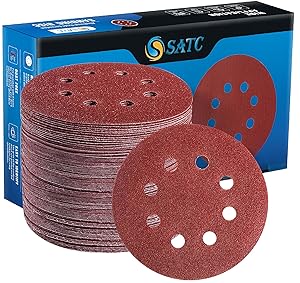
Hook-and-loop (commonly called Velcro) works like its namesake fabric fastener. The backing plate on your sander has a fuzzy adhesive loop layer bonded to it. The sanding disc has tiny hook fibres on its back that grip those loops mechanically. When you press the disc onto the plate, the hooks and loops interlock; when you pull it off, they release cleanly without leaving adhesive residue.
The advantages are substantial:
- Reusable: The backing plate lasts for years (typically 3–5 years of regular trade use). Once worn, it’s a simple replacement (£15–60 depending on brand).
- Quick changes: You can swap grits in 5 seconds — peel off one disc, slap on the next. No scraping, no solvents, no downtime.
- No residue: Unlike PSA, there’s no sticky buildup on the plate or disc.
- Cost-effective: Hook-and-loop discs cost roughly £0.40–£1.50 per pad depending on grit and brand. Over a working lifetime, this is significantly cheaper than PSA.
- Grip is forgiving: Minor dust or debris on the disc back won’t prevent adhesion the way PSA backing would.
The main limitation is that once the backing plate’s loop layer becomes matted or flattened (from repeated use or heat), it loses grip and discs will slip. When this happens, the entire backing plate must be replaced — you can’t rejuvenate it.
What Is PSA Backing?
PSA (pressure-sensitive adhesive) is a permanent sticky coating on the sanding disc back that bonds directly to the flat metal backing plate of your sander. There’s no mechanical interlock — the disc is glued on. Once stuck, it stays stuck until deliberately removed.
Key characteristics:
- One-time use: Once a PSA disc is applied to a backing plate, it’s meant to stay there until the abrasive wears out. Removing it before then leaves adhesive residue that’s messy to clean.
- Permanent bond: PSA discs provide maximum grip under extreme load — no risk of slipping or shifting.
- Lower cost per disc: PSA discs are slightly cheaper than hook-and-loop discs (typically £0.30–£1.20), but you’re buying a single-use product.
- Simpler backing plate: A PSA backing plate is just flat metal — no loop layer to wear out. In theory, it lasts indefinitely.
- No backing plate waste: You don’t replace backing plates on PSA sanders, so there’s less hardware waste over time.
The downsides are significant for most UK tradespeople:
- Removal is messy: Peeling off a PSA disc prematurely (e.g., if you’ve used the wrong grit or the disc is damaged) leaves behind sticky residue. You’ll need goo remover or acetone to clean the plate. This takes 10–30 minutes.
- Grit changes are slow: If you’re working with multiple grits in one job, you can’t quickly swap. Each disc change means waiting for the new disc to set and removing sticky residue from the old one.
- Committed to one abrasive: Once a PSA disc is stuck on, you’re using it until it’s worn out, even if you’d prefer to switch grits mid-job.
- Over a jobsite lifespan, more expensive: A PSA disc might cost £0.20 less than a hook-and-loop disc, but if you go through 50 discs in a year, that’s only £10 savings. The hassle of multiple removal/adhesive cleanup cycles costs far more in labour time.
Head-to-Head Comparison Table
| Factor | Hook-and-Loop | PSA |
|---|---|---|
| Attachment Type | Mechanical (hooks grip loops) | Chemical (adhesive bonds to metal) |
| Cost per Disc | £0.40–£1.50 | £0.30–£1.20 |
| Reusable? | Yes, until backing plate wears | One-time use |
| Backing Plate Life | 3–5 years (then replaced) | Indefinite (metal doesn’t wear) |
| Backing Plate Cost | £15–£60 (replacement every 3–5 years) | £0 (never needs replacing) |
| Grit Change Time | 5 seconds (peel off, stick on new) | 10–30 minutes (peel, clean residue, apply new) |
| Slip Under Load? | Possible if backing is worn | No — permanent bond |
| Clean-up | Zero residue; simple peel-off | Sticky residue requires solvent and scraping |
| Dust Interference | Forgiving; dust won’t prevent adhesion | Sticky residue traps dust; messy |
| Heat Tolerance | Good; loop layer rated to ~70°C | Excellent; adhesive rated to 80°C+ |
| Best For | General trade use, multiple grits, frequent changes | Dedicated applications, single grit per session, wet sanding |
Recommended Sanding Discs & Pads
As an Amazon Associate we earn from qualifying purchases. Check fitment & current price on Amazon (affiliate links).
Before you buy: check that the size, fitting/bore and maximum-rated speed marked on the accessory match what your tool’s manual specifies. We have not physically tested these products; listings are compiled from published specifications. These are affiliate links.
Get the free Angle Grinder Disc & Safety Sheet (PDF)
The right disc for every job, plus the RPM checks that keep you safe.
Which Brands Use Which System?
Hook-and-Loop Dominates the UK Market
The vast majority of UK orbital sanders — Makita, DeWalt, Bosch, Festool, Ryobi — use hook-and-loop backing. This is the default for trade and DIY machines because it’s faster to swap grits, cheaper overall, and easier to maintain.
If you own a standard orbital sander from any major UK brand, it almost certainly uses hook-and-loop.
PSA Is Specialised
Bosch PEX series (some models) offer PSA backing as an option. Certain industrial sanders and specialist woodworking machines use PSA. Wet sanders and profile sanders often use PSA because the application demands a permanent, slip-proof bond.
If your sander manual doesn’t mention PSA explicitly, it’s using hook-and-loop. Check the backing plate — hook-and-loop will feel fuzzy when clean; PSA backing plate is just smooth metal.
Can You Convert Between Systems?
Theoretically, conversion pads exist. A “PSA-to-hook-and-loop” adapter pad has a hook-and-loop backing on one side and a PSA adhesive on the other, allowing you to stick a PSA disc to a hook-and-loop backing plate.
In practice, conversion pads are not recommended. Here’s why:
- Unreliable bond: A conversion pad adds an extra layer between the disc and the backing. This reduces grip reliability, especially under high load.
- Easy to forget the adapter: You’ll forget to remove the conversion pad before swapping to another disc, and it will jam in your sander.
- Not cost-effective: A conversion pad costs £5–15, and you only save £0.20–0.30 per PSA disc. It’s not worth the hassle.
- Limited availability: Most UK tool shops don’t stock conversion pads; you’d have to order online.
Better solution: Stick with the backing type your sander was designed for. If you need to use a different disc type occasionally, buy an inexpensive second backing plate for your sander (typically £15–40) rather than fiddling with converters.
Cost Analysis: Hook-and-Loop vs PSA Over Time
Let’s work through a real-world scenario for a UK chippy or joiner working ~250 days per year.
Hook-and-Loop Scenario: 5 Discs per Day, Multiple Grits
Daily disc cost: 5 discs × £0.80 = £4.00
Annual disc cost: £4.00 × 250 days = £1,000
Backing plate replacement (once every 4 years): £40 ÷ 4 = £10 per year
Total annual cost: ~£1,010
PSA Scenario: 5 Discs per Day, One Grit per Session
Daily disc cost: 5 discs × £0.70 = £3.50
Annual disc cost: £3.50 × 250 days = £875
Cleaning supplies (acetone, scrapers, labour): estimated £100 per year
Backing plate: never replaced (£0)
Total annual cost: ~£975
On paper, PSA is £35 cheaper per year. But this assumes no grit changes mid-job and no accidents. If you change grits more than twice per day on average, hook-and-loop pulls ahead.
The real cost of PSA is time and frustration. Cleaning up sticky residue is tedious, slow work. For most UK tradespeople, the mental energy savings of hook-and-loop (quick peels, no solvents, no mess) justify the marginal extra cost.
Which Should You Choose?
Choose Hook-and-Loop If:
- You change grits multiple times per day (e.g., rough sand → medium sand → fine sand).
- You do general carpentry, joinery, or construction work (the default UK trade use case).
- You want minimal downtime between disc changes.
- You value simplicity and low maintenance.
- You’re building a toolkit and want to future-proof your sander choice.
Recommendation: If you’re buying a new orbital sander for trade use, buy hook-and-loop. It’s the UK default for good reason.
Choose PSA If:
- You’re working with water (wet sanding profiles, edge banding).
- You commit to a single grit for an entire session or day.
- You need maximum grip under extreme load and are willing to accept slow grit changes as a trade-off.
- You’re equipping a dedicated specialist tool (e.g., a dedicated wet sanding station).
- Your sander came with PSA backing from the factory and you’re making the best of it.
Recommendation: If you already own a PSA-backed sander, use PSA discs. Don’t convert to hook-and-loop unless you’re willing to replace the backing plate.
Maintenance Tips for Both Systems
Hook-and-Loop Backing Plate Care
- Keep it clean: Dust buildup clogs the hooks. Brush the backing plate gently with an old toothbrush every few days to restore grip.
- Don’t get it wet: If you accidentally expose the backing plate to water, let it dry completely (2–4 hours) before reusing.
- Replace when flat: When the backing feels smooth and slippery instead of fuzzy, it’s time for a replacement. Don’t wait — slipping discs are a safety risk.
- Store it clean: Keep your backing plate protected from dust and moisture when not in use.
PSA Backing Plate Care
- Keep it residue-free: After removing a disc, use a plastic scraper to remove any residual adhesive. A clean plate ensures the next disc bonds properly.
- Use goo remover for stubborn residue: If adhesive buildup is thick, apply goo remover (like Goof Off) and scrape gently.
- Test adhesion before heavy work: Press the new disc firmly onto the plate for 30 seconds to ensure a solid bond before starting the sander.
- Never sand with a loose disc: If a PSA disc starts to peel during use, stop immediately and reapply pressure or swap the disc.
Related Guides on This Site
- Sander Pad Compatibility Guide — Full breakdown of all compatibility factors
- 125mm vs 150mm Sander Pads — Size selection guide
- Sander Pad Hole Pattern Guide — Dust extraction patterns explained
- Best Sander Pads for Wood, Metal and Plaster — Material selection and grit choice
Watch: Video Guide
Frequently Asked Questions
Can I stick a PSA disc onto a hook-and-loop backing plate?
You can use a conversion pad, but it’s not recommended. Conversion pads are bulky, unreliable, and not cost-effective. If you regularly need PSA discs, buy a second sander with PSA backing or replace your hook-and-loop backing plate instead.
Why does my hook-and-loop backing plate feel flat and slippery?
The loop layer is matted from use and heat. This is normal wear. Try brushing it gently with an old toothbrush to restore some grip. If that doesn’t work, the backing plate needs replacement (typically £15–60 depending on brand).
Can I use PSA discs on a hook-and-loop backing plate without a converter?
Not effectively. The PSA adhesive won’t bond to the fuzzy hook layer; it will slip or peel off under load. You’d need either a conversion pad or a flat PSA-compatible backing plate.
Is PSA disc adhesive the same as spray adhesive or contact cement?
No. PSA adhesive is specifically formulated for sanding discs. It’s rated for sustained temperature, won’t outgas, and maintains grip over months of storage. Spray adhesive or contact cement will cure differently, won’t hold reliably, and can degrade the disc backing. Always use disc-specific adhesive if replacing a PSA backing.
How long does a hook-and-loop backing plate actually last?
On average, 3–5 years of regular trade use (5+ days per week). DIY use or hobby use might stretch it to 7–10 years. Once the hook layer is flat, replacement is the only fix. There’s no way to rejuvenate a worn backing plate.
Which system is safer for overhead work?
Hook-and-loop, because you can quickly swap out a disc if it’s slipping or overheating. PSA discs are “stuck” — if something goes wrong mid-job, you can’t instantly change the disc. That said, neither system is inherently unsafe if the backing plate is in good condition and the disc is matched correctly.
How we compile this guide
We cross-reference compatibility details against manufacturer specifications where available, official tool manuals, and the physical standards that govern fitment (bore sizes, arbor diameters, voltage platforms, connector types). We prioritise primary sources over retailer listings, flag anything we can’t confirm, and re-verify the data on a regular cycle. Where we give a buying recommendation, we tell you the reasoning — not just the link. More on our method →