What Is TPI and Why It Matters
TPI stands for Teeth Per Inch — the count of blade teeth along one inch. It’s the single most critical number when choosing a jigsaw blade because it determines how fast the blade cuts and how smooth the finish will be.
Think of it this way: more teeth per inch means more cutting edges making contact with the material per second, which produces a finer finish and less splintering. Fewer teeth per inch means each tooth removes more material per pass, cutting faster but leaving a rougher surface.
Getting the TPI right transforms a struggling, jamming cut into a smooth, efficient one. Using the wrong TPI is the most common reason tradspeople blame their jigsaw when the real problem is the blade.
How TPI Affects Cutting Speed vs Finish Quality
Low TPI (6–10 teeth per inch) — Each tooth is spaced further apart, so each tooth removes a larger chunk of material. The blade cuts fast, making it ideal for demolition work, rough cuts, or thick softwood where speed matters more than finish.
Mid-Range TPI (10–14 teeth per inch) — A balanced compromise. Cuts reasonably fast while producing an acceptable finish for general-purpose work. This is the “default” setting for most tradespeople — if you’re unsure, start here.
High TPI (18–24+ teeth per inch) — Very fine teeth make many small cuts rather than few large ones. This produces the smoothest possible finish and is essential for thin materials, metal, and laminate where a rough finish would ruin the work.
The trade-off:** Higher TPI takes more time to complete a cut because the blade is working harder and cooler. Lower TPI is faster but produces a rougher finish and generates more heat.
TPI by Material: Complete Reference Table
| Material | Thickness | Ideal TPI | Blade Type | Speed (relative) | Finish Quality |
|---|---|---|---|---|---|
| Softwood (pine, fir) | 25–50 mm | 6–8 | HCS | Fast | Rough (acceptable for structural) |
| Hardwood (oak, ash, walnut) | 25–50 mm | 8–12 | HCS | Medium | Good |
| Plywood | 12–25 mm | 10–12 | HCS down-cut | Medium | Very good (minimal splinter) |
| Chipboard | 12–25 mm | 10–12 | HCS or BIM | Medium | Good |
| MDF & OSB | 12–25 mm | 10–14 | HCS or BIM | Medium | Very good |
| Laminate | 3–5 mm (on plywood) | 10–14 | HCS fine-tooth | Slow | Excellent (no chipping) |
| Thin sheet steel | <1.5 mm | 24–32 | BIM | Slow | Clean edge |
| Thick steel plate | 3–6 mm | 18–21 | BIM progressive | Medium | Clean edge |
| Steel pipe | 2–5 mm wall | 14–21 | BIM | Medium | Clean edge |
| Aluminium | 2–6 mm | 14–18 | BIM | Medium | Clean edge (no gumming) |
| Stainless steel | 1–3 mm | 18–24 | BIM | Slow | Clean edge (heat-resistant blade) |
| Copper & brass | 1–4 mm | 18–24 | BIM | Medium | Clean edge |
| PVC & plastic | 2–10 mm | 8–14 | HCS fine-tooth | Slow | Very good (avoids melting) |
| Fibreglass | 3–6 mm | 10–14 | BIM | Slow | Good |
| Ceramic tile | 6–12 mm | N/A | Carbide grit | Very slow | Clean edge |
Recommended Jigsaw Blades
As an Amazon Associate we earn from qualifying purchases. Check fitment & current price on Amazon (affiliate links).
Before you buy: check that the size, fitting/bore and maximum-rated speed marked on the accessory match what your tool’s manual specifies. We have not physically tested these products; listings are compiled from published specifications. These are affiliate links.
Choosing TPI for Common Cutting Jobs
Kitchen Worktops & Laminate
Kitchen worktops are typically laminate (decorative layer) bonded to chipboard or plywood. The laminate surface is what matters — any chipping or breakout looks awful and ruins the job.
Use 10–14 TPI with a fine-tooth HCS blade (Bosch T101BF or Makita A-90310) and feed slowly. Consider a down-cut blade to direct splinters away from the top surface. Tape the cutting line on the top face to further protect against chipping.
Never use a coarse blade (6–8 TPI) on laminate — the larger tooth spacing will chip the decorative layer.
Plasterboard (Drywall)
Plasterboard cuts easily but requires a fine finish to match existing walls. The paper facing can tear if the blade is too coarse.
Use 10–12 TPI with HCS (Bosch T101BF). Feed moderately and let the blade do the work. This prevents the paper facing from tearing and leaves a clean edge that’s easier to finishing.
Decking & Exterior Timber
Decking is typically softwood (pine, larch) and rough appearance is acceptable — speed matters more than finish.
Use 6–8 TPI with HCS (Bosch T101B or Makita A-90350). Cut fast and don’t worry about splintering — weathering will blend rough edges, and any splinters will wear away with foot traffic.
Metal Pipe & Box Steel
Cutting 2–5 mm wall thickness steel pipe or box section requires a balance of speed and tooth durability.
Use 14–21 TPI with BIM (Bosch T118BF — progressive tooth). Feed slowly and use light oil to cool the blade. The progressive tooth pattern (alternating large and small teeth) clears swarf better and stays cooler than uniform teeth.
Never rush — metal cutting generates heat, and forcing the blade will dull it quickly.
Sheet Metal & Aluminium Extrusion
Thin materials need fine teeth to avoid deformation or tearing.
Use 24–32 TPI with BIM (Bosch T118A). Feed slowly and let the blade cut — pushing hard will overheat the blade and potentially melt thin aluminium.
MDF & Cabinet Assembly
MDF is dense and requires a fine blade to avoid dull edges, but it’s not as hard as metal.
Use 10–12 TPI with HCS or BIM. HCS is sufficient for occasional cuts; if you’re doing extensive MDF work, BIM will last longer. Feed steadily and clear dust frequently — MDF generates fine dust that can clog the blade.
Progressive Tooth vs Uniform Tooth Patterns
Uniform teeth are all the same size. They’re simple, affordable, and work for most single-material cuts. Most standard blades (Bosch T101B, T101BF) use uniform teeth.
Progressive teeth alternate between large and small teeth. The larger teeth remove material quickly; the smaller teeth follow behind to clear chips and cool the blade. Progressive blades are ideal for thick metal or demanding cuts where you need the blade to stay cool and cut efficiently.
If you’re cutting thick steel or doing many consecutive cuts, invest in a progressive blade (Bosch T118BF). For occasional work or wood, uniform teeth are fine.
Blade Speed Settings on Modern Jigsaws
Many cordless jigsaws (Makita, DeWalt, Milwaukee) have variable speed settings (typically 500–3,000 strokes per minute). This works alongside TPI to control the cut:
- Low speed (500–1,000 SPM) — Use with high TPI blades (18+) or hard materials. Reduces heat and prolongs blade life.
- Medium speed (1,500–2,000 SPM) — Default setting. Works for most wood and general-purpose cuts.
- High speed (2,500–3,000 SPM) — Use with low TPI blades (6–10) in softwood. Maximises cutting speed.
A good rule: if the blade is struggling or generating excessive heat, reduce the speed. If it’s crawling through the material, increase the speed.
Recommended Blade Sets by TPI Coverage
Most tradespeople own 3–5 different blade types covering the TPI range. Here’s a practical starter set:
| Blade Model | Material/Material | TPI | Type | Best For |
|---|---|---|---|---|
| Bosch T101B | Softwood | 8 | HCS | Fast cuts, rough finish acceptable |
| Bosch T101BF | Hardwood, plywood, laminate | 10 | HCS | General-purpose, smooth finish |
| Bosch T118A | Sheet metal, thin aluminium | 24 | BIM | Thin material precision cuts |
| Bosch T118BF | Thick steel, pipe | 18–21 (progressive) | BIM | Heavy-duty metal cutting |
This four-blade set covers softwood (fast), hardwood (balanced), sheet metal (precise), and thick steel (heavy duty). You can build on this with specialist blades as needed (down-cut for laminate, carbide for tile).
Recommended Products
| Product | Details |
|---|---|
 | Bosch T101B Wood Blade View on Amazon |
 | Bosch T118A Metal Blade View on Amazon |
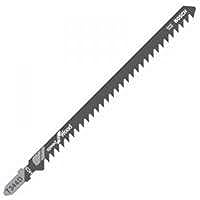 | Bosch T344D Fast Wood View on Amazon |
Watch: Video Guide
Frequently Asked Questions
What TPI should I use for cutting softwood?
For softwood up to 50 mm thick, use 6–8 TPI (Bosch T101B). It cuts fast and produces an acceptable rough finish. If you want a finer finish, step up to 10 TPI (Bosch T101BF), though this will be slower.
What’s the difference between 10 TPI and 14 TPI?
14 TPI cuts slower but produces a finer finish and is better for thin materials or laminate. 10 TPI is faster and works for general-purpose wood cutting. For most tradespeople, 10 TPI is the best balance — if you need a smoother finish, go to 14 TPI.
Can I use the same TPI blade for all materials?
No. Different materials require different TPI. Using 8 TPI on sheet metal will break the blade instantly; using 24 TPI on thick softwood is inefficiently slow. Always match TPI to material thickness: thick = coarse, thin = fine.
Why does my blade skip or bounce when cutting?
Usually because the TPI is wrong for the material. If you’re getting skipping on wood, the blade is probably too fine (TPI too high). If you’re skipping on metal, the blade is too coarse. Also check that the blade is fully locked in the chuck — a loose blade will always bounce.
Does higher TPI always mean a cleaner cut?
Yes, but with a trade-off: higher TPI cuts slower and generates more heat. Always use the coarsest TPI that gives acceptable results for your material. Finer than necessary just wastes time and dulls the blade faster.
What TPI for cutting stainless steel?
Stainless steel requires 18–24 TPI with a BIM (bimetal) blade. Stainless is harder than mild steel and generates more heat, so use a fine blade and feed very slowly. Lubricate with light machine oil to keep the blade cool.
How we compile this guide
We cross-reference compatibility details against manufacturer specifications where available, official tool manuals, and the physical standards that govern fitment (bore sizes, arbor diameters, voltage platforms, connector types). We prioritise primary sources over retailer listings, flag anything we can’t confirm, and re-verify the data on a regular cycle. Where we give a buying recommendation, we tell you the reasoning — not just the link. More on our method →