Introduction
A jigsaw is the go-to tool for curved cuts, shaped openings, and intricate work in wood. But a wood-cutting jigsaw is only as good as the blade you fit. The difference between a clean, efficient cut and a ragged, splintered mess often comes down to choosing the right blade for the specific wood type and finish required.
This guide covers everything: which blade materials work best for different wood types, blade models you should own, TPI ranges, speed settings, and how to avoid the most common problems — splintering, binding, and blade breakage.
Best Blade Types for Wood Cutting
HCS (High Carbon Steel) Blades
HCS is the standard for wood. High carbon steel is sharp, affordable, and perfect for woodworking. The blade gets dull relatively quickly compared to bimetal, but that’s expected and acceptable — HCS blades are cheap enough that you replace them regularly.
HCS blades come in different lengths and tooth patterns. For wood, you’ll want either a general-purpose blade (8–10 TPI) for most work, or a fine-tooth blade (12+ TPI) for hardwood and decorative cuts.
When to use HCS: All general wood cutting — softwood, hardwood, plywood, MDF. If it’s wood, HCS is your standard choice.
BIM (Bimetal) Blades for Wood
Bimetal blades have HCS teeth welded to a flexible steel backing. They stay sharp far longer than HCS alone and are tougher than pure HCS — but they cost more.
For wood alone, BIM is overkill. Save bimetal for composite materials (plywood with thick laminate), extremely hard woods, or if you cut wood professionally and go through dozens of blades per month.
When to use BIM on wood: Hardwood repeatedly, heavy professional use, composite materials with laminate facing, or exotic hardwoods that are very dense.
Softwood Cutting — Fast Rips and Demolition
Softwood (pine, fir, spruce, larch) is the easiest wood to cut with a jigsaw. The main goal is usually speed — you’re not worried about a perfect finish because the wood will be painted or treated.
Best Blade: Bosch T101B
| Specification | Detail |
|---|---|
| Model | Bosch T101B |
| Type | HCS (High Carbon Steel) |
| TPI | 8 |
| Length | 60 mm |
| Shank | T-shank |
| Best For | Softwood rip cuts, fast demolition, rough work |
| Speed | Very fast — up to 3,000 SPM recommended |
| Finish | Rough, acceptable for structural work |
Recommended Jigsaw Blades
As an Amazon Associate we earn from qualifying purchases. Check fitment & current price on Amazon (affiliate links).
Before you buy: check that the size, fitting/bore and maximum-rated speed marked on the accessory match what your tool’s manual specifies. We have not physically tested these products; listings are compiled from published specifications. These are affiliate links.
The T101B is the workhorse blade. 8 TPI is coarse enough for rapid cuts through thick softwood, but not so coarse that it throws too much splinter. Use this for:
- Ripping through pine framing or joists
- Cutting softwood sheet (plywood subfloor, sheathing)
- Demolition work where finish doesn’t matter
- Fast rough cuts on site
Alternative for softwood: Makita A-90350 is an equivalent 8 TPI HCS blade. If you’re a Makita user, this will perform identically to the T101B.
Speed Settings for Softwood
Run your jigsaw at full speed (2,500–3,000 SPM) when cutting thick softwood with a coarse blade. The coarse teeth can handle the speed without dulling quickly. Feed steadily and don’t force — let the blade pull the saw through the cut.
Hardwood Cutting — Smooth Finishes for Visible Work
Hardwood (oak, ash, walnut, teak) is denser than softwood and splinters more easily. If you’re cutting hardwood for visible surfaces — like a kitchen worktop edge, furniture, or trim — you need a fine-tooth blade that leaves a smooth, almost sanded edge.
Best Blade: Bosch T101BF
| Specification | Detail |
|---|---|
| Model | Bosch T101BF |
| Type | HCS (High Carbon Steel) |
| TPI | 10 |
| Length | 60 mm |
| Shank | T-shank |
| Best For | Hardwood, visible cuts, smooth finish required |
| Speed | Medium speed — 1,500–2,000 SPM |
| Finish | Excellent — smooth edge, minimal splintering |
The T101BF is the blade for fine hardwood work. The “F” stands for “Fine,” and at 10 TPI it produces cuts smooth enough that light sanding (if any) is the only finishing required. Use this for:
- Curved cuts in oak or ash (furniture, trim)
- Shaped openings in hardwood panels
- Door frames and decorative work
- Any hardwood cut where the edge is visible
Run at medium speed: 1,500–2,000 SPM is ideal for hardwood with fine teeth. Higher speed will cause the blade to bounce and chatter. Let the blade do the work — don’t force it.
Alternative blades: DeWalt DT2294 is a fine-tooth hardwood blade with similar performance to the T101BF. Makita A-90310 is another equivalent fine-tooth option.
Plywood, Chipboard & Composite Cutting
Plywood and chipboard are trickier than solid wood because the veneer layers can splinter and chip out. The key is using a fine blade and supporting the material well on the baseplate.
Best Blade: Bosch T101AO (Down-Cut)
| Specification | Detail |
|---|---|
| Model | Bosch T101AO |
| Type | HCS (High Carbon Steel) |
| TPI | 10 |
| Cut Direction | Down-cut (teeth point downward) |
| Shank | T-shank |
| Best For | Plywood, chipboard, visible top surface |
| Finish | Excellent on top face (minimal splinter) |
The T101AO is a down-cut blade, meaning the teeth point downward. This direction pushes splinters away from the top surface — exactly what you want when cutting kitchen worktops, cabinet sides, or any plywood where the top face is visible.
The trade-off is that the bottom face will be rougher than the top. If both faces need to be clean, flip the material and make the cut from the other side.
Pro tip: Tape the cutting line with masking tape on the top surface before cutting. This further reduces splintering. Feed slowly and support the material firmly against the baseplate — any flex in the workpiece will cause the veneer to chip.
Alternative: Milwaukee 49-22-5030 is an equivalent down-cut blade.
Standard Plywood Cutting (If You Don’t Have a Down-Cut Blade)
If you’re using a standard up-cut blade (T101BF) on plywood, you’ll get splinter on the top face. Minimise this by:
- Using 10–12 TPI (fine blade)
- Taping the cutting line with masking tape
- Feeding slowly and steadily
- Supporting the material close to the cut line
- Accepting that you may need to sand the edge afterward
MDF & Engineered Wood
MDF and OSB are denser than plywood but more uniform. They cut cleanly with a fine HCS blade (10–12 TPI), but the edges tend to be rough and need light sanding.
Best blade: Bosch T101BF (10 TPI, fine tooth). This produces clean, almost sanded edges on MDF with minimal additional finishing.
Alternative for heavy MDF work: A BIM blade will last longer if you’re cutting a lot of MDF, because the material is abrasive and dulls HCS quickly. Makita A-90310 or DeWalt DT2294 in BIM would be a good choice for professional MDF shops.
Cutting Speed & Blade Tension
Recommended Speed by Wood Type
| Wood Type | Blade TPI | Recommended SPM | Notes |
|---|---|---|---|
| Softwood (rip cut) | 6–8 | 2,500–3,000 (max) | Maximize speed for fast cutting |
| Softwood (fine cut) | 10–12 | 2,000–2,500 | Reduce speed slightly for control |
| Hardwood | 10–12 | 1,500–2,000 | Lower speed for smooth finish and control |
| Plywood/chipboard | 10–12 | 1,500–2,000 | Lower speed reduces splintering |
| MDF | 10–14 | 2,000–2,500 | Fine blade, medium-high speed |
Blade Tension (Orbital vs Straight Cut)
Many modern cordless jigsaws have an orbital cutting action setting (0–3 stages). Orbital action tilts the blade forward during the cut, which increases cutting speed but produces a rougher finish.
- Orbital 0 (straight cut) — Smoothest finish, best for hardwood and visible work. Slower but cleaner.
- Orbital 1–2 — Balanced speed and finish. Good for general wood cutting.
- Orbital 3 (maximum) — Fastest cutting. Use for rough softwood cuts where finish doesn’t matter.
If you want a smooth finish in hardwood or plywood, use Orbital 0 (straight cut) and run at medium speed.
Common Problems & How to Fix Them
Excessive Splintering on Plywood
Problem: The top face of plywood splinters badly during the cut.
Solutions:
- Switch to a down-cut blade (Bosch T101AO)
- Tape the cutting line with masking tape
- Use a finer blade (12 TPI instead of 10)
- Reduce cutting speed and feed more slowly
- Support the workpiece close to the blade
Blade Binding or Stalling
Problem: The blade gets stuck mid-cut and the jigsaw stalls.
Solutions:
- The blade TPI may be wrong — if it’s too fine, the blade can’t clear chips efficiently. Try a coarser blade (8 TPI instead of 10).
- You may be cutting too thick material for the blade. A 60 mm blade shouldn’t cut deeper than 25–30 mm — any thicker will bind.
- Check that the blade isn’t warped or damaged. A bent blade will bind immediately.
- Reduce feed pressure — you’re forcing the blade.
Rough, Dull-Looking Edge
Problem: The cut edge is rough and torn, even with a fine blade.
Solutions:
- The blade is dull. Replace it — a dull HCS blade should be discarded after 15–20 cuts in hardwood.
- You’re running the blade too fast for the tooth pattern. Lower the speed and feed rate.
- Use a finer blade (10 TPI instead of 8) if doing decorative work.
Recommended Wood Blade Set
A practical three-blade set covers most wood-cutting jobs:
- Bosch T101B (8 TPI, HCS) — Fast softwood cutting. Keep several of these on hand — they’re cheap.
- Bosch T101BF (10 TPI, HCS) — General-purpose hardwood and plywood. The most-used blade in most tradespersons’ kits.
- Bosch T101AO (10 TPI, down-cut) — Plywood with visible top surface, laminate-faced boards.
This three-blade combination covers softwood rips, hardwood curves, and splintery plywood. Add a fine 12-TPI blade (Bosch T101BM) if you do delicate decorative work.
Buy Bosch Wood Jigsaw Blade Sets on Amazon
Buy Makita Wood Jigsaw Blade Sets on Amazon
Recommended Products
| Product | Details |
|---|---|
 | Bosch T101B Wood Blade View on Amazon |
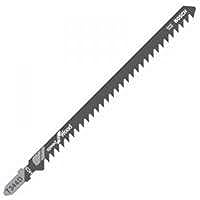 | Bosch T344D Fast Wood View on Amazon |
 | Bosch T101AO Curve Blade View on Amazon |
 | Bosch T101BR Reverse Tooth View on Amazon |
Watch: Video Guide
Frequently Asked Questions
What’s the difference between T101B and T101BF?
T101B has 8 TPI (coarse) and is best for fast softwood cuts. T101BF has 10 TPI (fine) and is better for hardwood and smooth finishes. T101BF will work on softwood but will be slower; T101B on hardwood will be faster but leave a rough edge.
Can I use a metal blade to cut wood?
Technically yes, but you shouldn’t. Metal blades (24+ TPI, BIM) are much too fine and slow for wood. You’ll waste an hour cutting what should take 5 minutes. Reserve metal blades for metal only.
Why does my jigsaw blade keep breaking when cutting hardwood?
Most likely you’re forcing it or twisting the blade side-to-side during the cut. Hardwood is denser, so feed more slowly and let the blade do the work. Also check that the blade is fully locked in the chuck — a loose blade will snap immediately. Finally, if the TPI is wrong (too coarse for the hardness), replace it with a finer blade.
Should I use a down-cut blade for all plywood cutting?
Down-cut (T101AO) is best if the top face of the plywood is visible (kitchen worktops, cabinet sides). If both faces will be hidden or the bottom doesn’t matter, a standard blade (T101BF) is fine and slightly faster. Use down-cut when appearance matters on the top surface.
What’s the best speed setting for hardwood with a Makita or DeWalt jigsaw?
For hardwood with a fine blade (10 TPI), run at 1,500–2,000 SPM with Orbital setting 0 (straight cut). This produces the smoothest finish. Higher speed will cause chatter; lower speed is unnecessary and just slows the cut.
Can I use the same blade for MDF and hardwood?
Yes. A 10 TPI HCS blade (Bosch T101BF) works acceptably on both. MDF will dull the blade faster because it’s abrasive, so expect to replace it sooner than when cutting softwood. If you cut a lot of MDF professionally, use a BIM blade to extend blade life.
How we compile this guide
We cross-reference compatibility details against manufacturer specifications where available, official tool manuals, and the physical standards that govern fitment (bore sizes, arbor diameters, voltage platforms, connector types). We prioritise primary sources over retailer listings, flag anything we can’t confirm, and re-verify the data on a regular cycle. Where we give a buying recommendation, we tell you the reasoning — not just the link. More on our method →