Battery choice decides how long a cordless chainsaw runs between charges. Makers do not publish runtimes for most battery and saw pairings, so this guide sets out which batteries each maker lists for its saws, plus our suggestions on capacity.

Makita, DEWALT and Milwaukee each sell several capacities on the platforms their chainsaws use. A higher-capacity (Ah) battery stores more charge, so it runs longer per charge than a smaller pack of the same voltage.
We have not run cutting tests ourselves. The capacity suggestions below are our editorial picks; the compatibility details come from the makers’ manuals and product pages.
Quick Recommendations
| Use Case | Makita 18V LXT | DeWalt 20V MAX | Milwaukee M18 |
|---|---|---|---|
| Best all-round | BL1850B (5.0Ah) | DCB205 (5.0Ah) | 48-11-1850 (5.0Ah) |
| Best for heavy use | BL1860B (6.0Ah) | DCB206 (6.0Ah) | 48-11-1860 (6.0Ah) |
| Smaller pack | BL1830 (3.0Ah) | DCB204 (4.0Ah) | 48-11-1840 (4.0Ah) |
Get the free Power-Tool Battery Compatibility Handbook (PDF)
Which batteries fit which tools — cross-brand, adapters & Ah, decoded.
Why Battery Choice Matters for Chainsaws
We have not measured current draw, and the makers we checked do not publish it for these saws, so we make no claim about how hard a chainsaw works its battery compared with other tools.
Makers rarely publish cut counts. The one figure we found is Makita New Zealand’s: about 160 cuts through 50 mm cedar on one charge of a BL1850B with the DUC254. Your count will depend on the wood, the size of the cut and the saw. We have not run cutting tests ourselves.
A second battery lets you keep cutting while one charges. Some saws, such as the Makita DUC353 and Milwaukee M18 F2CHS50, take two 18V batteries at once (Makita lists the DUC353 as 2 × 18V).
Best Batteries for Makita Chainsaws
Makita BL1850B (5.0Ah) — Best All-Round for Pruning and Light Felling
Our suggested starting point for Makita’s 18V LXT saws. Makita’s EU manuals list the BL1850B (5.0 Ah) for both the DUC254 and the DUC353. We have not measured its runtime.

Buy Makita BL1850B on Amazon — Model: BL1850B
Makita BL1860B (6.0Ah) — Best for Heavy Use and Professional Work
For longer sessions, the BL1860B (6.0 Ah) has 20% more capacity than a 5.0 Ah pack, and Makita lists it for the DUC254 and DUC353. We have no maker figure for the extra cutting time.

Buy Makita BL1860B on Amazon — Model: BL1860B
Makita BL1830 (3.0Ah) — Smaller Pack (Limited Use Only)
The BL1830 (3.0 Ah) is listed for the DUC254 in Makita’s Hong Kong manual (the EU manual lists the BL1830B). It has 40% less capacity than a 5.0 Ah pack, so we suggest it only if you already own one.

Buy Makita BL1830 on Amazon — Model: BL1830
Makita’s EU manuals for the DUC254 and DUC353 list the BL1815N, BL1820B, BL1830B, BL1840B, BL1850B and BL1860B (all on the Makita 18V LXT platform); the Hong Kong DUC254 manual also lists the BL1830, BL1840 and BL1850. Makita’s 40V XGT chainsaws (UC014G, UC016G) take XGT batteries, not LXT.
Best Batteries for DeWalt Chainsaws
DeWalt DCB205 (5.0Ah) — Best All-Round for Pruning and Light Felling
Our suggested starting point for DEWALT’s 20V MAX saws. DEWALT’s manual for the DCCS620 lists the DCB205 (5.0 Ah) among its compatible batteries. We have not measured its runtime.

Buy DeWalt DCB205 on Amazon — Model: DCB205
DeWalt DCB206 (6.0Ah) — Best for Heavy Use and Professional Work
The DCB206 (6.0 Ah) has 20% more capacity than the DCB205 and is also on the DCCS620’s compatible-battery list. We have no maker figure for the extra cutting time.

Buy DeWalt DCB206 on Amazon — Model: DCB206
DeWalt DCB204 (4.0Ah) — Best Lightweight for Moderate Use
The DCB204 sits between lightweight and practical capacity. It is a little lighter than the 5.0Ah DCB205 (DeWalt US: 1.4 lb vs 1.54 lb) and holds a third more charge than a 3.0Ah pack. This is a reasonable choice for occasional pruning and light limbing work, though we’d still recommend stepping up to the 5.0Ah for anything more demanding.
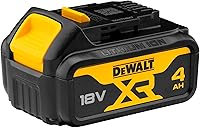
Buy DeWalt DCB204 on Amazon — Model: DCB204
The DCCS620 manual lists the DCB204, DCB205 and DCB206 among its compatible batteries (all on the DeWalt 20V MAX platform). In the UK, DEWALT sells this platform as 18V XR (20V is the maximum initial voltage; 18V is nominal).
Best Batteries for Milwaukee Chainsaws
Milwaukee 48-11-1850 (5.0Ah) — Best All-Round for Pruning and Light Felling
Our suggested starting point for Milwaukee’s M18 saws. Milwaukee says its M18 FUEL 16″ chainsaw (2727-20) is compatible with all M18 batteries. We have not measured runtime with the 48-11-1850 (5.0 Ah).

Buy Milwaukee 48-11-1850 on Amazon — Model: 48-11-1850
Milwaukee 48-11-1860 (6.0Ah) — Best for Heavy Use and Professional Work
The 48-11-1860 (6.0 Ah) has 20% more capacity than a 5.0 Ah pack. For comparison, Milwaukee supplies its 2727-21HD chainsaw kit with a 12.0 Ah HIGH OUTPUT HD12.0 pack (48-11-1812).

Buy Milwaukee 48-11-1860 on Amazon — Model: 48-11-1860
Milwaukee 48-11-1840 (4.0Ah) — Smaller Pack for Moderate Use
The 48-11-1840 (4.0 Ah) is the smallest of the three. It makes sense if you already own it for other M18 tools; for longer cutting sessions we suggest a larger pack.
Buy Milwaukee 48-11-1840 on Amazon — Model: 48-11-1840
Milwaukee’s US page for the M18 FUEL 16″ chainsaw (2727-20) says it is compatible with all M18 batteries (see the Milwaukee M18 platform).
Full Comparison Table
| Battery | Platform | Capacity | Best For | Buy Link |
|---|---|---|---|---|
| Makita BL1850B | 18V LXT | 5.0Ah | General pruning and light felling | Buy on Amazon |
| Makita BL1860B | 18V LXT | 6.0Ah | Heavy use, firewood, professional work | Buy on Amazon |
| Makita BL1830 | 18V LXT | 3.0Ah | Emergency use only | Buy on Amazon |
| DeWalt DCB205 | 20V MAX | 5.0Ah | General pruning and light felling | Buy on Amazon |
| DeWalt DCB206 | 20V MAX | 6.0Ah | Heavy use, firewood, professional work | Buy on Amazon |
| DeWalt DCB204 | 20V MAX | 4.0Ah | Smaller pack, moderate use | Buy on Amazon |
| Milwaukee 48-11-1850 | M18 | 5.0Ah | General pruning and light felling | Buy on Amazon |
| Milwaukee 48-11-1860 | M18 | 6.0Ah | Heavy use, firewood, professional work | Buy on Amazon |
| Milwaukee 48-11-1840 | M18 | 4.0Ah | Smaller pack, moderate use | Buy on Amazon |
Watch: Video Guide
Frequently Asked Questions
How many cuts do you get from a single chainsaw battery?
Makers rarely publish cut counts. The one figure we found is Makita New Zealand’s: about 160 cuts through 50 mm cedar on one charge of a BL1850B with the DUC254. Your count will depend on the wood, the size of the cut and the saw. We have not run cutting tests ourselves.
What’s the minimum battery capacity for chainsaw work?
We recommend 5.0Ah as the practical minimum for any regular cutting. A 3.0Ah battery will frustrate you — you’ll spend more time swapping batteries than cutting. A 4.0Ah battery sits in an awkward middle ground; it’s better than 3.0Ah but doesn’t deliver the value jump of a 5.0Ah. Start with 5.0Ah and consider 6.0Ah if you do sustained cutting work.
Should I buy an 18V or 36V cordless chainsaw?
Some saws, such as the Makita DUC353 and Milwaukee M18 F2CHS50, take two 18V batteries at once, and Makita also makes 40V XGT chainsaws (UC014G, UC016G). We have no maker data comparing runtime or cutting capacity, so choose the saw and bar length the maker lists for the work you do.
Can I use a small 3.0Ah battery for pruning work?
Yes, if the saw maker lists it: Makita’s DUC254 manuals list 3.0 Ah packs. A 3.0 Ah pack has 40% less capacity than a 5.0 Ah one, so expect fewer cuts per charge; we have no maker figure.
Are Makita, DeWalt and Milwaukee batteries interchangeable on chainsaws?
Not officially. Each maker’s saws take its own batteries: Makita’s DUC saws take 18V LXT packs (its UC014G and UC016G take 40V XGT), DEWALT’s 20V MAX saws take DEWALT packs, and Milwaukee’s M18 saws take M18 packs. Most brands support only their own batteries; third-party adapters are not part of any maker’s system, and damage linked to one may not be covered — check the maker’s guarantee terms (Makita and Milwaukee exclude non-Makita or non-approved parts and accessories).
How we compile this guide
We cross-reference compatibility details against manufacturer specifications where available, official tool manuals, and the physical standards that govern fitment (bore sizes, arbor diameters, voltage platforms, connector types). We prioritise primary sources over retailer listings, flag anything we can’t confirm, and re-verify the data on a regular cycle. Where we give a buying recommendation, we tell you the reasoning — not just the link. More on our method →