Festool has built its reputation on precision dust extraction and proprietary pad systems. If you’re investing in a Festool sander, understanding pad compatibility and abrasive options is crucial—because Festool’s ecosystem doesn’t play well with standard 8-hole discs, and mixing incompatible components will severely compromise dust extraction performance.
This guide covers every Festool sander model, explains the hole pattern differences, shows you OEM replacement pad part numbers, and reveals which third-party abrasives actually work—and which don’t.
Festool Sander Models and Pad Sizes
All modern Festool sanders use either proprietary Jetstream or MultiJetstream 2 hole patterns. The pad size dictates the working area and tool weight.
| Model | Pad Size (mm) | Hole Pattern | Orbit (mm) | Power |
|---|---|---|---|---|
| ETS 125 | 125 × 90 | Jetstream | 2.0 (random) | 300W corded |
| ETS 150/3 | 150 × 100 | Jetstream | 3.0 (random) | 310W corded |
| ETS 150/5 | 150 × 100 | Jetstream | 5.0 (random) | 310W corded |
| Rotex RO 90 DX | 90 diameter | MultiJetstream 2 | 0.5–5.0 (variable) | 600W corded |
| Rotex RO 125 FEQ | 125 diameter | MultiJetstream 2 | 0.5–5.0 (variable) | 600W corded |
| Rotex RO 150 FEQ | 150 diameter | MultiJetstream 2 | 0.5–5.0 (variable) | 600W corded |
Understanding Festool Hole Patterns
Festool‘s proprietary hole patterns are not accidental—they’re engineered to maximise dust extraction efficiency. The system works by routing air directly through holes in the pad, then through the sander’s filtration unit. Every hole is positioned to capture dust at the point of abrasion.
Jetstream Hole Pattern
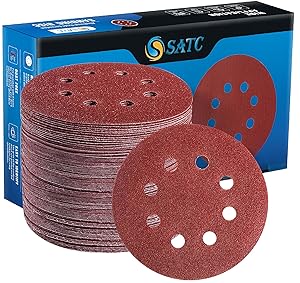
Used on ETS 125, ETS 150/3 and ETS 150/5 models. The Jetstream pattern features a grid of holes that distributes vacuum pressure across the entire pad. This pattern is NOT compatible with standard 8-hole abrasives or any non-Festool pad.
MultiJetstream 2 Hole Pattern
The Rotex range uses MultiJetstream 2, which adds more holes and an improved layout for the larger, more powerful machines. Rotex pads are also proprietary and require specific abrasives.
Can You Use Standard Discs on Festool Sanders?
Technically, yes. You can mount an 8-hole or PSA disc onto a Festool pad using an interface pad or adhesive backing. But—and this is critical—you will lose approximately 40–50% of dust extraction efficiency because the holes won’t align with the vacuum ports.
This means:
- More dust escapes into your workshop air
- Dust clogs the pad faster
- The sander clogs and requires frequent stops to empty the bag
- Abrasive life is shortened due to dust coating the surface
Some workshop users do this anyway for cost savings, particularly for rough stock removal where dust extraction isn’t as critical. But if you’re doing finish sanding or working indoors, stick with proper Festool abrasives.
Festool Replacement Pads
Replacement pads should be ordered directly from Festool or authorised distributors. OEM pads are designed to maintain vacuum integrity and deliver consistent performance.
| Model | OEM Part Number | Density | Price (approx.) |
|---|---|---|---|
| ETS 125 Soft Pad | 492280 | Soft (red) | £12–15 |
| ETS 125 Medium Pad | 492279 | Medium (black) | £12–15 |
| ETS 150 Soft Pad | 492282 | Soft (red) | £14–17 |
| ETS 150 Medium Pad | 492281 | Medium (black) | £14–17 |
| Rotex RO 90 Pad | 492856 | Soft (red) | £18–22 |
| Rotex RO 125/150 Pad | 492857 | Soft (red) | £22–28 |
Pad density matters: soft pads (red) conform better to uneven surfaces—use for rough wood or profile following. Medium pads (black) provide more even pressure—use for flat surfaces and finish work. Festool rarely offers hard pads for sanders, as the random orbital action doesn’t benefit from maximum rigidity the way a DA sander does.
Festool Replacement Abrasives (Granat and Abranet)
Festool makes three lines of abrasives for sanders: Granat (closed-coat, traditional), Granat Soft (for coated materials), and Abranet (mesh, for superior dust capture).
All come in Jetstream and MultiJetstream 2 hole patterns with sticky-back (PSA) or hook-and-loop backing.
Granat Abrasives
Granat is Festool‘s workhorse sanding disc. It comes in grits from P40 to P220. Each disc has pre-punched holes matching your sander’s pattern.
- ETS 125 Granat (125 × 90 mm) — 10-pack, P80 to P150 typically stock
- ETS 150 Granat (150 × 100 mm) — 10-pack, same grit range
- Rotex Granat (90, 125, 150 mm discs) — 10-pack or 50-pack
Buy Festool Granat discs on Amazon UK
Abranet Mesh Discs
Abranet is a game-changer for finish work. Instead of solid abrasive, it uses open-weave mesh embedded with sharp particles. Benefits:
- 40–50% better dust extraction (mesh holes don’t clog like solid abrasive)
- Cooler cutting, less burning on coatings and veneers
- 2–3 times longer working life per disc
- Lower heat generation = less swelling on MDF and veneers
Abranet costs 2–3× more per disc than solid Granat, but the extended life and superior surface finish often justify the cost on high-value jobs.
Buy Festool Abranet discs on Amazon UK
Compatible Third-Party Abrasives
Finding third-party discs that work with Festool is limited but possible. Your options are:
Mirka Abranet and Mirka Deros Discs
Mirka makes Festool-compatible mesh discs in both Jetstream and MultiJetstream 2 patterns. Quality is comparable to Festool Abranet, and pricing is 20–30% lower.
However, availability in the UK is limited and most specialist suppliers stock them on order only.
Interface Pads and PSA Backing
If you have a stock of standard PSA (self-adhesive) discs in 5″ or 6″ 8-hole, you can buy an interface pad that converts your Festool pad to accept standard abrasives. This is a thin rubber layer with PSA backing that sticks to your hook-and-loop pad.
Trade-off: you lose vacuum efficiency (as noted earlier) and dust extraction drops 40–50%. Best used for rough stock removal only.
Festool vs Standard Sanders: Why the System Matters
If you’re comparing Festool to Makita, DeWalt or Bosch, the proprietary pad system is a key differentiator. Here’s why:
- Vacuum routing: Every hole in a Festool pad connects to a dust port. Standard pad holes are just perforations for hook-and-loop mounting.
- Filtration: Festool‘s dust cartridges deliver 99% dust capture (certified to EU standards). Most DIY sanders are 85–95%.
- Pad lifespan: Because dust is controlled, pads stay effective longer and don’t glaze as quickly.
- Cost of ownership: Although abrasive costs are higher upfront, lower dust re-circulation and longer pad life can offset the premium over several years.
For professional work, particularly on coated woods, veneers, or in confined spaces, Festool justifies its cost. For rough DIY framing or demolition, a Makita or DeWalt 8-hole sander offers far better value.
Watch: Video Guide
Frequently Asked Questions
Can I use Festool discs on a standard 8-hole sander pad?
Yes, physically they’ll fit if you use an interface pad. However, most Festool Granat discs are pre-punched for Jetstream patterns, so holes won’t align. You’d need to use Festool discs with PSA backing and a PSA interface pad—which defeats the purpose of buying Festool quality.
Which Festool abrasive is best for finishing furniture?
Abranet in grits P120–P220, on a soft pad. The mesh reduces heat and doesn’t clog as quickly as solid abrasive, resulting in a smoother surface and fewer torn grain problems.
How often should I replace my Festool pad?
Replace when the surface becomes uneven or the hook-and-loop backing no longer grips discs securely—typically after 50–100 hours of heavy use. If you sand lightly once or twice weekly, a pad can last 1–2 years.
Is Festool dust extraction really that much better?
Yes. Independent testing shows Festool sanders capture 95–99% of dust when using matched disc and pad. Standard 8-hole sanders capture 80–90%. In a small workshop or when sanding indoors, the difference is immediately noticeable.
Can I buy Festool abrasives anywhere other than Festool dealers?
Granat discs are widely stocked on Amazon UK and eBay. Abranet is less common but available through specialist suppliers like Axminster. Prices are typically 10–15% cheaper on Amazon than direct from Festool.
What’s the difference between Jetstream and MultiJetstream 2?
Jetstream is used on smaller, older ETS models and has fewer but larger holes. MultiJetstream 2 is used on more powerful Rotex machines and has more numerous smaller holes for improved vacuum distribution. Discs are not interchangeable between the two patterns.