
Never use nylon wall plugs or plasterboard anchors for safety-critical fixings. Handrails, stair rails, banisters, balustrades, gates, ladders, climbing or play equipment, overhead fixings, and anything else whose failure could cause a fall or injury need a fixing designed and rated for that purpose — typically a through-bolt, a mechanical anchor or a resin-bonded anchor with a published load rating (and, for structural use, a European Technical Assessment). If you are not certain the wall and the fixing are up to the job, get advice from a builder or structural engineer.
Types of Wall Fixings — Every Fixing Explained
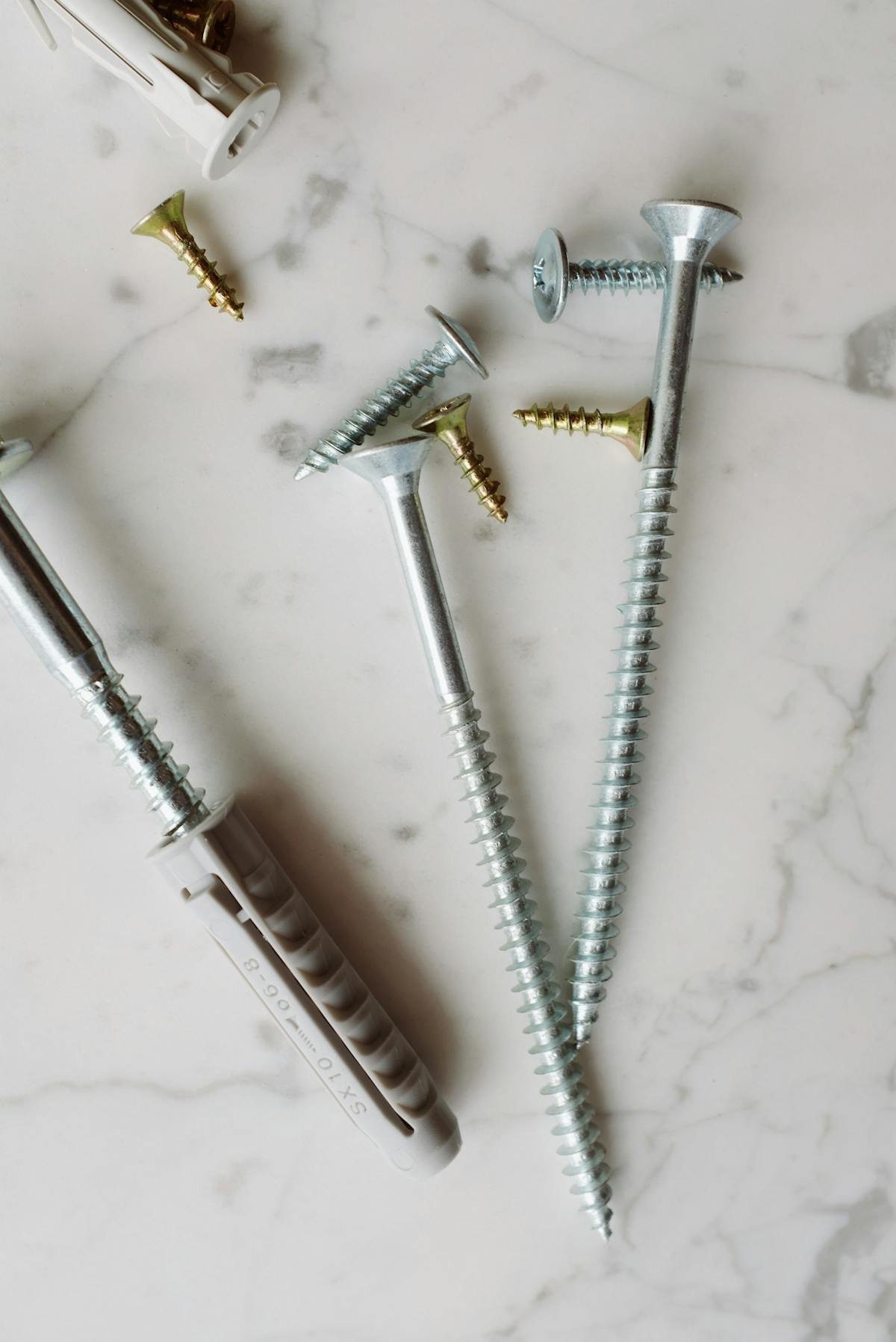
There are dozens of wall fixing types available, each designed for specific wall materials, load requirements, and installation scenarios. This guide covers every common fixing type you’ll encounter in the UK, from basic plastic wall plugs to heavy-duty chemical anchors, so you can choose the right one for any job.
Quick Guide
The most important decision is what type of wall you’re fixing into. Masonry walls (brick, block, concrete) use expansion fixings. Plasterboard/hollow walls use toggle or anchor fixings. Use the wrong type and the fixing will fail regardless of size.
Masonry Fixings
Standard Expansion Wall Plugs
A widely used masonry fixing. A ribbed plastic sleeve is inserted into a pre-drilled hole, and a screw driven in expands the plug against the masonry. Often colour-coded by size, but colours vary by brand (Rawlplug UNO: yellow 5mm, red 6mm, brown 7mm, blue 8mm, grey 10mm). Works in solid brick, block, concrete, and stone.
Load capacity: Depends entirely on size and substrate — see the substrate-by-substrate table on our masonry wall plugs guide. Wall types: All solid masonry. Removable: Yes.
Universal Wall Plugs (e.g., Fischer DuoPower)
Designed for solid masonry, hollow block and plasterboard, with a published load for each base material a size covers (fischer gives no plasterboard load for some sizes, such as DuoPower 8 x 65). In solid walls they expand like standard plugs. In hollow walls they fold and knot behind the material. More expensive but very versatile when you’re unsure of the wall construction.
Load capacity: fischer publishes 15 kg for the 8mm DuoPower in 12.5mm plasterboard; masonry figures depend on size and wall type, so use fischer’s datasheet. Wall types: those fischer lists for the size. Removable: Yes.
Frame Fixings (Hammer Fixings)
Long, slim fixings (typically 8–10mm x 80–160mm) designed to fix through timber frames directly into masonry. Commonly used for window and door frames, battens, and timber wall plates. You drill through both the frame and masonry in one go, insert the fixing, and tighten.
Load capacity: Moderate to high. Wall types: Solid masonry (through timber). Removable: Difficult.
Resin Anchors (Chemical Fixings)
Two-part chemical adhesive injected into a drilled hole, then a threaded rod inserted. The resin sets hard and bonds the rod permanently to the masonry. Essential for hollow masonry (perforated brick, aerated block) and crumbly or poor-quality substrates where expansion fixings can’t grip.
Load capacity: Very high (structural-grade). Wall types: All masonry, especially hollow/soft. Removable: No (permanent).
Sleeve Anchors / Wedge Anchors
Heavy-duty metal anchors for concrete and hard masonry. A bolt is tightened which expands a metal sleeve or wedge against the hole walls. Used commercially for fixing steel brackets, handrails, machinery, and structural connections to concrete.
Load capacity: Very high. Wall types: Concrete, hard masonry. Removable: Difficult.
Masonry Screws (e.g., Tapcon, Thunderbolt)
Self-tapping screws that cut their own thread directly into masonry — no wall plug needed. Drill a pilot hole slightly smaller than the screw, then drive it in. Quick and convenient for medium loads. The thread grips the masonry directly.
Load capacity: Moderate. Wall types: Concrete, hard brick. Removable: Yes (but hole may be weakened for reuse).
Plasterboard / Hollow Wall Fixings
Self-Drill Metal Fixings
Zinc alloy fixings with a coarse, sharp thread that drills directly into plasterboard with no pre-drilling. The most popular quick-fix option for light to medium loads. Drive them in with a screwdriver or drill, then insert the screw.
Load capacity: fischer publishes 8 kg per metal self-drill anchor in 12.5mm board. Wall types: Plasterboard. Removable: Leaves a larger hole.
Spring Toggles (Butterfly Fixings)
A spring-loaded metal bar passes through a pre-drilled hole and opens behind the plasterboard, creating a wide bearing surface. Good holding power and widely available. The toggle drops into the cavity if the bolt is removed.
Load capacity: fischer publishes 15 kg per spring toggle in 12.5mm board. Wall types: Plasterboard, hollow doors. Removable: Toggle lost if bolt removed.
GripIt Fixings
A UK-designed plasterboard fixing with rotating wings that grip behind the board. Available in 15 mm (yellow), 18 mm (red), 20 mm (brown) and 25 mm (blue). GripIt’s UK datasheet gives safe static loads of 71, 74, 93 and 113 kg respectively in shear (load acting down the wall) and 20 kg each in tension, tested on 15mm plasterboard; safe loads reduce on thinner board (minimum 9.5mm). GripIt describes them as removable and reusable: reverse the action to close the wings and take the fixing out.
Load capacity: GripIt UK gives safe static loads of 71–113 kg in shear and 20 kg in tension (15mm board). Wall types: Plasterboard 9.5–15mm (GripIt UK). Removable: Yes (GripIt says removable and reusable).
Gravity / Snap Toggles
A metal channel drops behind the plasterboard and is pulled tight against it by tightening the bolt. Very strong and the channel stays permanently in place. More expensive than spring toggles but better for fixtures that may need periodic removal (like towel rails).
Load capacity: depends on the product and board thickness — check the maker’s published figure. Wall types: Plasterboard. Removable: Bolt removes, channel stays.
Plastic Plasterboard Plugs
Budget option — a plastic plug with barbs or threads designed for plasterboard. Very limited holding power — the weakest plasterboard fixing there is. Fine for smoke alarms, small pictures, and cable clips. Not suitable for anything with meaningful weight.
Load capacity: low — light items only; check the maker’s rating. Wall types: Plasterboard. Removable: Yes.
Comparison Chart
| Fixing Type | Wall Type | Pre-Drill? | Reusable? |
|---|---|---|---|
| Standard wall plug | Solid masonry | Yes | Yes |
| Universal plug | Many (check the maker’s list) | Yes | Yes |
| Frame fixing | Masonry (through timber) | Yes | No |
| Resin anchor | Any masonry | Yes | No |
| Masonry screw | Concrete, hard brick | Yes (pilot) | Limited |
| Self-drill (metal) | Plasterboard | No | No |
| Spring toggle | Plasterboard | Yes | No |
| GripIt | Plasterboard | Yes | Yes |
| Gravity toggle | Plasterboard | Yes | Partial |
Recommended Wall Plugs & Fixings
As an Amazon Associate we earn from qualifying purchases. Check fitment & current price on Amazon (affiliate links).
Before you buy: check that the size, fitting/bore and maximum-rated speed marked on the accessory match what your tool’s manual specifies. We have not physically tested these products; listings are compiled from published specifications. These are affiliate links.
Load figures are not listed here because a plug’s capacity depends on the product and the wall it goes into, not on its colour. See the substrate-by-substrate load table, sourced from fischer’s published figures.
Recommended Fixing Kits
| Product | Type | Best For | Link |
|---|---|---|---|
| Rawlplug Mixed Wall Plug Kit (272 Pieces) | Assorted masonry plugs | Complete home kit | View on Amazon |
| GripIt 15mm Plasterboard Fixings (4 Pack) | Plasterboard toggle | Plasterboard jobs | View on Amazon |
| Fischer DuoPower 6x30mm (100 Pack) | Universal plugs | Many wall types (fischer publishes a load for each) | View on Amazon |
As an Amazon Associate, we earn from qualifying purchases.
Where to Buy Wall Fixings
Heavy Duty Wall Anchors on Amazon
How we compile this guide
We cross-reference compatibility details against manufacturer specifications where available, official tool manuals, and the physical standards that govern fitment (bore sizes, arbor diameters, voltage platforms, connector types). We prioritise primary sources over retailer listings, flag anything we can’t confirm, and re-verify the data on a regular cycle. Where we give a buying recommendation, we tell you the reasoning — not just the link. More on our method →