Impact drivers are one of the most popular cordless tools on any job site, and the battery you pair with one can make a real difference to weight, balance, and runtime. The good news is that impact drivers are relatively light on power draw — meaning you don’t always need the biggest battery in the range.
Get the free Power-Tool Battery Compatibility Handbook (PDF)
Which batteries fit which tools — cross-brand, adapters & Ah, decoded.

This guide covers the best battery choices for impact drivers across Makita, DeWalt, and Milwaukee, with recommendations for both light and heavy use.
Compare All Impact Drivers Batteries on Amazon
Why Battery Choice Matters for Impact Drivers
Impact drivers are compact, fast-spinning tools designed for driving screws and tightening bolts. They draw moderate current in short bursts rather than sustained loads, which means a smaller battery can go a surprisingly long way. However, if you’re driving hundreds of screws into hardwood or lag bolts into concrete, a higher-capacity pack will keep you going without swapping batteries mid-job.
Match your battery to the task — lightweight 2.0Ah packs for overhead and quick jobs, mid-range 4.0-5.0Ah for general use, and high-capacity 6.0Ah+ only for sustained heavy-duty applications.
Best Batteries by Brand
Makita 18V LXT Impact Drivers
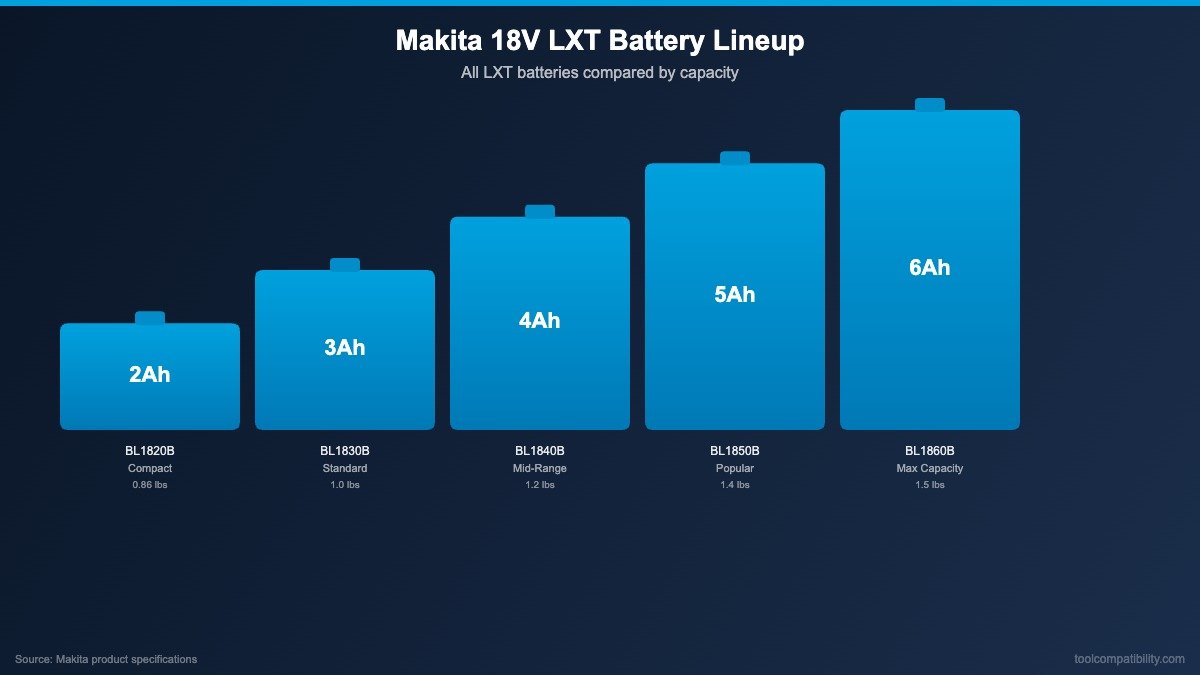
- Light use (occasional DIY, short tasks): BL1820B (2.0Ah) — keeps the tool light and balanced at just 370g.
- General use (trade, mixed fastening): BL1830B (3.0Ah) — the sweet spot of runtime and weight.
- Heavy use (all-day fastening, lag bolts): BL1850B (5.0Ah) — enough capacity for a full shift without swapping. See our BL1850B replacement guide.
Browse Makita 18V Batteries on Amazon
DeWalt 20V MAX Impact Drivers
- Light use: DCB203 (2.0Ah) — compact and light, perfect for overhead work.
- General use: DCB204 (4.0Ah) — solid runtime for a full day of mixed tasks. See our DCB204 replacement guide.
- Heavy use: DCB205 (5.0Ah) — the professional’s choice for sustained driving. See our DCB205 replacement guide.
Browse DeWalt 18V Batteries on Amazon
Milwaukee M18 Impact Drivers
- Light use: 48-11-1820 (2.0Ah) — Milwaukee’s compact pack, ideal for the M18 FUEL impact driver.
- General use: 48-11-1850 (5.0Ah) — the standard trade battery. See our 48-11-1850 replacement guide.
- Heavy use: 48-11-1860 (6.0Ah) — maximum runtime for all-day driving. See our 48-11-1860 replacement guide.
Browse Milwaukee M18 Batteries on Amazon
Do You Need a High Output Battery for an Impact Driver?
Generally, no. Impact drivers don’t draw enough sustained current to benefit from High Output or POWERSTACK batteries. A standard battery at the right capacity will perform identically in an impact driver. Save the premium packs for high-drain tools like angle grinders and circular saws.
Our Top Pick
For most users, a 3.0–4.0Ah battery is the ideal match for an impact driver. It keeps the tool light enough for comfortable one-handed use while providing enough runtime for a solid day’s work. If you use your impact driver as your primary tool all day, step up to a 5.0Ah.
Related Guides
- Every Makita 18V LXT Battery Compared
- Every DeWalt 20V MAX Battery Compared
- Every Milwaukee M18 Battery Compared
Watch: Video Guide
Frequently Asked Questions
Capacity Guide for Impact Drivers
Impact drivers are moderate-drain tools that benefit from a balance of weight and runtime. Here is how different battery capacities affect impact driver performance:
1.5-2.0Ah compact batteries are often the ideal choice for impact drivers. These tools are designed for one-handed operation, and a compact battery keeps the tool light and well-balanced. For driving screws, assembling furniture, or working overhead, a compact battery provides 1-2 hours of intermittent use.
3.0-4.0Ah mid-range batteries suit users who drive large quantities of screws or bolts in a single session. Framing, decking, and construction tasks benefit from the extra runtime without adding excessive weight. Most professional users find this capacity range hits the ideal balance.
5.0Ah+ batteries are generally overkill for impact drivers unless you need all-day runtime without swapping. The extra weight shifts the tool’s balance point and can cause fatigue during extended overhead or repetitive driving.
Standard vs High Performance Batteries
Impact drivers typically do not benefit as dramatically from premium battery tiers as power-hungry tools like grinders and circular saws. A standard lithium-ion battery delivers excellent performance for most driving tasks because impact drivers operate in short, controlled bursts rather than sustained high-draw mode.
However, if you frequently drive large lag bolts or long structural screws, a high-output battery can maintain peak torque delivery slightly longer during each impact burst. This translates to marginally faster driving speeds on the toughest fasteners. For standard screw driving, the difference is negligible.
Our recommendation: invest in multiple compact batteries rather than fewer high-capacity ones. This gives you better tool balance, the ability to keep working while one battery charges, and lower total cost.
Does a bigger battery make my impact driver more powerful?
Not directly. Battery capacity (Ah) affects runtime, not peak torque. However, HIGH OUTPUT batteries from Milwaukee and POWERSTACK batteries from DeWalt can deliver higher sustained current, which prevents power drop-off during demanding tasks. For most impact driver use, any mid-range battery (3.0-5.0Ah) is sufficient.
What Ah battery is best for an impact driver?
A 2.0-3.0Ah compact battery is ideal for impact drivers. Impact drivers are lightweight, one-handed tools where balance matters. A heavy 6.0Ah battery makes the tool unwieldy and does not improve performance for typical fastening tasks. Save the big batteries for saws and grinders.
Should I use lithium-ion or NiCd batteries in my impact driver?
Always lithium-ion. NiCd (nickel-cadmium) batteries are obsolete technology — heavier, lower capacity, suffer from memory effect, and contain toxic cadmium. All current impact drivers are designed for lithium-ion batteries. If you have old NiCd batteries, recycling them and upgrading to lithium-ion is strongly recommended.
Impact Driver Battery FAQ
One of the most common questions is whether a bigger battery always means more torque. The answer is no — torque is determined by the motor and gearing, not the battery. However, a higher-capacity battery maintains consistent voltage delivery under load for longer, which means the tool sustains peak performance throughout demanding tasks rather than gradually losing power as the cell depletes.
Another frequent concern is heat. Impact drivers draw significant current during heavy fastening, and this generates heat in both the tool and the battery. Premium cells with built-in thermal management — like DeWalt’s POWERSTACK or Milwaukee’s High Output packs — dissipate heat more effectively, reducing the risk of thermal shutdown during extended use. If you regularly drive long lag bolts or work with hardwoods, investing in a battery with better thermal performance is worthwhile.
How we compile this guide
We cross-reference compatibility details against manufacturer specifications where available, official tool manuals, and the physical standards that govern fitment (bore sizes, arbor diameters, voltage platforms, connector types). We prioritise primary sources over retailer listings, flag anything we can’t confirm, and re-verify the data on a regular cycle. Where we give a buying recommendation, we tell you the reasoning — not just the link. More on our method →
Recommended Batteries
As an Amazon Associate we earn from qualifying purchases. Check fitment & current price on Amazon (affiliate links).
Before you buy: check that the size, fitting/bore and maximum-rated speed marked on the accessory match what your tool’s manual specifies. We have not physically tested these products; listings are compiled from published specifications. These are affiliate links.