Makita 18V LXT batteries don’t natively fit DeWalt 20V MAX tools — the connector shapes are completely different. However, third-party battery adapters exist that let you use your Makita batteries in DeWalt tools (and vice versa). This guide covers how these adapters work, which ones are available, the safety risks involved, and whether they’re worth buying.
Browse Makita 18V LXT Batteries on Amazon
Check Makita-to-DeWalt Adapters on Amazon
Short Answer
Yes, you can use Makita 18V batteries in DeWalt 20V MAX tools with a third-party adapter. These adapters are widely available on Amazon and eBay for around $15–$30. However, they bypass built-in safety communication between battery and tool, void warranties on both sides, and are not endorsed by either Makita or DeWalt.
How Do Makita-to-DeWalt Battery Adapters Work?
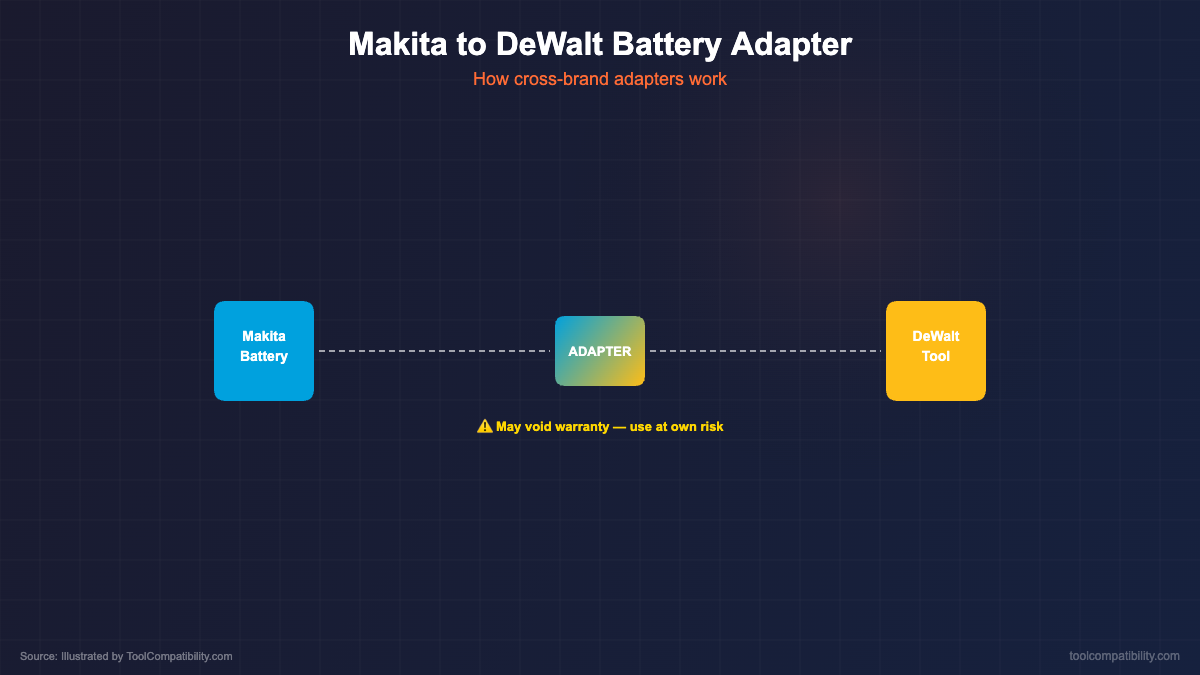
A battery adapter is a passive connector that physically bridges the gap between a Makita slide-on battery interface and a DeWalt slide-on battery slot. The adapter has a Makita-style receptacle on one end and a DeWalt-style connector on the other. It routes power from the Makita battery’s positive and negative terminals to the corresponding terminals on the DeWalt tool.
The voltage is close enough to work: Makita’s “18V” batteries and DeWalt’s “20V MAX” batteries both operate at a nominal 18 volts (DeWalt’s “20V MAX” label refers to peak unloaded voltage — the working voltage is 18V). This means the power output is compatible in practice.
Available Adapters
| Direction | What It Does | Typical Price | Where to Buy |
|---|---|---|---|
| Makita 18V → DeWalt 20V | Use Makita batteries in DeWalt tools | $15–$25 | Amazon, eBay, AliExpress |
| DeWalt 20V → Makita 18V | Use DeWalt batteries in Makita tools | $15–$25 | Amazon, eBay, AliExpress |
Recommended Batteries
As an Amazon Associate we earn from qualifying purchases. Check fitment & current price on Amazon (affiliate links).
Before you buy: check that the size, fitting/bore and maximum-rated speed marked on the accessory match what your tool’s manual specifies. We have not physically tested these products; listings are compiled from published specifications. These are affiliate links.
Get the free Power-Tool Battery Compatibility Handbook (PDF)
Which batteries fit which tools — cross-brand, adapters & Ah, decoded.
Popular adapter brands include Echoyee (model MT20DL), MAKBOS, Powuse, and Biswaye. Most adapters are passive — they simply bridge the connectors without any active electronics. Some newer adapters include a USB charging port as a bonus feature.
Safety Risks & Limitations
While these adapters do work, there are real safety and practical concerns to be aware of:
| Risk | Explanation |
|---|---|
| BMS communication bypass | Makita and DeWalt batteries have onboard Battery Management Systems (BMS) that communicate with the tool to manage temperature, discharge rate, and voltage cutoff. Adapters bypass this communication entirely — the tool cannot read the battery’s state. |
| No automatic shutoff | Because the tool can’t read battery voltage through the adapter, it won’t shut off when the battery is depleted. Over-discharging damages lithium-ion cells and shortens battery life. |
| Overheating risk | Without BMS communication, there’s no temperature monitoring. High-draw tools (grinders, circular saws) can push a battery into thermal stress without the tool knowing. |
| Warranty void | Both Makita and DeWalt explicitly exclude warranty coverage for damage caused by third-party accessories. Using an adapter voids the warranty on both the tool and the battery. |
| Physical bulk | The adapter adds 1–2 inches of length between battery and tool, making the tool heavier and less balanced. |
| Not for high-draw tools | Adapters are generally safe for drills, drivers, and lights. Using them with circular saws, grinders, or SDS hammers significantly increases the risk of overheating. |
When It Makes Sense to Use an Adapter
- You already own one brand and need to use a single tool from another brand occasionally. If you’re a Makita user and bought a DeWalt speciality tool on clearance, an adapter saves buying a whole new battery platform.
- Low-power tools only. LED lights, radios, fans, inflators, and compact drills are safe candidates. Avoid high-draw tools.
- Temporary or infrequent use. If you’re using the adapter once a month, the risks are minimal. Daily professional use is a different story.
When You Should NOT Use an Adapter
- High-draw tools: Circular saws, grinders, SDS rotary hammers, reciprocating saws.
- Professional daily use: The warranty and safety risks outweigh the cost savings.
- If you’re planning to expand into the other brand: It’s cheaper long-term to buy a starter battery and charger kit than to rely on adapters across your whole workshop.
The Bottom Line
Makita-to-DeWalt battery adapters work and are affordable. They’re a practical solution for occasional, light-duty cross-brand use. But they come with real trade-offs: bypassed safety systems, voided warranties, and potential battery damage from over-discharge. For anything beyond casual use, buying the right battery for the right tool is the safer and smarter investment.
Related Guides
- Every Makita 18V LXT Battery Compared
- Every Makita 18V LXT Tool and Which Batteries Fit
- Makita 18V LXT Charger Compatibility Guide
- Makita 18V LXT vs 40V XGT
- Every DeWalt 20V MAX Battery Compared
Video Guide
Frequently Asked Questions
A Smarter Approach to Multi-Brand Tools
If you need tools from both Makita and DeWalt, the safest strategy is maintaining separate battery collections. Keep your Makita 18V LXT batteries for Makita tools and DeWalt 20V MAX batteries for DeWalt tools. While this requires more batteries, it preserves warranties, ensures optimal performance, and eliminates the safety concerns of cross-brand adapters.
Before buying into a second platform, check whether your current brand offers the tool you need. Both Makita and DeWalt have extensive ranges that cover nearly every power tool category. Sometimes the grass just looks greener, and the equivalent tool in your current platform would serve you equally well while keeping your battery ecosystem simple.
Do Makita to DeWalt battery adapters actually work?
Third-party adapters that allow Makita 18V batteries to physically connect to DeWalt 20V tools do exist and function. However, there is a voltage mismatch — Makita LXT batteries are 18V while DeWalt 20V MAX tools expect 20V (nominal 18V). Performance may be slightly reduced, and neither Makita nor DeWalt endorses this practice.
Will using a Makita-to-DeWalt adapter void my warranty?
Using a third-party adapter does not automatically void your entire tool warranty in most jurisdictions. However, any damage caused by using an incompatible power source would not be covered. Both Makita and DeWalt will likely decline warranty claims if adapter use is identified as the cause of a failure.
Are there any risks to using cross-brand battery adapters?
Yes. Risks include: voltage mismatch affecting tool electronics, potential overheating due to bypassed safety circuits, added bulk and poor connection stability, and no manufacturer support if something goes wrong. For occasional light-duty use the risk is low, but for professional or heavy-duty work, using native batteries is strongly recommended.
How we compile this guide
We cross-reference compatibility details against manufacturer specifications where available, official tool manuals, and the physical standards that govern fitment (bore sizes, arbor diameters, voltage platforms, connector types). We prioritise primary sources over retailer listings, flag anything we can’t confirm, and re-verify the data on a regular cycle. Where we give a buying recommendation, we tell you the reasoning — not just the link. More on our method →