Makita says its 18V LXT system has over 325 tools powered by the same battery. LXT packs run from 1.5Ah (BL1815N) up to 12.0Ah (BL18120), so choosing the right one for your needs can be confusing.

This guide compares every Makita 18V LXT battery side by side, explains what each one is best suited for, and helps you decide which batteries belong in your kit.
Every Makita 18V LXT Battery at a Glance
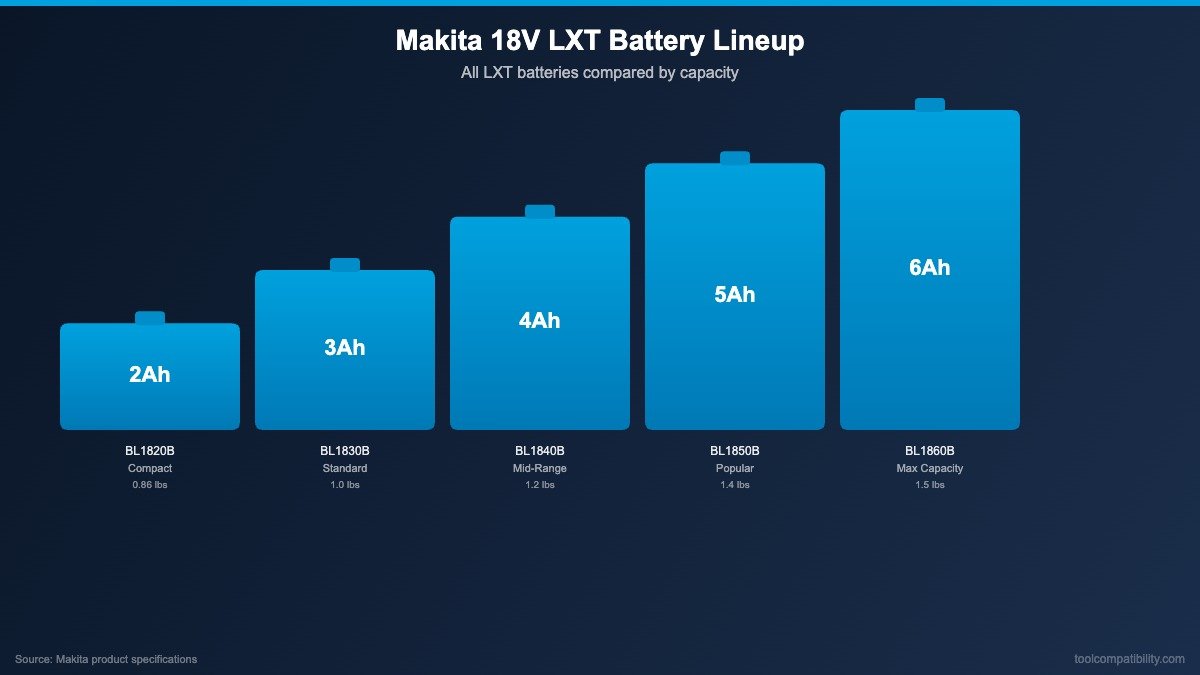
The table below compares Makita 18V LXT batteries by capacity, net weight (as listed by Makita UK), energy and suggested use.
| Battery Model | Capacity (Ah) | Net weight (kg, Makita UK) | Energy (Wh) | Best For | Buy Link |
|---|---|---|---|---|---|
| BL1815N | 1.5 | Not stated (no current Makita UK page) | 27 (calculated) | Light tasks — impact drivers, drills, LED worklights | Check Price |
| BL1820B | 2.0 | 0.38 | 36 | Light-to-medium use — drivers, small grinders, trim routers | Check Price |
| BL1830B | 3.0 | 0.64 | 54 | General-purpose — combi drills, jigsaws, multi-tools | Check Price |
| BL1840B | 4.0 | 0.64 | 72 | Extended sessions — circular saws, routers, SDS drills | Check Price |
| BL1850B | 5.0 | 0.63 | 90 | Heavy-duty — angle grinders, mitre saws, blowers | Check Price |
| BL1860B | 6.0 | 0.66 | 108 | Maximum runtime — chainsaws, lawn mowers, dust extractors | Check Price |
| BL1890 | 9.0 | 0.97 | 162 | Very long sessions where weight matters less | — |
| BL18120 | 12.0 | 1.3 | 216 | Very long sessions where weight matters less | — |
Genuine batteries, chargers and kits for this platform
As an Amazon Associate we earn from qualifying purchases. Genuine packs only; check the listing matches your platform before buying (affiliate links).
Before you buy: check that the size, fitting/bore and maximum-rated speed marked on the accessory match what your tool’s manual specifies. We have not physically tested these products; listings are compiled from published specifications. These are affiliate links.
Get the free Power-Tool Battery Compatibility Handbook (PDF)
Which batteries fit which tools — cross-brand, adapters & Ah, decoded.
Understanding Makita LXT Battery Capacities
All Makita 18V LXT batteries use the same slide-on battery system; Makita says the same LXT battery powers over 325 tools. The difference between models is mainly capacity (measured in amp-hours), which affects runtime and weight.
Higher-capacity packs generally weigh more (Makita UK lists 0.38 kg for the BL1820B and 0.66 kg for the BL1860B, and 1.3 kg for the 12.0Ah BL18120), so for overhead work or extended use the trade-off matters.
BL1815N (1.5Ah) — The Lightweight
The BL1815N is a 1.5Ah 18V LXT pack (it appears in the battery table of Makita’s DC18RC charger manual). Makita UK has no current product page for it, so we cannot confirm its weight or construction. Small packs like this suit light-duty tools such as impact drivers, LED worklights and radios, where low weight matters more than runtime.
BL1820B (2.0Ah) — The Compact All-Rounder
Makita UK describes the BL1820B as a “compact and light” 2.0Ah pack with a charge level indicator, “ideal for screwdrivers thanks to its light weight” (net weight 0.38 kg). It suits light-to-medium tasks such as drill drivers, trim routers and quick cuts with small angle grinders.
BL1830B (3.0Ah) — The General-Purpose Pick
For most DIYers and tradespeople, the BL1830B is a sensible middle choice; Makita calls it a “powerful general-use battery”. It suits combi drills, jigsaws and multi-tools for moderate use. Note that Makita UK lists it at 0.64 kg, the same as the 4.0Ah BL1840B.
BL1840B (4.0Ah) — The Extended Session Battery
The BL1840B has a third more capacity than a 3.0Ah pack (4.0Ah vs 3.0Ah) and, per Makita UK, the same 0.64 kg net weight as the BL1830B. It suits circular saws, routers and SDS drills for longer sessions. Makita does not publish runtimes for these tool and battery pairs, and we have not tested them.
BL1850B (5.0Ah) — The Heavy-Duty Workhorse
The BL1850B is a 5.0Ah pack that Makita describes as “ideal for tools with a high power consumption”; we would use it for angle grinders, mitre saws and blowers. See our Makita BL1850B replacement battery guide for compatible third-party options.
BL1860B (6.0Ah) — Maximum Runtime
The BL1860B is Makita’s 6.0Ah LXT pack (Makita also sells larger 9.0Ah BL1890 and 12.0Ah BL18120 LXT packs) and a good match for chainsaws, lawn mowers, dust extractors and cordless vacuums. Check our Makita BL1860B replacement battery guide for alternatives.
Which Makita LXT Battery Should You Buy?
- Occasional DIY: Start with a pair of BL1830B (3.0Ah) batteries.
- Regular trade use: Go with BL1850B (5.0Ah) packs as your daily drivers.
- Garden tools and high-drain equipment: The BL1860B (6.0Ah) gives you the longest runtime.
- Lightweight and overhead work: Keep a BL1820B (2.0Ah) for impact drivers and worklights.
Makita 18V LXT packs share the same battery system, so you can mix and match capacities to suit different tasks; check your tool’s manual for any battery it recommends.
Related Guides
- Makita 18V LXT Battery Compatibility — Full Tool List
- Replacement Battery for Makita BL1850B
- Replacement Battery for Makita BL1860B
- Replacement Battery for Makita BL1830
Frequently Asked Questions
Choosing the Right Makita Battery for Your Needs
With so many options in the Makita 18V LXT range, selecting the right battery can feel overwhelming. Here is a practical framework based on typical use cases.
Compact batteries (2.0-3.0Ah): Ideal for impact drivers, oscillating tools, and any application where weight and balance matter more than runtime. The BL1820B and BL1830B slide onto compact tools without adding unnecessary bulk, making them excellent for overhead work and tight spaces.
Standard batteries (4.0-5.0Ah): The all-round choice in the LXT range. We think the BL1850B is the best starting point for drills, circular saws and most trade tools; Makita UK lists it at 0.63 kg. Start here if you are building your first LXT battery collection.
High-capacity batteries (6.0Ah and up): The BL1860B suits demanding tools such as grinders, rotary hammers and demolition hammers, and like the other B-suffix packs it has a charge level indicator. Makita also sells 9.0Ah and 12.0Ah LXT packs (BL1890, BL18120) for longer sessions.
Star Protection and Battery Intelligence
Makita says its Star Protection Computer Controls enable real-time communication between tool and battery to prevent overload, over-discharge and overheating, and that its chargers communicate with the battery’s built-in chip to regulate current, voltage and temperature.
Makita does not publish a figure for how much longer Star Protection packs last than earlier packs, and we have not tested this.
Which Makita LXT battery has the best value?
For most users we think the BL1850B (5.0Ah) is the best balance of capacity and weight: Makita UK lists it at 0.63 kg, about the same as the 3.0Ah BL1830B (0.64 kg). For professionals, the BL1860B (6.0Ah, 0.66 kg) adds a little more capacity. Prices vary, so check current prices before you buy.
What does the B suffix mean on Makita batteries?
Makita UK describes each current B-suffix pack (BL1820B to BL1860B) as having a charge level indicator. We have not found a Makita statement defining the suffix itself, and we have not compared B and non-B packs electrically.
Is there a Makita LXT battery bigger than 6.0Ah?
Yes. Makita UK lists the 9.0Ah BL1890 (0.97 kg) and the 12.0Ah BL18120 (1.3 kg) 18V LXT packs. Makita’s separate 40V XGT platform has packs up to 8.0Ah (BL4080F). Makita’s 18Vx2 tools take two LXT packs at once.
Video Guide
One trap worth knowing: Makita also sells an entry-level G-Series 18V platform, and Makita says its G-Series charger (DC18WA) is not compatible with its LXT or CXT batteries, so treat the two as separate systems.
How we compile this guide
We cross-reference compatibility details against manufacturer specifications where available, official tool manuals, and the physical standards that govern fitment (bore sizes, arbor diameters, voltage platforms, connector types). We prioritise primary sources over retailer listings, flag anything we can’t confirm, and re-verify the data on a regular cycle. Where we give a buying recommendation, we tell you the reasoning — not just the link. More on our method →