Makita’s LXT chargers charge 14.4V and 18V LXT slide-style batteries; they differ mainly in charging speed and number of ports. Makita’s XGT chargers (DC40RA, DC40RB) charge LXT batteries only through the optional ADP10 adapter, and the G-Series DC18WA charger is not compatible with LXT batteries. This guide covers the main UK chargers, Makita’s stated charging times and how to choose.

Browse Makita 18V Chargers on Amazon
Check Makita DC18RC Charger Price on Amazon
Quick Compatibility Rule
Makita lists the DC18RC, DC18RD and DC18SD as chargers for 14.4V and 18V LXT batteries. The DC18RC manual’s charging table covers 18V packs from the BL1815N (1.5 Ah) to the BL1860B (6.0 Ah), and the UK product pages add times for 9.0 Ah and 12.0 Ah. Makita describes the DC18RC as a rapid charger with a cooling fan, with charging “optimised in terms of voltage, current and temperature”. G-Series batteries need the DC18WA charger, which Makita says is not compatible with LXT batteries.
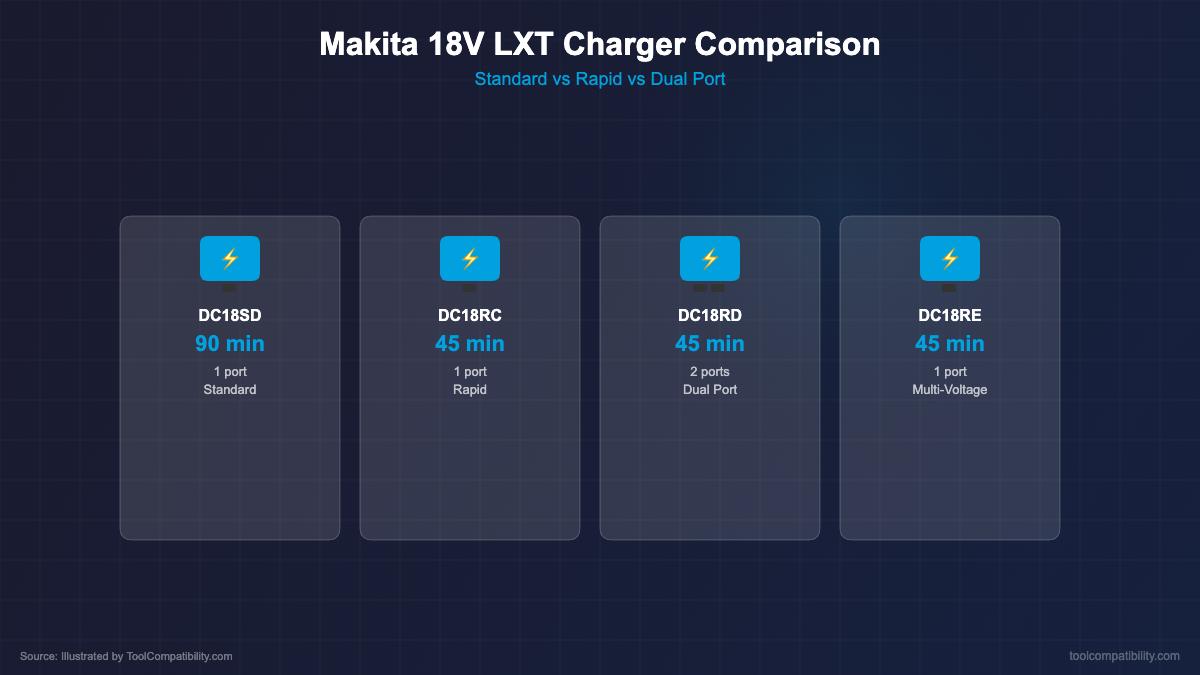
Makita LXT Charger Comparison
| Charger Model | Type | Ports | 18V LXT | 40V XGT | 12V CXT | Approx. Time (5 Ah) | Key Feature |
|---|---|---|---|---|---|---|---|
| DC18SD | Standard | Not stated | ✅ | No | No | 110 min | Makita UK: 2.0 Ah 45, 4.0 Ah 90, 6.0 Ah 130 min |
| DC18RC | Rapid, fan-cooled | Not stated | ✅ | No | No | 45 min | Makita UK: 2.0 Ah 24, 4.0 Ah 36, 6.0 Ah 55 min |
| DC18RD | Two-port rapid | 2 | ✅ | No | No | 45 min | Charges two batteries at the same time (manual) |
| DC18RE (US) | Rapid, LXT and CXT | Not stated | ✅ | No | ✅ | 45 min | Makita USA lists it as discontinued; not on Makita UK |
| DC40RA | XGT rapid | 1 | With ADP10 | ✅ | No | 50 min (XGT 5.0 Ah) | LXT only with the optional ADP10 adapter (BL1850B 35 min) |
| DC40RB | XGT two-port | 2 | With ADP10 | ✅ | No | 50 min (XGT 5.0 Ah) | Charges two XGT batteries as fast as the DC40RA charges one |
Genuine batteries, chargers and kits for this platform
As an Amazon Associate we earn from qualifying purchases. Genuine packs only; check the listing matches your platform before buying (affiliate links).
Before you buy: check that the size, fitting/bore and maximum-rated speed marked on the accessory match what your tool’s manual specifies. We have not physically tested these products; listings are compiled from published specifications. These are affiliate links.
Get the free Power-Tool Battery Compatibility Handbook (PDF)
Which batteries fit which tools — cross-brand, adapters & Ah, decoded.
Which Batteries Work With Which Chargers?
| Battery Type | DC18SD | DC18RC | DC18RD | DC18RE | DC40RA/RB |
|---|---|---|---|---|---|
| BL1820B (2.0 Ah) | ✅ | ✅ | ✅ | ✅ | With ADP10 |
| BL1830B (3.0 Ah) | ✅ | ✅ | ✅ | ✅ | With ADP10 |
| BL1840B (4.0 Ah) | ✅ | ✅ | ✅ | ✅ | With ADP10 |
| BL1850B (5.0 Ah) | ✅ | ✅ | ✅ | ✅ | With ADP10 |
| BL1860B (6.0 Ah) | ✅ | ✅ | ✅ | ✅ | With ADP10 |
| 12V Max CXT batteries | Not listed | Not listed | Not listed | ✅ | Not listed |
| 40V Max XGT batteries | Not listed | Not listed | Not listed | Not listed | ✅ |
Which Charger Should You Buy?
| Situation | Recommended Charger | Why |
|---|---|---|
| Budget / casual DIY | DC18SD | Standard charger; Makita UK times 45-265 min |
| Regular pro use | DC18RC | Fan-cooled rapid charger; 5.0 Ah in 45 min |
| Pro with multiple batteries | DC18RD | Two ports; charges two batteries at the same time |
| Own both LXT and CXT tools | DC18RE | US model for LXT and CXT, listed as discontinued by Makita USA |
| Own both LXT and XGT tools | DC40RA + ADP10 | Charges XGT; LXT only with the optional ADP10 adapter |
Common Questions
Can I use the 40V XGT charger for my 18V LXT batteries?
Only with an adapter. Makita says the DC40RB is compatible with the optional ADP10 adapter for charging LXT batteries, and the ADP10 manual gives LXT charge times on the DC40RA, DC40RB and DC40RC (for example 35 minutes for a BL1850B on the DC40RA or DC40RB).
Will the rapid charger damage my battery?
Makita describes the DC18RC’s charging as optimised in terms of voltage, current and temperature, with a cooling fan that cools the battery. Its manual says a battery that is too hot is cooled by the fan before charging begins, and a flashing red light means charging may not start until the battery temperature allows.
Can I charge old NiCad Makita batteries with these chargers?
The DC18RC manual’s charging table lists Makita Ni-MH batteries (9.6V to 14.4V) as well as 14.4V and 18V Li-ion batteries. It does not list Ni-Cd batteries, so check the manual for your charger.
What about Makita’s AWS (Auto-Start Wireless System)?
AWS (Auto-Start Wireless System) is not covered by this charger guide; check Makita’s tool and extractor pages for which models support it.
Related Guides
- Every Makita 18V LXT Battery Compared
- Every Makita 18V LXT Tool and Which Batteries Fit
- Makita 18V LXT vs 40V XGT
- How Long Do Power Tool Batteries Last?
Video Guide
Charging Best Practices
Makita’s DC18RC manual includes the following charging guidance.
Temperature: Makita’s DC18RC manual says not to charge when room temperature is below 10°C or above 40°C. A battery that is too hot is cooled by the charger’s fan before charging begins.
After charging: the DC18RC manual says to remove the battery cartridge from the charger after charging.
Troubleshooting Common Charger Issues
Red and green lights flashing alternately: Makita’s DC18RC manual says charging is not possible: the terminals on the charger or battery are clogged with dust, or the battery is worn out or damaged. A flashing red light means the battery is too hot or too cold and charging may not start until its temperature allows.
Red light on: the battery is charging. The light changes to green when charging is complete (DC18RC manual).
Battery runs down quickly: we have no Makita figure for cycle life. If the charger shows alternating green and red lights, Makita says the battery may be worn out or damaged. Recycle old batteries at a collection point.
What is the difference between Makita DC18RC and DC18RD chargers?
Makita gives the DC18RC and DC18RD the same charging times (for example 45 minutes for a 5.0 Ah battery and 55 minutes for a 6.0 Ah). The DC18RD manual says it “can charge two batteries at the same time”.
Can I charge Makita 40V XGT batteries on an LXT charger?
No. Makita lists the DC18RC, DC18RD and DC18SD for 14.4V and 18V LXT batteries, and the DC40RA, DC40RB and DC40RC for XGT batteries. The DC18RE is a US charger for 18V LXT and 12V max CXT batteries; it does not charge XGT, and Makita USA lists it as discontinued.
Is the Makita DC18SD slow charger worth buying?
Makita’s UK figures for the DC18SD are 110 minutes for a 5.0 Ah battery and 130 minutes for a 6.0 Ah, against 45 and 55 minutes on the DC18RC. It can suit a second or overnight charger; for regular work the DC18RC charges much faster.
Can Makita chargers charge non-Makita batteries?
No. Makita’s DC18RC manual says the charger is for charging Makita battery cartridges and should never be used for other purposes or for other manufacturers’ batteries.
Frequently Asked Questions
Always use the charger specified for your battery platform. Using incorrect chargers can damage cells and create safety hazards, and damage from it may not be covered by the maker’s guarantee.
Can I use any Makita charger with my 18V LXT battery?
For the LXT chargers, yes: Makita lists the DC18RC, DC18RD and DC18SD for 14.4V and 18V LXT batteries, with charging times from 1.3 Ah to 12.0 Ah on its UK pages. The exceptions are the G-Series DC18WA charger, which Makita says is not compatible with LXT batteries, and the XGT chargers, which need the ADP10 adapter.
How fast does the Makita DC18RC charge?
Makita’s UK page gives 24 minutes for 2.0 Ah, 22 for 3.0 Ah, 36 for 4.0 Ah, 45 for 5.0 Ah, 55 for 6.0 Ah, 85 for 9.0 Ah and 120 minutes for 12.0 Ah.
Can I charge Makita XGT batteries on an LXT charger?
No. Makita lists its LXT chargers for 14.4V and 18V batteries and its XGT chargers for XGT batteries. Charging across platforms works only the other way, with the ADP10 adapter, which lets XGT chargers charge LXT batteries.
How we compile this guide
We cross-reference compatibility details against manufacturer specifications where available, official tool manuals, and the physical standards that govern fitment (bore sizes, arbor diameters, voltage platforms, connector types). We prioritise primary sources over retailer listings, flag anything we can’t confirm, and re-verify the data on a regular cycle. Where we give a buying recommendation, we tell you the reasoning — not just the link. More on our method →