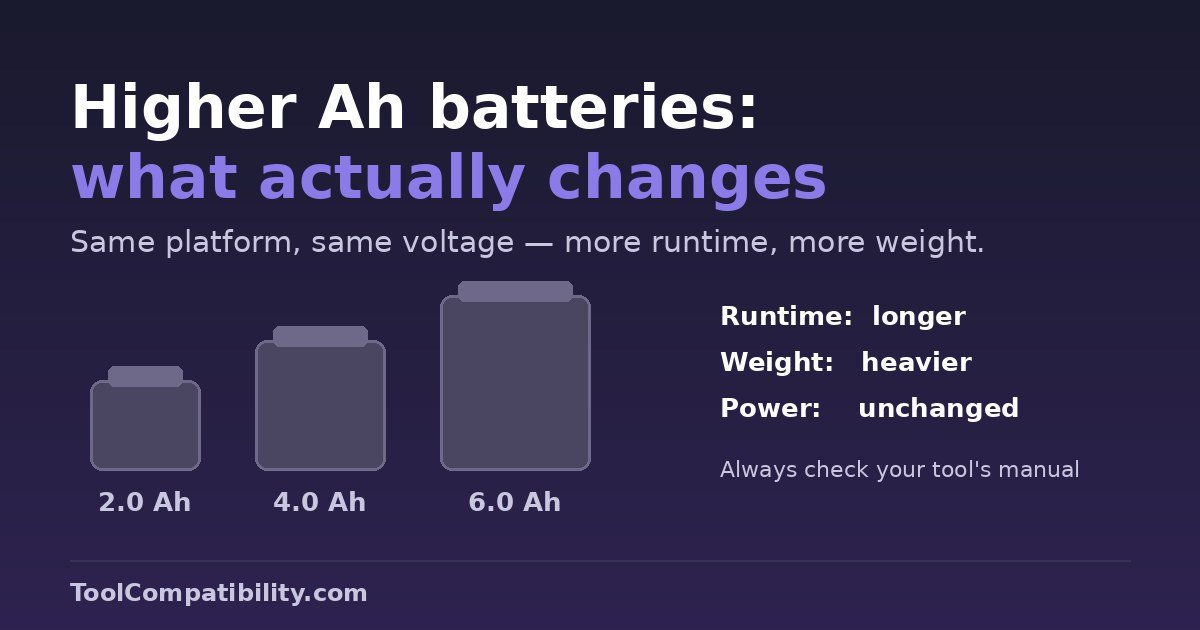
In almost all cases, yes — a higher-Ah battery from the same platform and voltage will run the same tools. The tool draws the current it needs; the extra capacity gives you longer runtime, not more voltage. What does change is size, weight and balance, and a few compact tools are specified for particular packs — so check your tool’s manual before assuming a larger pack is suitable.
Get the free Power-Tool Battery Compatibility Handbook (PDF)
Which batteries fit which tools — cross-brand, adapters & Ah, decoded.
Browse High-Capacity Drill Batteries on Amazon
The Short Answer
Within the same platform (e.g. Makita 18V LXT, DeWalt 20V MAX, Milwaukee M18), all batteries are fully interchangeable regardless of their Ah rating. A 6.0Ah battery works in the same tool as a 2.0Ah battery. The tool draws only the current it needs — it doesn’t matter if the battery can supply more.
What Does Ah Actually Mean?
Ah stands for amp-hours, and it measures battery capacity — essentially how much energy the battery can store. Think of it like a fuel tank: a higher Ah rating means a bigger tank. It doesn’t change the power output (that’s determined by voltage), it just means the battery lasts longer between charges.
- 2.0Ah = small fuel tank — lighter, charges faster, runs shorter
- 5.0Ah = medium fuel tank — the all-round sweet spot
- 8.0Ah+ = large fuel tank — heavier, but runs much longer
Will a Higher Ah Battery Make My Tool More Powerful?
Not directly. A standard 6.0Ah battery delivers the same voltage as a 2.0Ah battery, so the tool’s maximum power output is the same. However, higher-capacity batteries can maintain voltage better under heavy load, which means sustained performance is often slightly better — the tool is less likely to slow down mid-cut on a large battery.
The exception is High Output batteries (like Milwaukee’s HO range or Bosch’s ProCORE), which are specifically engineered to deliver higher sustained current. These can genuinely improve performance in high-drain tools like circular saws and grinders.
The Only Downside: Weight
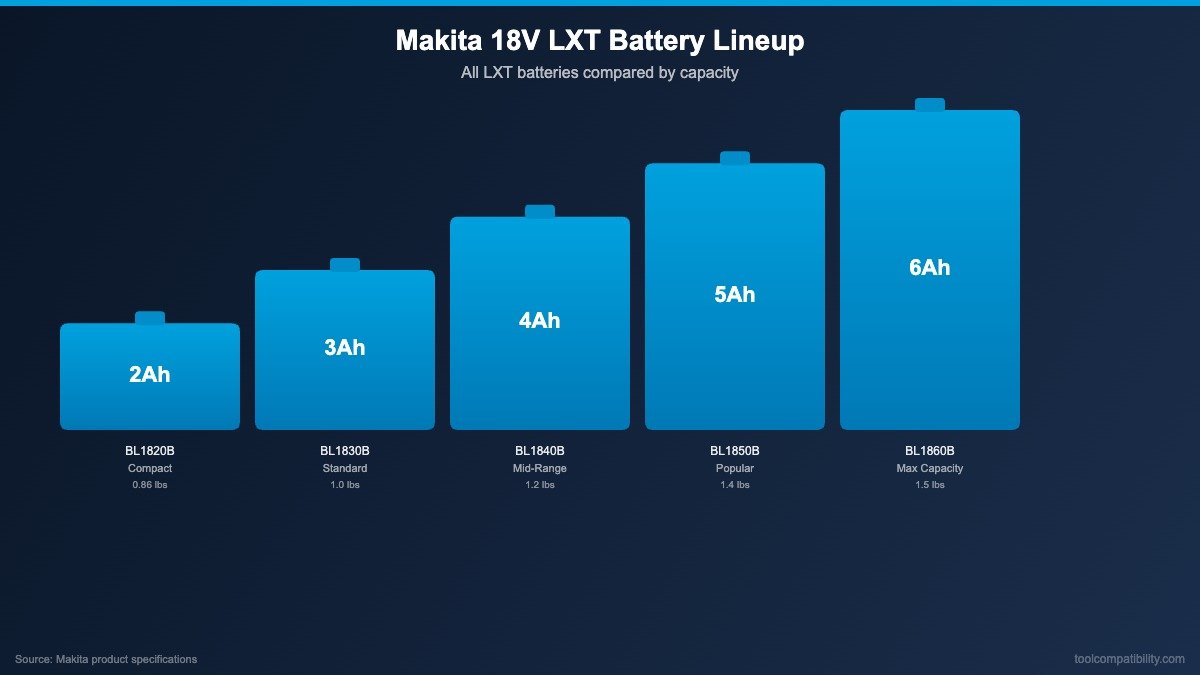
Higher Ah batteries contain more cells, which means they’re heavier. A Makita BL1860B (6.0Ah) weighs 680g compared to 370g for a BL1820B (2.0Ah). For overhead work or tools you hold in one hand all day, this weight difference matters. That’s why many professionals carry both sizes — a compact battery for light tools and a large one for power-hungry tools.
Quick Reference
- Higher Ah battery in your drill? Normally yes — check your manual.
- Higher Ah battery in your impact driver? Yes, just heavier.
- Higher Ah battery in your circular saw? Yes, and recommended.
- Different voltage battery in your tool? No — never mix voltages.
- Different brand battery in your tool? No — batteries are brand-specific (except Bosch AMPShare partners).
Related Guides
- Best Battery for Impact Drivers (2026)
- Best Battery for Cordless Circular Saws (2026)
- Best Battery for Cordless Drills (2026)
- Every Makita 18V LXT Battery Compared
Video Guide
Frequently Asked Questions
How Higher Ah Affects Tool Performance
A common misconception is that a higher Ah battery makes your tool more powerful. In reality, amp-hours measure capacity (runtime), not power output. Your drill will produce the same torque and speed regardless of whether a 2.0Ah or 6.0Ah battery is attached. The difference is how long it can sustain that performance before the battery runs flat.
That said, higher-capacity batteries can maintain peak performance more consistently under heavy load. When a smaller battery is pushed hard, its voltage drops faster, which can result in slightly reduced performance toward the end of its charge cycle. A larger battery has more headroom to deliver sustained current without this voltage sag.
Weight and Balance Considerations
The most important practical consideration when using a larger battery is weight. A 6.0Ah battery typically weighs 50-80% more than a 2.0Ah compact. This extra weight changes the balance point of your tool, which affects handling and user fatigue over extended use.
For overhead drilling, driving screws in tight spaces, or any one-handed operation, a compact battery is usually the better choice despite its shorter runtime. For bench-mounted tasks, heavy-duty drilling, or sustained cutting, the extra weight is barely noticeable and the extended runtime is a clear advantage.
When to Stick with the Standard Battery
Not every situation benefits from a larger battery. Here are cases where the stock battery is the better option:
- Compact tools: Sub-compact drills and drivers are designed around small batteries. A large battery makes them unwieldy and defeats the purpose of their compact design.
- Occasional use: If you only use a tool for 10-15 minutes at a time, investing in larger batteries offers no practical benefit. Your standard battery will handle intermittent use easily.
- Weight-sensitive work: Overhead installation, tight-space plumbing, and electrical work all favour the lightest possible tool. Every gram matters when your arm is extended above your head for hours.
The best approach for most users is to own a mix of battery sizes: compact batteries for light-duty and overhead work, and larger batteries for demanding or sustained tasks.
Will a 6.0Ah battery damage a tool rated for 2.0Ah?
Normally not. Within the same platform and voltage, the tool draws the current it needs regardless of the pack’s capacity, so a 6.0Ah pack in a tool supplied with a 2.0Ah pack simply runs longer. The practical differences are weight, size and balance — and a larger pack lets you work for longer, which can mean more heat build-up in the tool during sustained heavy use. Check your tool’s manual: manufacturers list the packs approved for each tool. A 6.0Ah battery simply has a larger energy reservoir — like putting a bigger fuel tank in a car. The engine does not work harder because the tank is bigger.
Does a higher Ah battery make my tool more powerful?
Not directly. Ah measures capacity (runtime), not power output. However, higher Ah batteries can sustain peak current delivery for longer, which means less power drop-off during demanding tasks. This effect is most noticeable in high-draw tools like saws and grinders, and barely perceptible in drills and drivers.
Is there a downside to always using the biggest battery?
Weight is the main trade-off. A 6.0Ah battery can weigh twice as much as a 2.0Ah, making tools heavier and less balanced. For overhead work, tight spaces, and one-handed tools like impact drivers, a compact battery is actually preferable. Match the battery size to the tool and task for the best experience.
How we compile this guide
We cross-reference compatibility details against manufacturer specifications where available, official tool manuals, and the physical standards that govern fitment (bore sizes, arbor diameters, voltage platforms, connector types). We prioritise primary sources over retailer listings, flag anything we can’t confirm, and re-verify the data on a regular cycle. Where we give a buying recommendation, we tell you the reasoning — not just the link. More on our method →
Recommended Batteries
As an Amazon Associate we earn from qualifying purchases. Check fitment & current price on Amazon (affiliate links).
Before you buy: check that the size, fitting/bore and maximum-rated speed marked on the accessory match what your tool’s manual specifies. We have not physically tested these products; listings are compiled from published specifications. These are affiliate links.