Your cordless drill is only as good as the battery powering it. Whether you’re driving screws into softwood or boring large-diameter holes through hardwood, battery capacity decides how long you can work between charges.

Below we break down the best battery options for cordless drills across the three major platforms — Makita 18V LXT, DeWalt 20V MAX, and Milwaukee M18 — so you can pick the right cell for your drill and your budget.
Quick Recommendations
| Use Case | Makita 18V LXT | DeWalt 20V MAX | Milwaukee M18 |
|---|---|---|---|
| Best all-round | BL1850B (5.0Ah) | DCB205 (5.0Ah) | 48-11-1850 (5.0Ah) |
| Best for heavy drilling | BL1860B (6.0Ah) | DCB206 (6.0Ah) | 48-11-1860 (6.0Ah) |
| Smaller pack / overhead | BL1830 (3.0Ah) | DCB204 (4.0Ah) | 48-11-1840 (4.0Ah) |
Starter packs by platform
As an Amazon Associate we earn from qualifying purchases. Genuine packs only; check the listing matches your platform before buying (affiliate links).
Before you buy: check that the size, fitting/bore and maximum-rated speed marked on the accessory match what your tool’s manual specifies. We have not physically tested these products; listings are compiled from published specifications. These are affiliate links.
Get the free Power-Tool Battery Compatibility Handbook (PDF)
Which batteries fit which tools — cross-brand, adapters & Ah, decoded.
Why Battery Choice Matters for Drills
Cordless drills are moderate-draw tools. For light-duty screw driving, a compact 2.0–3.0Ah battery keeps weight down and is perfectly adequate. Once you step up to hammer-drill mode or start using large spade bits and holesaws, power draw increases significantly and a 5.0Ah or 6.0Ah pack will give you noticeably longer runtime between charges.
As a general rule: match your battery capacity to your workload. A 3.0Ah pack is ideal for quick jobs and overhead work where weight matters. A 5.0Ah pack is the best all-rounder for most tradespeople. A 6.0Ah pack is worth the extra weight if you drill large holes or use the hammer function frequently.
Best Batteries for Makita Cordless Drills
Makita’s 18V LXT platform powers drills like the DHP486 hammer drill driver. Makita says the same LXT battery powers over 325 tools, so a BL1830 fits the same LXT tools as a BL1860B.
Makita BL1850B — Best All-Round (5.0Ah)
The 5.0Ah BL1850B is our pick for most drilling tasks. Makita UK lists it at 0.63 kg, about the same as the 3.0Ah BL1830B, so the extra capacity costs little in weight.

Makita BL1860B — Best for Heavy Drilling (6.0Ah)
If you regularly use the DHP486 in hammer mode or drill large-diameter holes, the 6.0Ah BL1860B has 20% more capacity than the BL1850B, and Makita UK lists it only 30 g heavier (0.66 kg vs 0.63 kg).

Makita BL1830 — Smaller Pack Option (3.0Ah)
For overhead work or cabinet installation you may want a smaller pack, but note that the 3.0Ah BL1830 does not save weight: Makita UK lists the BL1830B at 0.64 kg, about the same as the 5.0Ah BL1850B. Its runtime is shorter, so keep a second battery on the charger.

See all compatible batteries on our Makita 18V LXT Battery Compatibility page.
Best Batteries for DeWalt Cordless Drills
DeWalt’s 20V MAX platform covers drills like the DCD791 brushless drill driver and the DCD996 3-speed hammer drill. DeWalt says its XR FLEXVOLT batteries are backwards compatible with its 18V XR (US: 20V MAX) tools, switching voltage automatically to suit the tool; check your drill’s manual.
DeWalt DCB205 — Best All-Round (5.0Ah)
The DCB205 is DeWalt’s 5.0Ah 20V MAX pack (US part number; DeWalt’s UK 5.0Ah 18V XR pack is the DCB184). It balances runtime and weight well for general drilling and driving.

DeWalt DCB206 — Best for Heavy Drilling (6.0Ah)
The 6.0Ah DCB206 is the pick if you use the DCD996 in hammer mode regularly. The extra capacity means fewer battery swaps during demanding tasks like drilling into masonry.

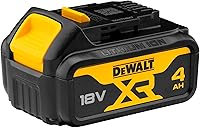
DeWalt DCB204 — Best Lightweight Option (4.0Ah)
At 4.0Ah the DCB204 is lighter than the 5.0Ah and 6.0Ah packs (DeWalt US: 1.4 lb, against 1.54 lb for the DCB205 and 2.25 lb for the DCB206) while still suiting screw driving and light drilling.
See all compatible batteries on our DeWalt 20V MAX Battery Compatibility page.
Best Batteries for Milwaukee Cordless Drills
Milwaukee’s M18 platform includes drills like the 2804-20 M18 FUEL hammer drill. Note that the 2503-20 drill driver is an M12 FUEL tool (Milwaukee US), so it takes M12 batteries, not M18. Milwaukee says M18 batteries are compatible with M18 tools and chargers, and M12 batteries with M12 tools and chargers.
Milwaukee 48-11-1850 — Best All-Round (5.0Ah)
The 48-11-1850 is Milwaukee’s US M18 REDLITHIUM XC5.0 pack (Milwaukee’s UK 5.0Ah M18 pack is the M18 B5) and our pick for everyday drilling.

Buy Milwaukee 48-11-1850 on Amazon
Milwaukee 48-11-1860 — Best for Heavy Drilling (6.0Ah)
For sustained hammer-drilling or large-hole work with the 2804-20, the 6.0Ah 48-11-1860 gives you more capacity. Note that Milwaukee lists it as an XC6.0 pack, not a HIGH OUTPUT pack; its HIGH OUTPUT XC6.0 is a different part (48-11-1865).

Buy Milwaukee 48-11-1860 on Amazon
Milwaukee 48-11-1840 — Smaller Pack Option (4.0Ah)
The 4.0Ah XC pack suits overhead drilling and quick tasks, but it may not save much weight: Milwaukee UK lists its 4.0Ah and 5.0Ah M18 packs (M18 B4, M18 B5) at the same 0.7 kg.
Buy Milwaukee 48-11-1840 on Amazon
See all compatible batteries on our Milwaukee M18 Battery Compatibility page.
Full Comparison Table
| Battery | Platform | Capacity | Best For | Buy Link |
|---|---|---|---|---|
| Makita BL1850B | 18V LXT | 5.0Ah | All-round drilling | Amazon |
| Makita BL1860B | 18V LXT | 6.0Ah | Heavy drilling / hammer mode | Amazon |
| Makita BL1830 | 18V LXT | 3.0Ah | Smaller pack / overhead | Amazon |
| DeWalt DCB205 | 20V MAX | 5.0Ah | All-round drilling | Amazon |
| DeWalt DCB206 | 20V MAX | 6.0Ah | Heavy drilling / hammer mode | Amazon |
| DeWalt DCB204 | 20V MAX | 4.0Ah | Smaller pack / overhead | Amazon |
| Milwaukee 48-11-1850 | M18 | 5.0Ah | All-round drilling | Amazon |
| Milwaukee 48-11-1860 | M18 | 6.0Ah | Heavy drilling / hammer mode | Amazon |
| Milwaukee 48-11-1840 | M18 | 4.0Ah | Smaller pack / overhead | Amazon |
Watch: Video Guide
Frequently Asked Questions
What size battery is best for a cordless drill?
For most users, a 5.0Ah battery is the best all-round choice. It offers a good balance of runtime and weight. If you mainly drive screws and do light drilling, a 3.0–4.0Ah pack saves weight. For heavy hammer-drilling or large-hole boring, step up to 6.0Ah.
Can I use a higher capacity battery in my drill?
Yes. Within the same platform (e.g. Makita 18V LXT), packs of different capacities normally fit the same tools (check your tool’s manual). A 6.0Ah battery works in the same drill as a 2.0Ah — it’s just heavier and lasts longer. The tool draws only what it needs.
Does a bigger battery make my drill more powerful?
Not directly. A larger battery gives you longer runtime, not more torque. Some makers market particular packs for extra power (Milwaukee says its HIGH OUTPUT XC6.0 delivers 50% more power than its XC packs), but the 6.0Ah packs listed here are standard packs.
Can I use DeWalt FLEXVOLT batteries in a 20V MAX drill?
Yes. DeWalt says its XR FLEXVOLT batteries are backwards compatible with its 18V XR (US: 20V MAX) tools, switching voltage automatically to suit the tool; check your drill’s manual. See our DeWalt 20V MAX and FLEXVOLT compatibility guide for full details.
Are Milwaukee M12 and M18 batteries interchangeable?
No. Milwaukee says M18 batteries are compatible with M18 tools and chargers, and M12 batteries with M12 tools and chargers. M12 is Milwaukee’s 12V system and M18 its 18V system, so do not use an M12 battery in an M18 drill. See our Milwaukee M12 vs M18 compatibility guide for more details.
How we compile this guide
We cross-reference compatibility details against manufacturer specifications where available, official tool manuals, and the physical standards that govern fitment (bore sizes, arbor diameters, voltage platforms, connector types). We prioritise primary sources over retailer listings, flag anything we can’t confirm, and re-verify the data on a regular cycle. Where we give a buying recommendation, we tell you the reasoning — not just the link. More on our method →