
Original Milwaukee 48-11-1850 Battery (OEM Option)
Genuine Milwaukee 5.0Ah M18 REDLITHIUM XC5.0 extended capacity battery for all-day runtime.
Buy Original Milwaukee 48-11-1850 Battery
Compatible Replacement Batteries for Milwaukee 48-11-1850
Genuine batteries, chargers and kits for this platform
As an Amazon Associate we earn from qualifying purchases. Genuine packs only; check the listing matches your platform before buying (affiliate links).
Before you buy: check that the size, fitting/bore and maximum-rated speed marked on the accessory match what your tool’s manual specifies. We have not physically tested these products; listings are compiled from published specifications. These are affiliate links.
Get the free Power-Tool Battery Compatibility Handbook (PDF)
Which batteries fit which tools — cross-brand, adapters & Ah, decoded.
Compatible Chargers
Ready to Replace Your Milwaukee 48-11-1850 Battery?
Related Guides
- Every Milwaukee M18 Battery Compared
- Every Milwaukee M18 Tool and Which Batteries Fit
- Milwaukee M18 Charger Compatibility Guide
- Milwaukee FORGE Battery Guide
- Milwaukee M18 vs M18 FUEL
Frequently Asked Questions
Is the 48-11-1850 being discontinued?
We have not found a Milwaukee notice about the 48-11-1850, a US part number for the M18 REDLITHIUM XC5.0 pack; Milwaukee UK sells its 5.0Ah pack as the M18 B5. Milwaukee also sells HIGH OUTPUT and FORGE packs.
Can I use the 48-11-1850 in M12 tools?
No. M12 and M18 are separate Milwaukee platforms with different packs, and the 48-11-1850 fits M18 tools only.
What is the best charger for the 48-11-1850?
For the 5.0Ah M18 B5, Milwaukee UK lists 59 minutes on the M12-18 FC and M18 DFC chargers and 100 minutes on the M12-18 C and M1418C6. The US chargers named on older versions of this page (48-59-1808, 48-59-1807, 48-59-1802) are not in our sources.
How long will a 48-11-1850 power a Milwaukee circular saw?
Runtime depends on the saw, blade and material, and we have not tested it.
Video Guide
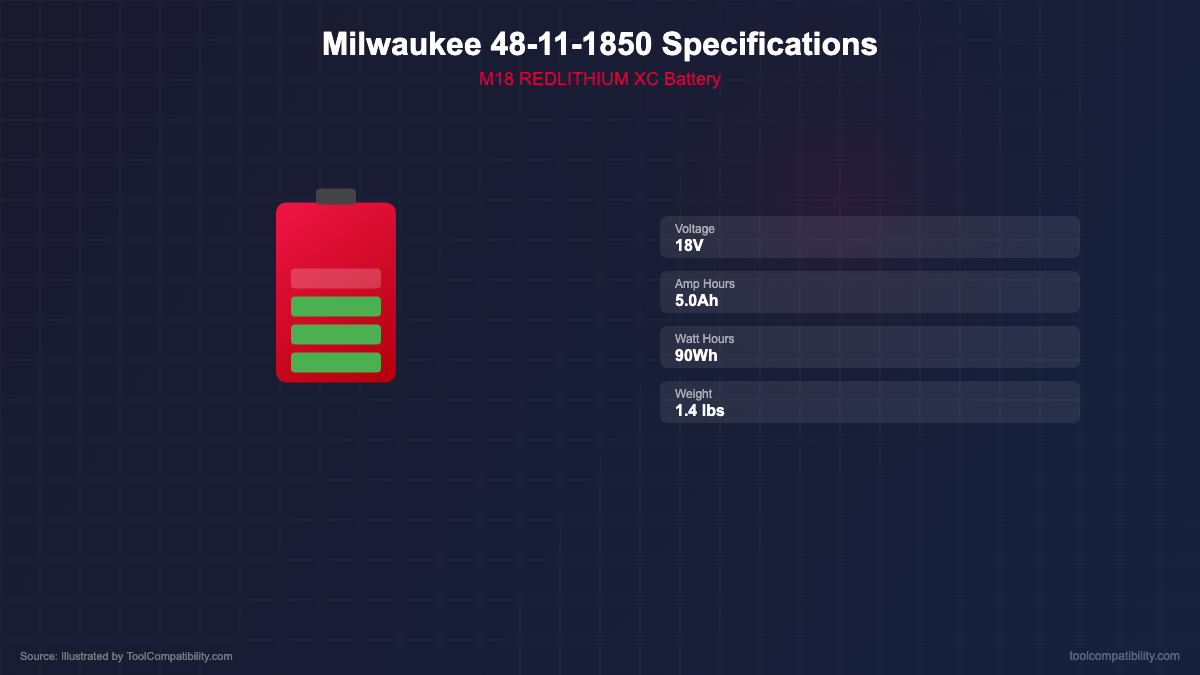
Key Specifications
| Specification | Details |
|---|---|
| Nominal Voltage | 18V |
| Capacity | 5.0 Ah |
| Watt-Hours | 90 Wh |
| Chemistry | Lithium-Ion |
| Weight | Not stated in our Milwaukee sources (Milwaukee UK lists the 5.0Ah M18 B5 at 0.7 kg) |
| Battery Indicator LED | Yes (Fuel gauge) |
| Compatible Platform | Milwaukee M18 Series |
Signs Your 48-11-1850 Battery Needs Replacing
Lithium-ion batteries degrade naturally over time. Here are the key signs that your Milwaukee 48-11-1850 battery needs replacing:
- Rapid discharge: The battery drains noticeably faster than when it was new, even after a full charge. If a battery that once lasted an hour now dies in 20 minutes, capacity has degraded significantly.
- Charges but dies quickly under load: The battery appears to charge fully but shuts off within minutes when powering demanding tools. This indicates internal cell failure where the battery can no longer deliver sufficient current.
- Excessive heat during use or charging: While some warmth is normal, a battery that becomes uncomfortably hot during operation or on the charger has damaged cells. Excessive heat is both a symptom and a cause of further degradation.
- Physical swelling or damage: Any visible bulging, cracking, or deformation of the battery casing means the cells inside have failed. Stop using a swollen battery immediately and dispose of it safely at a recycling point.
- Charger error indicators: If your Milwaukee charger flashes error lights or refuses to charge the battery entirely, it has detected a fault. Most modern chargers include diagnostic features that identify damaged batteries.
- Age: lithium-ion packs lose capacity with age and use. If an older pack’s runtime has clearly dropped, replacement is worthwhile.
OEM vs Third-Party Replacement Batteries
When replacing your Milwaukee 48-11-1850, you have two main options: genuine Milwaukee batteries or third-party compatible alternatives. Both will physically fit and power your tools, but there are meaningful differences worth considering.
| Factor | Genuine Milwaukee | Third-Party Compatible |
|---|---|---|
| Typical Price | £55-95 | £28-55 |
| Cell Quality | Milwaukee genuine pack | Varies by manufacturer |
| Warranty | Milwaukee UK: 1 year; eligible REDLITHIUM batteries 2 years with online registration within 30 days | Varies by seller |
| Safety Certifications | Built and certified to Milwaukee’s own standards, with UKCA/CE marking | Varies by seller. Markings such as UKCA or CE are the manufacturer’s own declaration, not independent proof of testing — check who the responsible manufacturer or importer is before buying |
| Expected Lifespan | Not published by Milwaukee | Not published |
| Performance Consistency | Made for Milwaukee M18 tools | Compatible, slight variation possible |
Choose genuine Milwaukee batteries if you use your tools professionally and depend on them for income: you get a pack Milwaukee makes and supports, with a known warranty route.
Third-party batteries can suit homeowners and occasional users who want a lower cost; quality varies, so check the seller and warranty. You can often buy two third-party packs for the price of one genuine unit.
How to Get the Most from Your Replacement Battery
Follow these care tips to maximise the lifespan and performance of your new Milwaukee 48-11-1850 replacement battery:
- First use: charge a new pack fully before use.
- Storage: Milwaukee UK advises storing packs 40-60% charged in a cool, dry, well-ventilated place between 5 °C and 20 °C, away from rapid temperature changes.
- Avoid temperature extremes: Milwaukee UK says to avoid charging in high temperatures. Never leave batteries in a hot vehicle or in direct sunlight.
- After charging: Milwaukee UK says not to leave batteries charging unattended and to disconnect them once they reach a full charge.
- Use Milwaukee-approved chargers: Milwaukee UK says manufacturer-approved batteries and chargers are designed to work together safely; check that your M18 charger lists the pack.
How we compile this guide
We cross-reference compatibility details against manufacturer specifications where available, official tool manuals, and the physical standards that govern fitment (bore sizes, arbor diameters, voltage platforms, connector types). We prioritise primary sources over retailer listings, flag anything we can’t confirm, and re-verify the data on a regular cycle. Where we give a buying recommendation, we tell you the reasoning — not just the link. More on our method →